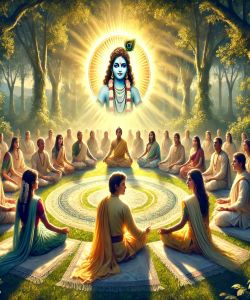
1. Overview of Krishna Meditation
Krishna Meditation represents a profound and rigorous spiritual discipline, rooted in the theological framework of Vaishnavism, specifically the Gaudiya Vaishnava tradition. It is fundamentally a practice of bhakti-yoga, the yoga of devotion, which posits that the ultimate goal of human existence is the re-establishment of the soul’s dormant, loving relationship with the Supreme Personality of Godhead, Krishna. This meditative system is not merely a technique for achieving mental quietude or stress reduction; such outcomes are considered incidental by-products. Its primary and unequivocal objective is the purification of consciousness, transforming it from a material, self-centred state to a spiritual, God-centred one. This is achieved through a structured process of engaging the senses and the mind in service to the divine. The practice is anchored in ancient Vedic scriptures, most notably the Bhagavad-gita and the Srimad-Bhagavatam, which provide the philosophical underpinning and narrative context for the meditation. Practitioners engage in specific activities such as mantra chanting (japa), congregational singing (kirtan), and the study of sacred texts, all designed to absorb the mind in thoughts of Krishna. Unlike passive, observational forms of meditation, Krishna Meditation is an active, dynamic process of devotional servitude. It demands intellectual rigour to comprehend its complex philosophy and unwavering discipline to execute its daily practices. It is, therefore, a comprehensive system for ontological re-orientation, aimed at transcending the ephemeral nature of material existence to realise a permanent, blissful, and conscious reality in connection with the Absolute Truth. It is an exacting path that requires sincere commitment and a clear understanding of its transcendental, non-material objectives, distinguishing it entirely from secular mindfulness or wellness pursuits.
2. What are Krishna Meditation?
Krishna Meditation comprises a suite of devotional practices (sadhana) derived from the principles of bhakti-yoga. The central tenet is the direction of one's consciousness towards the Supreme Being, Krishna, as the ultimate object of love and meditation. It is an active and multifaceted engagement, utilising the mind, intelligence, and senses in the service of the divine, rather than attempting to negate their functions. The core purpose is to purify one's existence and awaken the soul's innate spiritual nature. This is not a singular, monolithic technique but a holistic system of life, which can be understood through its principal components.
- Mantra Meditation (Japa and Kirtan): The most prominent feature is the auditory meditation on sacred sounds, specifically the Hare Krishna maha-mantra. When chanted individually and softly on a string of beads, it is called japa. This is a personal, introspective practice requiring focus and discipline. When chanted congregationally, often with musical accompaniment, it is known as kirtan. This is an expressive, communal practice that amplifies the spiritual energy and fosters a collective devotional consciousness. Both forms are designed to cleanse the mind of material anxieties and preoccupations, directly connecting the practitioner with the divine through sound vibration.
- Scriptural Meditation (Sravanam and Pathanam): This involves the systematic hearing (sravanam) and reading (pathanam) of sacred texts that describe the nature, form, pastimes, and teachings of Krishna. The Bhagavad-gita and Srimad-Bhagavatam are paramount. This is not passive reading but an active meditation, wherein the practitioner immerses the intellect in transcendental knowledge, seeking to understand the philosophical foundations of reality and one's place within it. It provides the essential context and conviction that sustain the entire meditative process.
- Deity Meditation (Arcanam): This is the practice of worshipping the authorised form of the Lord, known as the Deity. It involves a highly regulated process of offering articles such as incense, flowers, and food, while meditating on the transcendental form of Krishna. This practice engages all the senses in a structured, devotional manner, helping to control the mind and fix it upon a tangible representation of the Absolute, thereby spiritualising one's sensory experience.
3. Who Needs Krishna Meditation?
- The Individual Seeking Transcendental Purpose: Those who have realised the inherent limitations and ultimate dissatisfaction of materialistic pursuits, such as wealth, prestige, and sensory gratification, require this system. It is for the person who confronts existential questions regarding the meaning of life, suffering, and death, and who intuits that the answers lie beyond the phenomenal world. Krishna Meditation provides a robust framework for understanding and pursuing a higher, eternal purpose.
- The Practitioner Disenchanted with Impersonal Spirituality: Individuals who have explored impersonal or voidist spiritual paths but remain unfulfilled by their abstract and often emotionally arid nature will find this practice necessary. Krishna Meditation is intensely personal, focusing on the development of a reciprocal, loving relationship with a supreme person. It is for those who seek a devotional outlet and a tangible object for their spiritual affections.
- The Intellectually and Philosophically Inquisitive: This meditation is required by those who demand a spiritual path that is not only emotionally satisfying but also intellectually coherent and philosophically profound. The vast scriptural library that underpins Krishna Meditation offers rigorous, systematic answers to the fundamental questions of metaphysics, ontology, and epistemology, satisfying the most discerning intellectual.
- The Individual Seeking to Overcome Anarthas (Internal Impurities): Anyone burdened by deep-seated negative habit patterns—such as lust, anger, greed, envy, and illusion—needs this practice. Krishna Meditation is specifically designed as a potent purification process (ceto-darpana-marjanam) that systematically cleanses the heart and mind, allowing the practitioner's inherent good qualities to emerge.
- The Aspiring Bhakti-Yogi: Ultimately, this practice is for any individual who, by predisposition or accumulated merit, feels an intrinsic attraction to the path of devotion (bhakti). It is for the soul who naturally desires to love and serve God, providing the authorised, time-tested methodology for cultivating and perfecting that innate devotional sentiment into pure, unmotivated love of Godhead.
4. Origins and Evolution of Krishna Meditation
The origins of Krishna Meditation are immemorial, rooted in the most ancient of India’s sacred texts, the Vedas. The philosophical seeds are found within the Upanishads, which discuss the nature of the Absolute Truth (Brahman), and are further crystallised in epic scriptures like the Mahabharata, within which the Bhagavad-gita is situated. The Bhagavad-gita stands as the seminal text, where Krishna Himself explicitly outlines the principles of bhakti-yoga, or devotional service, declaring it the supreme path. Here, the concept of meditating upon His personal form and dedicating all actions to Him is established as the most direct means of spiritual realisation. Thus, the practice is not a modern invention but an integral part of an ancient, continuous tradition of spiritual science.
The evolution of this meditative practice saw a significant efflorescence during the mediaeval Bhakti Movement, which swept across the Indian subcontinent. While various schools of thought existed, the most profound and systematic development concerning Krishna Meditation was promulgated by Sri Chaitanya Mahaprabhu in the 16th century in Bengal. Sri Chaitanya, understood by His followers to be Krishna Himself in the guise of a devotee, did not introduce a new philosophy but rather revealed the most sublime and practical application of the existing scriptures for the present age. He championed congregational chanting of the Hare Krishna maha-mantra (sankirtana) as the principal form of meditation, making the profound process of bhakti-yoga accessible to all, irrespective of social standing or scholarly qualification.
The teachings of Sri Chaitanya were systematically codified and philosophically elaborated upon by his chief disciples, the Six Goswamis of Vrindavan, who authored voluminous texts on the science of devotion. This created a rich theological and practical library that has guided practitioners for centuries. The modern, global dissemination of Krishna Meditation is owed almost entirely to the efforts of His Divine Grace A.C. Bhaktivedanta Swami Prabhupada. In the mid-20th century, he carried this tradition from India to the Western world, translating the key texts into English with extensive commentaries and establishing a worldwide organisation to teach the practice systematically. He preserved the authenticity of the ancient discipline while presenting it in a manner comprehensible to the contemporary mind, ensuring its evolution from a geographically contained tradition to a global spiritual movement.
5. Types of Krishna Meditation
Krishna Meditation is not a singular activity but a comprehensive system of devotional engagement. The various types are not mutually exclusive; rather, they are complementary aspects of a holistic practice designed to absorb the consciousness fully in the divine.
- Japa Yoga (Mantra Recitation): This is the foundational, personal practice of softly chanting the Hare Krishna maha-mantra—Hare Krishna, Hare Krishna, Krishna Krishna, Hare Hare / Hare Rama, Hare Rama, Rama Rama, Hare Hare—on a string of 108 beads, known as a japa-mala. This is a disciplined auditory meditation. The practitioner focuses intently on the precise pronunciation and hearing of the sacred syllables. Its purpose is to purify the mind, control the wandering senses, and establish a direct, personal connection with the divine names, which are considered non-different from Krishna Himself. It is a rigorous daily spiritual exercise.
- Kirtan (Congregational Chanting): This is the dynamic, communal form of mantra meditation. It involves the public and loud singing of the same maha-mantra or other devotional songs, typically led by one person and responded to by the group, often accompanied by traditional instruments. Kirtan is considered a potent and expressive form of meditation that fosters a powerful collective spiritual atmosphere. Its function is to awaken the soul’s joyous nature and to engage the emotions in a positive, God-centred direction.
- Sravanam (Transcendental Hearing): This is the meditative practice of systematically hearing about Krishna. It involves attentive listening to discourses on the philosophy of the Bhagavad-gita and the narrative pastimes of Krishna from the Srimad-Bhagavatam, delivered by an authoritative source. This is an intellectual and receptive meditation that fills the mind with transcendental knowledge, dispelling ignorance and doubt. It is considered the most crucial initial step in devotional life, as correct hearing provides the foundation for all other practices.
- Smaranam (Systematic Remembrance): This is the internal meditation of remembering Krishna. It flows naturally from sravanam. Having heard about His form, qualities, teachings, and pastimes, the practitioner makes a conscious effort to remember them throughout the day. This can involve mentally visualising His form as described in the scriptures or contemplating a particular teaching. It is a more advanced practice that aims to maintain an unbroken stream of Krishna consciousness amidst daily activities.
- Arcanam (Deity Worship): This is a formal, regulated meditation involving the worship of the authorised Deity form of Krishna. It is a highly structured practice that engages all the senses: seeing the form, smelling offered incense and flowers, tasting sanctified food (prasadam), and hearing prayers. It provides a tangible focus for devotion and trains the practitioner in cleanliness, punctuality, and reverence.
6. Benefits of Krishna Meditation
- Transcendence of Material Duality: The practice systematically elevates the consciousness beyond the dualities of material existence, such as happiness and distress, honour and dishonour, and pleasure and pain. By anchoring the mind in the unchanging, transcendental reality of Krishna, the practitioner develops a profound state of equanimity and is no longer disturbed by the inevitable vicissitudes of life.
- Purification of Consciousness (Ceto-Darpana-Marjanam): The primary benefit, as stated in scripture, is the cleansing of the mirror of the mind. The chanting of the holy names acts as a potent purifying agent, gradually eradicating deep-seated negative qualities (anarthas) like lust, anger, greed, envy, and illusion. This purification allows the soul’s original, pure qualities to manifest.
- Extinguishing the Fire of Material Existence (Bhava-Maha-Davagni-Nirvapanam): Krishna Meditation directly addresses the root cause of all suffering: the mistaken identification of the self with the material body. By reawakening one's true identity as an eternal spiritual servant of God, the practice extinguishes the perpetual cycle of birth, death, old age, and disease, which is likened to a blazing forest fire.
- Development of Spiritual Insight and Knowledge (Vidya-Vadhu-Jivanam): Regular engagement with the philosophy underpinning the meditation imparts deep transcendental knowledge (vidya). The practitioner gains a clear understanding of the nature of the self, the material and spiritual worlds, karma, and the Absolute Truth. This spiritual education illuminates one’s life and provides unerring guidance.
- Cultivation of Devotional Sentiment (Bhakti): The ultimate benefit is the awakening of one’s dormant, constitutional love for God. This is not a dry, intellectual pursuit but the cultivation of a rich inner life of devotional feeling. The practice progresses from a disciplined routine to a state of spontaneous, joyous service and loving reciprocation with the Supreme Person.
- Liberation from the Law of Karma: By dedicating all actions and thoughts to Krishna, the practitioner ceases to generate new karmic reactions. Furthermore, the potency of devotional service is such that it can neutralize the results of past karmic entanglements, leading to liberation from the cycle of action and reaction.
7. Core Principles and Practices of Krishna Meditation
- The Supremacy and Personality of Godhead: The foundational principle is the acceptance of Krishna as the Supreme Personality of Godhead, the source of all existence. He is not an abstract force or an impersonal void but the ultimate, all-attractive person, possessing infinite transcendental qualities. All meditative practices are directed towards this personal feature of the Absolute Truth.
- The Eternal Nature of the Soul (Atma): The practitioner must understand that the individual self (jiva-atma) is an eternal, spiritual entity, distinct from the temporary material body and mind. The soul's constitutional position is to be a loving servant of the Supreme Soul, Krishna. The current state of material suffering is due to the soul’s forgetfulness of this relationship.
- The Efficacy of the Holy Name (Nama-Tattva): A central tenet is the non-difference between Krishna and His holy names. The name 'Krishna' is not a mere linguistic symbol but a sound incarnation of God Himself. Therefore, chanting the Hare Krishna maha-mantra is understood to be direct association with Krishna, possessing immense purifying and liberating power.
- The Path of Devotional Service (Bhakti-Yoga): The exclusive means to realise the Absolute Truth is bhakti-yoga. This principle asserts that God, being supreme and independent, cannot be comprehended or attained through mechanical exercises or intellectual speculation alone. He reveals Himself only to the sincere devotee out of loving reciprocation. All practices are therefore performed in a mood of devotion and service.
- The Necessity of a Bona Fide Spiritual Master (Guru): One cannot successfully navigate this advanced spiritual path without guidance. It is a core principle to accept initiation and instruction from a qualified spiritual master who is part of an unbroken chain of disciplic succession (parampara). The guru imparts transcendental knowledge and guides the disciple in the practical application of the meditative process.
- Regulation and Sadhana (Disciplined Practice): Spiritual advancement is not arbitrary but is based on consistent, regulated practice (sadhana). This includes rising early, chanting a fixed number of rounds of the maha-mantra daily on japa beads, following four regulative principles (no meat-eating, no intoxication, no gambling, and no illicit sex), and engaging in regular scriptural study and devotional service.
- Offering the Fruits of Labour (Karma-Yoga): A practicing individual does not renounce activity but rather renounces the selfish attachment to the results of that activity. All work is performed as an offering to Krishna. This principle transforms ordinary, mundane work into a form of active meditation, spiritualising every aspect of one’s life.
8. Online Krishna Meditation
- Unprecedented Accessibility and Global Reach: The online modality removes geographical and logistical barriers entirely. Individuals from any location on the globe can access authentic instruction and participate in guided meditative sessions without the necessity of physical proximity to a temple or centre. This democratises access to a highly specialised spiritual tradition, making it available to sincere seekers who would otherwise be isolated.
- Structured and Sequential Learning Environments: Online platforms facilitate the delivery of Krishna Meditation as a systematic course of study and practice. Content can be organised into modules, progressing logically from foundational philosophy to advanced practical application. This ensures that participants receive a comprehensive and coherent understanding, preventing the haphazard or incomplete learning that can occur with informal study. Live sessions, pre-recorded lectures, and supplementary materials create a robust educational framework.
- Formation of a Digital Sangha (Community): While seemingly distant, online forums and live interactive sessions are instrumental in creating a virtual community of practitioners (sangha). This digital congregation provides mutual support, encouragement, and a shared sense of purpose, which are critical for sustaining a demanding spiritual practice. Participants can share realisations, ask questions, and engage in group kirtan, replicating key aspects of a physical community.
- Direct Access to Qualified Instructors: The online format allows practitioners to receive guidance from highly qualified and experienced teachers, regardless of their respective locations. This is a significant advantage, as access to an authorised teacher is a cornerstone of the tradition. Through video conferencing, Q&A sessions, and direct messaging, students can receive personalised instruction and clarification on complex philosophical points and practical challenges.
- Facilitation of Guided and Consistent Practice: Live, scheduled online sessions for group japa (chanting) and kirtan (singing) enforce discipline and consistency. Meditating in a group, even virtually, creates a powerful, focused atmosphere that can be more potent than practicing alone, especially for beginners. The fixed schedule provides the necessary structure to build a strong daily practice (sadhana).
9. Krishna Meditation Techniques
The primary technique within Krishna Meditation is japa, the personal chanting of the Hare Krishna maha-mantra. The process is precise and requires a disciplined, step-by-step approach for maximum efficacy.
- Step One: Preparation of the Self and Space: Begin by ensuring physical and environmental cleanliness. It is imperative to have bathed or at least washed one's hands, face, and mouth. The meditation should be conducted in a clean, quiet, and dedicated space, free from distractions. Practitioners traditionally sit in a dignified posture, either cross-legged on the floor or upright in a chair, to maintain alertness. The mind should be consciously settled, with an intention set to focus exclusively on the practice.
- Step Two: Correct Handling of the Japa Mala: The practitioner holds the string of 108 beads (japa-mala) in the right hand. The beads are rested over the middle finger, which provides support. The thumb is used to pull each bead, one by one, towards the body as the mantra is chanted. The index finger, considered contaminated due to its use in pointing and commanding, must not touch the beads. This disciplined handling aids concentration and shows reverence for the process.
- Step Three: The Chanting and Auditory Process: On the first bead (the one next to the larger head bead, or Krishna bead), one must chant the full maha-mantra clearly and distinctly: Hare Krishna, Hare Krishna, Krishna Krishna, Hare Hare / Hare Rama, Hare Rama, Rama Rama, Hare Hare. The focus is twofold: precise articulation of the sacred syllables and attentive hearing of the sound produced. The vibration of the mantra is the essential agent of purification. The chant should not be rushed or mumbled.
- Step Four: Progression and Completion of a Round: After completing one full mantra, the thumb moves to the next bead, and the mantra is repeated. This process continues for all 108 beads, constituting one "round" of japa. Upon reaching the 108th bead, one has completed a full circuit. The head bead is not chanted upon and must not be crossed. To begin the next round, one reverses the direction of the beads without crossing the head bead and proceeds back in the other direction.
- Step Five: Mental Focus and Conclusion: Throughout the process, the mind will inevitably wander. The core technique is to gently but firmly bring the mind back, again and again, to the single point of focus: the sound of the holy name. This is the primary work of the meditation. Upon completing the predetermined number of rounds for the session, the practitioner offers a short prayer of gratitude.
10. Krishna Meditation for Adults
Krishna Meditation presents a particularly cogent and compelling spiritual solution for adults navigating the complexities and responsibilities of mature life. The adult mind, often conditioned by years of education, professional demands, and relational commitments, requires a spiritual path that is not only emotionally resonant but also intellectually rigorous and practically applicable. This system squarely meets these requirements. Philosophically, it offers a sophisticated and comprehensive worldview that addresses the existential quandaries that typically surface in adulthood: the search for meaning beyond career and family, the confrontation with mortality, and the disillusionment that can arise from the pursuit of transient material goals. It provides a non-dogmatic yet definitive framework for understanding one's true identity, the nature of the world, and the ultimate purpose of life. Practically, the discipline of sadhana-bhakti—regulated devotional service—provides a structured and tangible method for spiritual advancement that can be integrated into a busy adult life. The daily commitment to japa meditation instills a powerful sense of inner stability and focus, acting as an anchor in the midst of professional pressures and domestic obligations. It is not an escapist fantasy but a pragmatic tool for cultivating emotional resilience, ethical clarity, and a profound sense of inner peace. For adults who are weary of superficial solutions and seek a genuine, transformative path, Krishna Meditation offers a demanding yet deeply rewarding discipline aimed at achieving the highest and most permanent form of human fulfilment: the reawakening of one's eternal, loving relationship with the Supreme.
11. Total Duration of Online Krishna Meditation
The standard, prescribed duration for a focused, instructor-led online Krishna Meditation session is one hour (1 hr). This specific timeframe is not arbitrary; it is deliberately structured to balance profundity of practice with the practical realities of a contemporary lifestyle. A duration of one hour is considered optimal for achieving a state of deep absorption without leading to mental fatigue or physical restlessness, particularly for those new to the discipline. It provides sufficient time for a session to include all essential components: a brief philosophical orientation to set the context, a period of guided congregational chanting or kirtan to energise the participants, a substantial period of focused individual japa meditation to facilitate deep internal work, and a concluding segment for questions and answers to ensure clarity and support. This structure ensures a comprehensive experience. A shorter duration would risk being superficial, failing to allow the practitioner to move beyond initial mental chatter. A significantly longer duration, while beneficial for advanced practitioners in a retreat setting, can be unsustainable as a regular online commitment and may prove counterproductive for individuals integrating the practice into daily work and family schedules. The one-hour module is therefore a highly effective and sustainable unit of practice, designed to deliver a potent dose of spiritual input that can be consistently maintained. It is long enough to be transformative and short enough to be practical, establishing a powerful rhythm of spiritual engagement in an individual's life without demanding a complete withdrawal from worldly duties.
12. Things to Consider with Krishna Meditation
Engaging with Krishna Meditation demands a serious and informed disposition, as it is a profound theological and practical system, not a casual spiritual hobby. The foremost consideration must be the authenticity of the source. It is imperative to seek instruction from a guide who is part of a recognised, bona fide disciplic succession (parampara), as this ensures the teachings are transmitted without adulteration or personal speculation. The tradition places immense emphasis on this lineage as the guarantor of potency. Secondly, a prospective practitioner must honestly assess their own motivations. If the goal is merely stress reduction or enhanced concentration for material gain, the practice will be misapplied, and its true, transcendental benefits will remain elusive. Sincere inquiry into the ultimate purpose of life and a genuine desire for spiritual realisation are the correct preliminary qualifications. Furthermore, one must be prepared for a disciplined commitment. Krishna Meditation is not a passive technique; it requires a regulated daily practice (sadhana), adherence to certain lifestyle principles, and a willingness to subordinate personal whim to the instructions of scripture and the spiritual master. One must also consider the philosophical depth of the path. It requires a readiness to engage the intellect, to study complex texts like the Bhagavad-gita, and to challenge one's pre-existing materialistic assumptions about reality. It is a path of transformation, not mere affirmation, and this can involve confronting and overcoming deeply ingrained mental and behavioural patterns. It is a comprehensive commitment of mind, body, and soul.
13. Effectiveness of Krishna Meditation
The effectiveness of Krishna Meditation must be evaluated strictly according to its own stated objectives, not by the secular metrics of stress reduction or mental wellness, which are considered insignificant side-effects. Its unequivocal goal is the attainment of Krishna-prema, pure love of God, and the complete purification of consciousness. Within this framework, its effectiveness is absolute and guaranteed, but it is entirely contingent upon the sincerity, determination, and adherence to the prescribed process by the practitioner. The scriptures that form the basis of this tradition, such as the Bhagavad-gita and Srimad-Bhagavatam, assert with divine authority that the process of bhakti-yoga is infallible. The primary technique, the chanting of the holy names of Krishna, is declared to be the most potent means of spiritual realisation in the current age. Its effectiveness, therefore, is not a matter of empirical debate but of theological axiom. The process works by a transcendental mechanism: the holy name, being non-different from Krishna Himself, possesses the all-purifying potency of the Supreme. When chanted with attention and reverence, it directly cleanses the heart of material contamination and awakens the soul’s dormant spiritual consciousness. The practical evidence of its effectiveness is observed qualitatively in the transformation of the practitioner's character: a diminishing of material desires, the development of universal compassion, a deep sense of inner peace and joy, and an increasing attachment to hearing and chanting about Krishna. Thus, its efficacy is not measured by external phenomena but by the internal, tangible evolution of consciousness towards its original, pure state.
14. Preferred Cautions During Krishna Meditation
It is imperative for the practitioner to observe stringent cautions to protect the integrity and potency of their spiritual practice. The foremost danger is that of spiritual pride or ego-inflation. As one makes tangible progress—experiencing states of peace or insight—a subtle pride can arise, leading one to believe they are an advanced devotee. This is a severe impediment, and one must consciously cultivate humility, always viewing oneself as a humble servant and attributing any progress to the mercy of the guru and Krishna, not personal prowess. Secondly, one must exercise extreme caution against familiarity or mechanical repetition. The chanting of the maha-mantra can, over time, become a ritualistic, inattentive habit rather than a heartfelt, mindful appeal. The practitioner must actively fight this tendency by constantly praying for genuine taste and focusing with renewed determination during each session. Another critical caution is the avoidance of nāma-aparādha, or offences against the holy name. These include criticising sincere devotees, equating the holy name with mundane pious activities, or using the practice for material gain. Such offences are considered the greatest obstacle to progress and must be scrupulously avoided by cultivating a respectful and reverent attitude. Furthermore, one must guard against the temptation to neglect practical material duties in the name of spiritual practice. A balanced life is essential; fanaticism or irresponsibility brings discredit to the path. The goal is to spiritualise one's activities, not to abandon them irresponsibly. These cautions are not meant to discourage but to ensure the practitioner navigates the path safely and effectively towards its ultimate goal.
15. Krishna Meditation Course Outline
Module One: Foundational Principles and Worldview
Introduction to the core philosophy of Vaishnavism.
Analysis of the distinction between the physical body and the eternal soul (atma).
Understanding the concepts of Karma, reincarnation, and the nature of material existence.
Defining the Supreme Personality of Godhead, Krishna, as the ultimate object of meditation.
Module Two: The Science of Mantra and the Holy Name
The theology of the holy name: understanding why the name of Krishna is non-different from Krishna Himself.
Detailed instruction on the Hare Krishna maha-mantra: its meaning, origin, and potency.
Practical phonetics and correct pronunciation for maximum efficacy.
The ten offences to be avoided while chanting (nāma-aparādha).
Module Three: The Core Meditative Practices: Japa and Kirtan
Step-by-step practical training in japa meditation using beads (japa-mala).
Techniques for enhancing concentration and overcoming mental distraction during japa.
Introduction to kirtan: the principles and practice of congregational chanting.
The role of community (sangha) in supporting and amplifying meditative practice.
Module Four: Scriptural Immersion and Philosophical Depth
Guided study of key chapters from the Bhagavad-gita, focusing on the paths of yoga and the supremacy of bhakti.
An introduction to the Srimad-Bhagavatam: hearing the pastimes and qualities of Krishna as a form of meditation.
Learning the art of sravanam (transcendental hearing) as a primary spiritual practice.
Module Five: Integration of Practice into Daily Life
The principle of prasadam: spiritualising the act of eating by offering food.
Transforming work and daily duties into devotional service (karma-yoga).
Establishing a sustainable daily spiritual schedule (sadhana).
Understanding the four regulative principles that support a pure and focused consciousness.
Module Six: The Role of the Guru and Disciplic Succession
The necessity of accepting guidance from a bona fide spiritual master.
Understanding the concept of the parampara (unbroken chain of spiritual masters).
The etiquette and nature of the guru-disciple relationship.
Continuing the path: next steps for sincere and committed practitioners.
16. Detailed Objectives with Timeline of Krishna Meditation
The progression through Krishna Meditation follows a structured, qualitative timeline, marked by the achievement of specific internal objectives rather than fixed calendar dates.
Initial Phase (Commencement to the First Few Months): Establishment of Foundational Practice
Objective: To establish an unbroken, daily practice (sadhana) of chanting a set minimum number of rounds of the maha-mantra.
Objective: To gain proficiency in the basic techniques of japa and to understand the philosophical rationale behind the practice.
Objective: To successfully adhere to the foundational regulative principles that support the meditation, thereby achieving a baseline of purity in lifestyle.
Timeline Marker: The practice transitions from being a forced effort to a non-negotiable part of the daily routine. A preliminary sense of peace and stability emerges.
Intermediate Phase (Several Months to a Few Years): Deepening of Absorption and Taste
Objective: To move from mechanical chanting to attentive, mindful chanting, developing a genuine taste (ruci) for hearing the holy name.
Objective: To systematically study foundational texts like the Bhagavad-gita, internalising their core teachings.
Objective: To achieve a significant reduction in the influence of gross material attachments and negative qualities (anarthas), such as anger and greed.
Timeline Marker: The practitioner begins to experience spontaneous moments of remembrance of Krishna throughout the day. The joy derived from the practice starts to outweigh material pleasures.
Advanced Phase (Ongoing Years of Sincere Practice): Development of Spontaneous Devotion
Objective: To develop a firm and unwavering faith (nistha) in the process and its goal, unshaken by any external circumstance.
Objective: To cultivate a continuous stream of remembrance (smaranam), where consciousness is naturally and consistently fixed on Krishna.
Objective: To progress to the stage of bhava-bhakti, the preliminary awakening of dormant love for God, characterised by intense spiritual emotions.
Timeline Marker: The practitioner’s entire existence becomes fully dedicated to devotional service. The distinction between "practice" and "life" dissolves.
Perfectional Stage (Attained by Grace): Realisation of Pure Love of God
Objective: To achieve the ultimate goal of Krishna-prema, pure, unmotivated, and uninterrupted love for Krishna.
Timeline Marker: This stage is not achieved by personal effort alone but is awarded by divine grace to the fully purified and surrendered devotee. It represents the perfection of meditation and life itself.
17. Requirements for Taking Online Krishna Meditation
Participation in online Krishna Meditation necessitates adherence to a specific set of technical, personal, and environmental requirements to ensure the integrity and effectiveness of the practice for all involved.
Technical and Equipment Requirements:
A stable, high-speed internet connection is non-negotiable. Intermittent connectivity disrupts personal focus and the collective atmosphere of a live session.
A functional computing device, such as a laptop, desktop, or tablet, with a working camera and microphone. The use of a smartphone is discouraged as it is prone to notifications and is less conducive to a stable, focused posture.
The ability to use the specified video conferencing software (e.g., Zoom, Google Meet) competently. This includes managing microphone muting, camera activation, and chat functions as instructed.
Environmental Requirements:
A dedicated, private, and quiet space for the duration of the session is mandatory. The environment must be free from household traffic, background noise, pets, and other potential distractions.
The space must be clean and orderly, reflecting the sanctity of the meditative practice. This is a matter of respect for the process and the other participants.
Appropriate and modest attire is required. Participants are expected to be presentable, as if attending a physical place of worship or instruction.
Personal and Attitudinal Requirements:
An unwavering commitment to punctuality. Arriving late is disruptive and disrespectful to the instructor and the group.
A sincere and receptive attitude. The participant must be willing to follow instructions precisely and engage with the philosophical content with an open but discerning mind.
The discipline to remain fully present and engaged for the entire session. This means no multitasking, checking emails, or engaging in other activities. The camera should remain on as a mark of accountability and presence.
A commitment to maintaining the confidentiality and respectful nature of the group dynamic, particularly in any shared discussions or Q&A sessions.
18. Things to Keep in Mind Before Starting Online Krishna Meditation
Before embarking on an online course of Krishna Meditation, it is imperative to conduct a rigorous self-assessment and establish a correct mental framework to prevent misunderstanding and ensure success. First, one must unequivocally understand that the online format is merely a medium of delivery, not a dilution of the discipline. It offers convenience but demands the same level of seriousness, discipline, and reverence as an in-person engagement. The expectation should not be for an easy or passive experience; it is an active, demanding spiritual practice that requires your full participation. You must be prepared to create a sacred space within your own home, free from the typical distractions that pervade a domestic online environment. This requires a conscious act of will. Furthermore, clarify your motivations. If you are seeking a quick fix for anxiety or a secular mindfulness tool, this path will be inappropriate and ultimately frustrating. Its purpose is explicitly theological and transcendental: the re-establishment of your relationship with God. Approach it with the gravity of a sincere spiritual seeker, not a casual consumer of wellness content. Finally, be prepared to challenge your own paradigms. The philosophical underpinnings of Krishna Meditation are profound and may directly contradict materialistic or impersonal worldviews. A readiness to listen, learn, and contemplate these new concepts with an open mind is an essential prerequisite for making any meaningful progress. This is not a self-help programme; it is an initiation into a timeless spiritual science.
19. Qualifications Required to Perform Krishna Meditation
The authority to perform—that is, to teach or guide others in—Krishna Meditation is not a qualification that can be self-arrogated or obtained through a secular academic degree. It is a sacred trust conferred through a specific and rigorous set of criteria rooted in tradition, personal realisation, and authorisation. An individual authorised to guide others must possess a comprehensive set of qualifications that ensure the purity and potency of the teachings are maintained. The requirements are absolute and non-negotiable.
The essential qualifications are:
- Unbroken Disciplic Succession (Parampara): The primary and most crucial qualification is that the instructor must be a duly initiated member of a bona fide Gaudiya Vaishnava parampara, an unbroken chain of spiritual masters originating from Krishna Himself. This lineage ensures the teachings are transmitted without corruption or personal speculation. They must be authorised to teach by their own spiritual master.
- Deep Scriptural Knowledge and Realisation (Sastra-Jnana and Vijnana): The guide must have a profound and thorough understanding of the foundational scriptures, particularly the Bhagavad-gita and Srimad-Bhagavatam. This is not mere academic knowledge (jnana) but realised knowledge (vijnana), meaning they have assimilated the teachings and can apply them practically and explain them with clarity and conviction.
- Exemplary Personal Conduct and Practice (Sad-acara): A genuine guide must be a living embodiment of the teachings. They must strictly follow the regulative principles of the tradition and maintain a consistent, high-standard daily practice (sadhana) of chanting and devotional service. Their personal character must be unimpeachable, demonstrating qualities such as humility, compassion, and control of the senses.
- The Ability to Impart Knowledge (Upadesa): The individual must possess the skill to present complex, transcendental subject matter in a way that is understandable and accessible to their audience, without oversimplifying or compromising the core message. They must be able to cut through the doubts of their students and inspire them with a genuine desire for spiritual life. Without these qualifications, any attempt to teach is unauthorised and spiritually ineffective.
20. Online Vs Offline/Onsite Krishna Meditation
Online
Online Krishna Meditation provides unparalleled accessibility and convenience. It eliminates all geographical barriers, allowing a sincere individual in any part of the world to connect with an authorised teacher and a global community of practitioners. This modality is highly structured, often presenting the philosophy and practices in a systematic, module-based format that is ideal for foundational learning. It allows for a degree of anonymity that may be comfortable for initial exploration. However, the online format presents distinct challenges. The establishment of a palpable spiritual atmosphere (sangha) can be more difficult through a screen. The subtle, personal energetic exchange that occurs in a physical space with a teacher and fellow devotees is largely absent. The practitioner also bears the full responsibility for creating and maintaining a sacred, distraction-free environment in their own home, a task that demands significant personal discipline. Feedback from the instructor is limited to what can be observed and communicated verbally or through text, lacking the nuance of direct, in-person observation of a student’s demeanour and practice. It is an excellent medium for instruction and initial engagement but requires high self-motivation to overcome its inherent remoteness.
Offline
Offline, or onsite, Krishna Meditation offers an immersive and potent spiritual experience that is difficult to replicate digitally. The primary advantage is the power of physical association (sangha). Meditating in a room filled with other focused practitioners and in the direct presence of a qualified teacher creates a powerful, synergistic energy that greatly aids concentration and inspiration. The environment, whether a temple or a dedicated centre, is already consecrated for spiritual activity, relieving the individual of the burden of creating that atmosphere themselves. The guru-disciple relationship can be cultivated on a much deeper, more personal level through direct interaction, service, and observation. The instructor can provide more subtle and personalised guidance based on direct perception. The main limitation of the offline model is its geographical dependence. It requires the practitioner to live in reasonable proximity to a centre and to dedicate specific time for travel and attendance. It may be less accessible for those with demanding schedules, physical limitations, or who live in remote areas. It represents the traditional and most powerful mode of practice but is constrained by logistics.
21. FAQs About Online Krishna Meditation
Question 1. Is this a religion? Answer: It is the science of sanatana-dharma, the eternal function of the soul, which underpins what is commonly known as Hinduism. It is a complete spiritual path with a specific theology, philosophy, and set of practices.
Question 2. Do I need to become a monk? Answer: No. The vast majority of practitioners integrate the meditation and principles into their regular family and professional lives.
Question 3. Is the mantra a form of self-hypnosis? Answer: No. Hypnosis dulls the consciousness. The mantra is a transcendental sound vibration designed to awaken and purify consciousness to a higher, more alert state.
Question 4. Must I be a vegetarian? Answer: Adherence to a vegetarian (specifically, lacto-vegetarian) diet is a core principle supporting the practice, as it is based on the principle of non-violence (ahimsa) and promotes mental clarity.
Question 5. Why is the chanting done on beads? Answer: The beads (japa-mala) are a tool to aid concentration and to count the number of mantras chanted, ensuring a consistent and disciplined daily practice.
Question 6. Can I practise this alongside other forms of meditation? Answer: It is generally advised to focus exclusively on one comprehensive system to achieve depth, as mixing different philosophies and techniques can lead to confusion and a lack of progress.
Question 7. What does "Krishna" mean? Answer: The name Krishna means "the all-attractive one." It refers to the Supreme Person who is the source of all pleasure.
Question 8. Is there any cost involved? Answer: Authentic spiritual knowledge is traditionally offered without price, though voluntary donations to support the teaching facility may be accepted.
Question 9. How is an online teacher's authenticity verified? Answer: Through their clear affiliation with a recognised, bona fide disciplic succession (parampara) and their adherence to its standards.
Question 10. Do I need to change my name or clothes? Answer: Such external changes are not a prerequisite for starting the practice. The primary change required is one of consciousness.
Question 11. What if I have doubts or find the philosophy difficult? Answer: Doubts are natural. The process encourages intelligent inquiry. A qualified instructor will address questions based on scriptural authority.
Question 12. How long until I see results? Answer: The timeline depends entirely on the sincerity and consistency of the practitioner. Some peace of mind is felt quickly, but deep transformation requires sustained effort.
Question 13. Is Krishna the same as Christ or Buddha? Answer: From the Vaishnava perspective, Krishna is the Supreme Personality of Godhead, the source of all. Other divine figures are respected but understood within this specific theological framework.
Question 14. Can I achieve the goal without a guru? Answer: The scriptures state that the guidance of a bona fide spiritual master is essential for navigating the complexities of the spiritual path successfully.
Question 15. What if I miss a day of practice? Answer: The recommendation is to maintain consistency. If a day is missed, one should resume the practice the following day with renewed determination, without becoming discouraged.
Question 16. Is this practice suitable for all ages? Answer: Yes, the principles and practices can be adapted for any age, though this course is structured for adults.
22. Conclusion About Krishna Meditation
In conclusion, Krishna Meditation must be understood not as a peripheral wellness technique but as a profound and all-encompassing spiritual discipline. It is a rigorous system of bhakti-yoga, grounded in the authoritative Vedic scriptures, with the explicit and uncompromising goal of reawakening the soul's eternal, loving relationship with the Supreme Person, Krishna. This path is demanding, requiring intellectual engagement with its deep philosophy, disciplined adherence to its daily practices (sadhana), and a fundamental re-orientation of one's entire life purpose from material self-interest to divine service. The practices of mantra meditation, particularly japa and kirtan, are not merely vocal exercises but are potent theological acts designed to purify consciousness at the deepest level. They are the prescribed means for transcending the dualities of material suffering and attaining a state of eternal, blissful, and knowledgeable existence. The availability of this practice through online modalities has removed geographical barriers, but it has not lessened the requisite seriousness or commitment. To approach Krishna Meditation with any motive other than a sincere desire for ultimate spiritual truth is to misapprehend its purpose and to render its potent techniques ineffective. It remains, as it has for millennia, an authentic, challenging, and supremely rewarding path for the soul who is determined to look beyond the ephemeral illusions of this world and seek the Absolute Truth. It is, in the final analysis, the science of the soul and its connection to God.