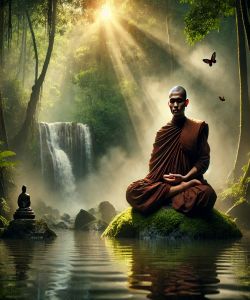
1. Overview of Monk Meditation
Monk Meditation represents an uncompromising and rigorous discipline of the mind, fundamentally distinct from the diluted forms of mindfulness prevalent in contemporary culture. It is not a therapeutic intervention, a relaxation technique, or a transient escape from worldly pressures. Rather, it is an exacting system for the radical deconstruction and reconstruction of one's perceptual and cognitive framework. This practice demands absolute commitment, mental fortitude, and an unwavering resolve to confront the innermost workings of consciousness without illusion or sentimentality. Its purpose is not comfort, but clarity; not temporary peace, but profound, unshakeable insight into the nature of existence. Practitioners are required to cultivate a state of hyper-aware observation, systematically dismantling ingrained patterns of thought, emotional reactivity, and egoic identification. The path is arduous, demanding a level of self-discipline and introspective honesty that few are prepared to undertake. It operates on the core premise that the default state of the human mind is one of distraction, delusion, and suffering, and that only through a structured, relentless, and methodical training can this state be transcended. It is, in essence, a form of deep mental conditioning, stripping away the superfluous to reveal the fundamental reality of the present moment. The process is transformative, but it is a transformation forged in the crucible of sustained, difficult, and deliberate effort. This is not a practice to be approached lightly; it is a profound commitment to mastering the self from the inside out, demanding nothing less than total engagement.
2. What are Monk Meditation?
Monk Meditation constitutes a formidable system of mental training rooted in ancient contemplative traditions, designed to cultivate profound insight and unshakable mental stability. It is fundamentally an ascetic practice in its demand for discipline, focus, and the stripping away of non-essential mental activities. It is not a singular technique but a comprehensive framework encompassing a variety of methodical approaches to observing and understanding the nature of consciousness.
At its core, this discipline is characterised by several key elements:
- Systematic Observation: It involves the direct, non-judgmental, and sustained observation of one's own mental and physical phenomena as they arise and pass away. This includes thoughts, emotions, bodily sensations, and the very act of perception itself.
- Cognitive Deconstruction: The practice is engineered to dismantle habitual thought patterns and automatic emotional reactions. By observing these processes without engagement, the practitioner learns to uncouple stimulus from response, thereby breaking cycles of conditioned behaviour and suffering.
- Cultivation of Equanimity: A central objective is the development of a balanced, impartial, and resilient state of mind. This is not a state of apathy but one of profound stability that remains undisturbed by the fluctuations of pleasant and unpleasant experiences.
- Insight into Impermanence (Anicca): Through rigorous observation, the practitioner gains a direct, experiential understanding that all phenomena—thoughts, feelings, and even the sense of self—are transient and in a constant state of flux.
- Insight into Non-Self (Anattā): The practice systematically erodes the ingrained notion of a solid, permanent, and independent "I" or "self." It reveals the self to be a composite of interdependent, impersonal processes, rather than a monolithic entity.
In essence, Monk Meditation is an active, investigative process. It is a direct and empirical exploration of the mind, undertaken not for relaxation, but for liberation from the mind's own self-imposed limitations and delusions.
3. Who Needs Monk Meditation?
- Individuals who seek to develop uncompromising mental fortitude and cognitive resilience, not merely to cope with stress, but to master their internal responses to external pressures with absolute command.
- Those who are prepared to engage in a rigorous and systematic deconstruction of their own ego and personality structure, with the objective of attaining profound self-knowledge beyond superficial introspection.
- Practitioners of high-stakes professions, such as senior leadership, emergency services, or strategic command, who require an unshakeable inner calm and clarity of thought under extreme duress.
- Individuals who have exhausted superficial self-help methodologies and demand a profound, foundational shift in their perception of reality, themselves, and their relationship to the world.
- Scholars, philosophers, and deep thinkers who wish to move beyond theoretical knowledge and gain direct, experiential insight into the fundamental nature of consciousness, existence, and perception.
- Those who recognise the pervasive nature of their own conditioned reactions—such as anger, anxiety, or attachment—and possess the resolve to dismantle these patterns at their root, rather than simply managing their symptoms.
- Individuals committed to a path of authentic spiritual or personal development that prioritises truth over comfort, and who are willing to confront difficult and unsettling aspects of their own psyche in the pursuit of that truth.
- Anyone who understands that genuine inner freedom is not a passive state to be wished for, but a hard-won victory achieved through relentless self-discipline, structured training, and an unwavering commitment to the practice.
- Those who seek to cultivate a state of profound, abiding equanimity that is not dependent on external circumstances, thereby establishing an inner sanctum of stability and peace.
- Individuals who feel a fundamental sense of dissatisfaction or meaninglessness in conventional existence and are prepared to undertake a demanding internal journey to discover a more authentic and substantial way of being.
4. Origins and Evolution of Monk Meditation
The origins of Monk Meditation are located not in a single, datable event, but in the deep strata of ancient contemplative inquiry. Its antecedents lie in the ascetic and philosophical traditions of the Indian subcontinent, where early renunciants and sages developed systematic methods for exploring the inner landscape of consciousness. These proto-meditative practices were born from a fundamental inquiry into the nature of suffering, existence, and the human condition. They were not casual pursuits but full-time, life-defining disciplines, undertaken by those who had renounced worldly life in favour of a rigorous quest for ultimate truth. The methods were empirical, relying on direct observation of the mind rather than on faith or divine revelation alone.
With the advent of foundational figures like the Buddha, these disparate practices were codified, refined, and integrated into a comprehensive philosophical and ethical framework. Within the nascent monastic communities, meditation was established as the central pillar of the path to enlightenment. It evolved from a solitary ascetic pursuit into a structured, teachable discipline, with established techniques, doctrinal underpinnings, and a clear soteriological goal. The emphasis was squarely on developing insight (Vipassanā) and concentration (Samatha) as a means to eradicate mental defilements and achieve liberation. This period marked the crystallisation of meditation as a formal, rigorous training system, transmitted through a direct lineage from teacher to student.
In subsequent epochs, as these traditions migrated across Asia, Monk Meditation diversified, adapting to new cultural and philosophical contexts. Different schools emerged, placing varying emphasis on specific techniques. For instance, some traditions prioritised seated meditation (Zazen) as the ultimate expression of practice, while others emphasised mindfulness in all activities or the cultivation of specific heart-qualities like compassion (Metta). Despite these variations, the core principles remained intact: discipline, sustained effort, non-judgmental observation, and the ultimate aim of seeing reality as it truly is. The evolution has always been one of refinement and pedagogical adaptation, never a dilution of its formidable core purpose.
5. Types of Monk Meditation
The discipline of Monk Meditation is not a monolithic entity but comprises several distinct, rigorous methodologies. Each type possesses a unique focus and technical approach, though all converge on the ultimate goal of profound insight and mental purification.
- Insight Meditation (Vipassanā): This is the practice of penetrating and investigative observation. Its sole objective is to cultivate a direct, experiential understanding of the fundamental nature of reality, specifically the characteristics of impermanence, unsatisfactoriness, and non-self. The practitioner systematically scans the mind and body, noting the arising and ceasing of all phenomena without reaction or judgment. It is a practice of raw, unvarnished seeing, designed to dismantle delusion at its root.
- Tranquillity Meditation (Samatha): This practice is dedicated to the cultivation of deep, unshakable concentration and mental calm. The practitioner focuses the mind on a single, chosen object—most commonly the breath—to the exclusion of all else. The goal is to suppress mental hindrances and achieve states of profound absorption (Jhāna), resulting in a mind that is powerful, pliable, and fit for the work of insight. Samatha is often considered a preparatory or complementary practice to Vipassanā, creating a stable platform from which to observe reality clearly.
- Seated Meditation (Zazen): Central to the Zen tradition, Zazen is presented not merely as a technique but as the direct expression of an enlightened mind. It is a practice of "just sitting" with intense, alert awareness, without a specific goal or object of focus beyond the present moment itself. The practitioner observes thoughts as they arise and pass, neither grasping nor rejecting them, returning consistently to a state of grounded, present awareness. It is an act of profound stillness and non-doing that demands immense mental discipline.
- Loving-Kindness Meditation (Metta Bhāvanā): This is a systematic cultivation of boundless, unconditional goodwill towards all beings, including oneself. It is not a sentimental exercise but a deliberate reconditioning of the heart and mind away from aversion, ill will, and selfishness. The practice typically involves the silent repetition of specific phrases, radiating feelings of loving-kindness in expanding circles from oneself to loved ones, neutral persons, difficult persons, and ultimately all sentient beings. It is a powerful antidote to a contracted, fearful mind.
6. Benefits of Monk Meditation
- Uncompromising Mental Fortitude: Develops an unshakeable inner core, rendering the practitioner resilient to external pressures, emotional turbulence, and psychological adversity. The mind becomes a fortress, not a vessel for transient disturbances.
- Radical Cognitive Clarity: Systematically dismantles mental fog, confusion, and cognitive biases. It cultivates a state of penetrating insight, allowing for precise, accurate, and dispassionate assessment of any situation.
- Mastery of Emotional Regulation: Moves beyond mere emotional suppression to achieve genuine command over affective states. The practitioner learns to observe emotions as they arise and pass without being commandeered by them, thus neutralising their disruptive power.
- Profound and Abiding Equanimity: Cultivates a deep, unwavering balance of mind that is not contingent on external circumstances. This is not apathy, but a state of profound stability that remains poised amidst both pleasure and pain, success and failure.
- Deconstruction of Egoic Structures: Facilitates the direct, experiential understanding that the conventional sense of "self" is a conditioned construct. This insight fundamentally reduces selfish craving, aversion, pride, and the suffering that arises from them.
- Enhanced Attentional Control: Forges an extraordinary capacity for sustained, focused attention. This heightened concentration is not merely an aid to meditation but a transferable skill that enhances performance in all areas of life demanding focus and precision.
- Direct Insight into the Nature of Reality: Provides a non-conceptual, experiential realisation of core existential truths, such as impermanence and interdependence. This fundamentally alters one's worldview, leading to a more sane and grounded way of being.
- Cultivation of Authentic Compassion: By understanding the shared nature of suffering and the non-self, the practitioner develops a genuine, non-sentimental compassion for all beings, rooted in wisdom rather than pity.
- Reduction in Psychological Suffering: Directly targets and uproots the mental causes of suffering—namely craving, aversion, and delusion—rather than merely addressing their symptoms. The result is a substantial and lasting decrease in anxiety, anger, and dissatisfaction.
7. Core Principles and Practices of Monk Meditation
- The Principle of Non-Negotiable Discipline (Sīla): The foundation is an uncompromising commitment to ethical conduct and self-restraint. This is not about moralistic purity but about creating a mind that is not agitated by guilt, remorse, or conflict. A disciplined life is a prerequisite for a disciplined mind; without it, meditation is built on sand.
- The Practice of Postural Integrity: A stable, upright, and grounded posture is mandatory. The body is not incidental; it is the physical anchor for the mind. Slouching or fidgeting reflects and reinforces a scattered mind. The posture must be held with alert relaxation—a precise balance of firmness and ease—for the duration of the session.
- The Practice of Anchored Attention (Samādhi): The mind must be trained to rest upon a single object of meditation, most commonly the physical sensation of the breath at the nostrils or the abdomen. This is not a passive observation but an active, moment-to-moment returning of the attention, relentlessly and without self-criticism, every time it wanders. This forges the muscle of concentration.
- The Principle of Radical Honesty: One must observe the contents of the mind exactly as they are, without censorship, judgment, or embellishment. This includes confronting uncomfortable truths, unattractive thoughts, and painful emotions. The practice demands the courage to see oneself without illusion.
- The Practice of Bare Awareness: When thoughts, sensations, or emotions arise, they are to be noted with a simple, non-discursive label (e.g., "thinking," "itching," "anger") and then allowed to pass without engagement. One does not follow the thought, analyse the emotion, or scratch the itch. This severs the chain of habitual reaction.
- The Principle of Impermanence (Anicca): A core intellectual understanding that must be verified through practice. The practitioner actively observes the arising and passing of all experiences, big and small, to gain a direct, visceral insight that nothing is permanent. This insight systematically erodes attachment and craving.
- The Principle of Non-Self (Anattā): The ultimate aim is to deconstruct the illusion of a solid, independent "I" who is the owner of experiences. Through sustained observation, it becomes clear that thoughts think themselves and feelings feel themselves. There is no central controller. This understanding is the root of liberation from egoic suffering.
8. Online Monk Meditation
- Accessibility to Authentic Discipline: The online format removes geographical barriers, providing access to rigorous, monastic-style instruction that was previously confined to remote monasteries or specialised retreat centres. It allows committed individuals to engage with a demanding practice without necessitating a complete disruption of their life circumstances.
- Structured and Uncompromising Curriculum: A properly constituted online course delivers a systematic, non-diluted curriculum. It enforces a disciplined progression through foundational principles and advanced techniques, ensuring that the practitioner builds a robust and coherent understanding. The structure itself becomes an instrument of discipline.
- Forced Self-Reliance and Internal Accountability: In the absence of a physically present teacher and group, the onus of discipline falls squarely upon the individual. This environment compels the practitioner to cultivate an internal locus of control and a powerful sense of self-responsibility, which are cornerstones of the monastic path. There is no one to perform for; the work is entirely internal.
- Integration into Daily Existence: The online modality demands that the practitioner create a sacred space for practice within their own environment. This act of carving out a disciplined sanctuary from the chaos of daily life is a powerful practice in itself, forcing the integration of formal meditation with worldly responsibilities. It breaks down the artificial barrier between "retreat" and "real life."
- Direct Application of Tenacity: Committing to a scheduled online session requires overcoming the inertia and distractions of one's personal environment. Successfully adhering to this schedule builds mental and volitional strength. It is a constant, real-world test of one's resolve, far removed from the supportive container of a residential retreat.
- Anonymity that Fosters Honesty: For some, the relative anonymity of an online setting can facilitate a more profound and unselfconscious introspection. Free from the perceived judgment of others in a physical group, the practitioner may feel more able to confront difficult personal material with radical honesty.
- Provision of Clear, Repeatable Instruction: Digital delivery allows for the provision of precisely articulated instructions, guided meditations, and doctrinal talks that can be reviewed as needed. This ensures that the technical and philosophical details of the practice are absorbed with clarity and precision, preventing misunderstanding.
9. Monk Meditation Techniques
- Step One: Formal Preparation: Select a location that is silent, secluded, and free from all potential interruptions. This space must be treated as a sanctum for the duration of the practice. Power down all electronic devices. Adopt a mindset of solemnity and purpose; this is not a casual activity.
- Step Two: Establish the Posture: Sit on a firm cushion on the floor, or if physically necessary, on an upright chair with feet flat on the ground. The posture must be stable and erect. The spine is to be held straight, like a stack of coins, without being rigid. The head should be balanced lightly atop the spine, with the chin slightly tucked. Hands are placed in a stable mudra, typically in the lap. This physical integrity is non-negotiable as it directly influences mental alertness.
- Step Three: Settle and Scan: Close the eyes gently. Take several deep, deliberate breaths to release gross physical tension. Then, conduct a brief, systematic scan of the body from head to toe, consciously relaxing any areas of holding or tightness. Ground your awareness in the physical reality of the body sitting in the room.
- Step Four: Anchor the Attention: Bring your full and undivided attention to the natural, unforced sensation of the breath. Choose a single, clear anchor point: either the touch of the air at the tip of the nostrils or the rising and falling sensation of the abdomen. Do not control the breath; observe it exactly as it is. Its rhythm, depth, and texture are the sole objects of your focus.
- Step Five: Execute Bare Awareness: Your mind will wander. This is not a failure; it is the object of the practice. The moment you realise your attention has drifted, gently but firmly acknowledge the distraction (e.g., "thinking," "hearing") and then immediately, without drama or self-recrimination, return your focus to the breath. This process of noticing and returning is the core exercise. Repeat it relentlessly.
- Step Six: Conclude with Intention: At the end of the allotted time, do not stand up abruptly. Gently release the formal focus on the breath and allow your awareness to expand to the body, then to the room. Conclude with a clear mental affirmation of your commitment to carrying the quality of awareness cultivated in the session into your next activity.
10. Monk Meditation for Adults
Monk Meditation is a discipline singularly suited to the mature adult mind, for it demands a level of psychological resilience and existential seriousness that is rarely found in the young. Adulthood, with its accumulated responsibilities, disappointments, and confrontations with limitation, provides the necessary existential grounding for such a rigorous undertaking. The practice is not a diversion or a hobby; it is a direct confrontation with the deep structures of one's own mind, and this requires the capacity for sustained, solitary effort that is the hallmark of maturity. An adult has typically experienced enough of life's vicissitudes to understand that lasting peace and stability cannot be secured from external sources. This hard-won recognition creates the fertile soil in which the seeds of this demanding practice can grow. The discipline requires one to observe the relentless stream of thoughts about past regrets and future anxieties—the very fabric of adult consciousness—without being swept away. It demands the strength to sit with the discomfort of one's own conditioned patterns and the patience to dismantle them piece by piece. This is not a task for the flighty or the impatient. It is for those who have moved beyond the search for simple solutions and are prepared to engage in the profound, often arduous work of mastering the self. The capacity for self-regulation, for prioritising long-term transformation over short-term gratification, and for understanding the necessity of unwavering commitment are all faculties that adulthood, ideally, bestows. Therefore, this practice is not merely for adults; it is, in many respects, only truly accessible to them.
11. Total Duration of Online Monk Meditation
The standard, non-negotiable duration for a single, formal online session of Monk Meditation is precisely one hour (1 hr). This specific duration is not arbitrary; it is a deliberately calibrated timeframe designed to balance rigour with practicality. A period shorter than this is insufficient to move beyond superficial mental chatter and allow the mind to settle into a state of deeper concentration and introspective clarity. The initial phases of any session are invariably spent grappling with restlessness and the momentum of daily concerns. It is only after a significant period of sustained effort that the mind achieves the stability required for the true work of observation and insight to begin. Conversely, extending the session much beyond this point in an un-supervised online context can lead to diminishing returns for the unseasoned practitioner, risking fatigue, torpor, or mental strain. The one-hour (1 hr) container provides a formidable yet achievable challenge. It is long enough to be a serious and transformative undertaking, demanding real commitment and mental stamina, yet it remains integrable into the structure of a disciplined daily life. This duration serves as a crucible, testing and building the practitioner's resolve, focus, and capacity for stillness within a defined and powerful boundary. It is the requisite time to ensure the practice is substantial, not superficial.
12. Things to Consider with Monk Meditation
Before embarking upon the formidable path of Monk Meditation, it is imperative to conduct a stark and honest self-assessment. This is not a wellness trend or a relaxation method to be casually adopted; it is a rigorous, and at times, destabilising, process of deep psychological deconstruction. One must consider whether one possesses the requisite emotional resilience and mental fortitude to confront the contents of one's own mind without flinching. The practice will inevitably bring to the surface suppressed memories, uncomfortable truths, and deeply ingrained patterns of negative conditioning. There is no escape within the practice itself; the only way out is through. Prospective practitioners must therefore be prepared for periods of significant psychological discomfort. Furthermore, one must evaluate one's capacity for unwavering self-discipline. The benefits of this practice are cumulative and directly proportional to the consistency and diligence of the effort applied. It demands a non-negotiable commitment of time and energy, a willingness to prioritise the practice over other, more immediately gratifying, pursuits. One should also consider the profound philosophical implications. This discipline systematically dismantles the conventional notion of a solid, enduring self. While this is considered the gateway to liberation, the process can be disorienting. One must be prepared to have one's most fundamental assumptions about identity and reality challenged and, ultimately, overturned. This is a serious undertaking for serious individuals.
13. Effectiveness of Monk Meditation
The effectiveness of Monk Meditation is absolute, provided the practitioner's commitment is equally absolute. Its potency lies in its direct, empirical, and uncompromising approach to the mind. Unlike theoretical philosophies or belief-based systems, this discipline operates on the principle of direct verification. Its results are not a matter of faith but of observable, repeatable consequences arising from specific mental actions. When practised with rigour and consistency, it systematically re-engineers the very architecture of cognition and emotional response. The effectiveness is evident in the tangible cultivation of unshakeable equanimity, enabling the practitioner to navigate life's adversities with a calm and centred mind. It is seen in the development of penetrating cognitive clarity, which cuts through confusion and allows for precise, effective decision-making. Its power is manifest in the dismantling of compulsive thought patterns and destructive emotional habits, freeing the individual from lifelong cycles of anxiety, anger, and craving. The practice is effective because it does not merely treat the symptoms of psychological distress; it targets and eradicates the root causes—the fundamental delusions of a separate self locked in a battle of grasping and aversion. The transformation is not superficial or temporary; it is a foundational shift in one's entire way of being, a hard-won freedom forged through the disciplined application of awareness. Its effectiveness is not in question; the only variable is the resolve of the person who undertakes it.
14. Preferred Cautions During Monk Meditation
It is imperative that the practice of Monk Meditation be approached with the utmost seriousness and a clear understanding of its potential hazards. The primary caution is against trivialisation. To treat this profound discipline as a mere relaxation technique or a tool for mild stress reduction is to fundamentally misunderstand its purpose and to court disillusionment. This is a rigorous system for mental deconstruction, and it must be respected as such. Practitioners must be cautioned against spiritual bypassing—the misuse of meditative states or philosophical concepts to avoid confronting unresolved psychological issues, difficult emotions, or life responsibilities. The practice is meant to increase engagement with reality, not to facilitate a detached escape from it. Furthermore, one must be wary of developing pride or arrogance based on one's practice. Progress in meditation is not a badge of honour; it is a tool for the dismantling of the very ego that would seek to claim such achievements. A critical caution concerns practising without a proper framework of understanding. Engaging in deep, intensive meditation without the guidance of core principles can lead to confusion, disorientation, or the misinterpretation of experiences. The mind is a powerful and complex territory; one should not wander into its depths without a map. Finally, practitioners must avoid straining. While the discipline is tough, the effort must be balanced and intelligent, not born of tense, forceful striving. The correct effort is one of persistent, patient, and unwavering application, not of aggressive, self-coercing will.
15. Monk Meditation Course Outline
Module 1: The Foundational Imperatives
The Philosophical Underpinnings: Understanding Suffering, Impermanence, and Non-Self.
The Ethical Framework (Sīla): Establishing the Non-Negotiable Ground of Conduct.
The Principle of Right Intention: Defining a Clear and Unwavering Purpose for Practice.
Setting the Conditions: Creating a Sanctum for Practice and a Life of Discipline.
Module 2: The Core Mechanics of Concentration (Samatha)
Mastery of Posture: The Unshakeable Physical Foundation.
The Science of the Breath: Anchoring Attention with Precision.
Identifying and Overcoming the Five Hindrances (Sensual Desire, Ill Will, Sloth, Restlessness, Doubt).
Techniques for Deepening Concentration and Achieving Mental Pliability.
Module 3: The Practice of Investigative Insight (Vipassanā)
Introduction to Bare Awareness: The Art of Non-Reactive Observation.
Systematic Body-Scanning: Observing Sensation as Impersonal Phenomena.
Deconstructing a Feeling: Tracking the Lifespan of Emotional States.
Noting Thoughts: Dis-identifying from the Content of the Mind.
Module 4: Advanced Principles and Integration
The Cultivation of Equanimity: Maintaining Balance Amidst Pleasure and Pain.
Working with Difficult Emotions: Transforming Hindrances into Objects of Insight.
The Practice of Loving-Kindness (Metta): Systematically Developing Unconditional Goodwill.
Mindfulness in Daily Life: Integrating Formal Practice with All Activities.
Module 5: Deepening Insight and Sustaining Practice
Direct Investigation of the "Self": Experientially Dismantling the Egoic Construct.
Navigating the Stages of Insight: Understanding the Progress of the Path.
Establishing a Lifelong, Self-Sustaining Practice.
The Role of Sangha: The Importance of a Community of Committed Practitioners.
16. Detailed Objectives with Timeline of Monk Meditation
- Weeks 1-2: Foundational Establishment
- Objective: To establish a non-negotiable, daily sitting practice.
- Objective: To achieve complete mastery of the correct, stable meditation posture.
- Objective: To understand and commit to the core philosophical principles of the practice.
- Timeline Benchmark: The practitioner can sit for the full, prescribed duration without significant physical agitation and can articulate the primary reason for their practice.
- Weeks 3-4: Concentration and Mental Stability
- Objective: To develop the capacity to keep attention anchored on the breath for sustained periods.
- Objective: To gain proficiency in identifying the five mental hindrances as they arise in real-time.
- Objective: To consistently execute the technique of "noting and returning" to the anchor without self-criticism.
- Timeline Benchmark: The mind demonstrates noticeably longer periods of calm abiding, and the practitioner feels less "pushed around" by their thoughts.
- Weeks 5-8: Introduction to Insight
- Objective: To begin the systematic application of bare awareness to all bodily sensations.
- Objective: To learn to observe the arising, peak, and passing of distinct emotional states without reaction.
- Objective: To start dis-identifying from thought-streams, viewing them as impersonal mental events rather than personal truths.
- Timeline Benchmark: The practitioner reports initial, fleeting moments of insight into the impermanent nature of their experiences.
- Weeks 9-12: Deepening and Integration
- Objective: To cultivate a robust state of equanimity towards both pleasant and unpleasant experiences that arise during sitting.
- Objective: To begin applying mindful awareness to routine daily activities, such as walking, eating, and listening.
- Objective: To systematically practise Loving-Kindness (Metta) to counteract aversion and cultivate a more open mental state.
- Timeline Benchmark: The practitioner demonstrates a marked decrease in emotional reactivity in daily life and can sustain a continuity of awareness beyond the formal sitting period.
17. Requirements for Taking Online Monk Meditation
- Unwavering Personal Commitment: An absolute, pre-existing resolve to undertake a demanding and rigorous course of self-discipline. This is not for the curious or the casual.
- A Dedicated, Sanctified Space: A private, silent, and consistently available physical location that will be used exclusively for practice. This space must be free from any potential for interruption by other people, pets, or noise.
- Robust and Reliable Technology: A stable, high-speed internet connection is non-negotiable. A functional computer or device with a camera and microphone, which must remain operational for the full duration of every session. Technical failures are the practitioner's responsibility to prevent.
- Psychological and Emotional Stability: The practitioner must possess a baseline of sound mental health. This is not a therapeutic intervention for acute psychological crises. It is a discipline for stable individuals seeking to achieve profound self-mastery.
- Capacity for Absolute Self-Discipline: The ability to adhere strictly to schedules, follow precise instructions without deviation, and motivate oneself in a solitary environment. The online format offers no external enforcement; discipline must be internal.
- Intellectual Receptivity: A willingness to engage with, and seriously consider, philosophical concepts that may fundamentally challenge one's current worldview, particularly concerning the nature of self, suffering, and reality.
- Complete Honesty: A commitment to being radically honest with oneself during practice and, where required, in communication with the instructor. There is no room for ego-preservation or pretense in this work.
- Punctuality and Preparedness: A mandatory requirement to be present and fully prepared in one's designated space before the scheduled start time of every single session. Lateness is unacceptable.
- Appropriate Attire: Modest, comfortable, and non-distracting clothing suitable for seated practice.
- Acceptance of the Rigour: A full and prior acceptance that the course will be demanding, may involve periods of discomfort, and requires sustained, strenuous mental effort.
18. Things to Keep in Mind Before Starting Online Monk Meditation
Before committing to an online course in Monk Meditation, it is imperative to conduct a rigorous internal audit of one's own resolve and environment. The digital medium presents a unique paradox: it offers unprecedented access to a profound discipline while simultaneously demanding a level of self-mastery that the practice itself is designed to cultivate. You must understand that the primary challenge will be one of internal accountability. Without the physical presence of a teacher or the collective energy of a group, the temptation to succumb to distraction, shorten a session, or abandon the practice altogether will be immense and relentless. You are solely responsible for forging your own container of discipline. This requires creating an inviolable sanctuary within your home—a space that is physically and psychologically cordoned off from the chaos of daily life. The boundary between your practice space and your living space must be absolute. Furthermore, you must be prepared to engage with a screen as a portal to deep inner work, a task that requires a specific kind of focused intention, distinct from the passive consumption of digital media that defines modern life. You must be ready to confront the loneliness of the solitary path, as the online format, by its nature, amplifies the internal nature of the journey. This is not a community-building exercise; it is a solitary confrontation with the self, facilitated by technology but ultimately undertaken alone.
19. Qualifications Required to Perform Monk Meditation
The authority to guide others in Monk Meditation is not a qualification that can be acquired through a brief training course or academic certification. It is a grave responsibility that demands a profound and multifaceted competency, rooted in authentic, long-term immersion in the practice. The primary and non-negotiable requirement is extensive, deep, and sustained personal practice over many years, preferably within a recognised lineage or tradition. The instructor must have moved beyond a mere intellectual understanding of the concepts to a visceral, experiential realisation of them. They must have navigated the challenging terrain of their own mind and experienced the stages of insight firsthand. This is paramount.
Beyond personal practice, several other qualifications are essential:
- Lineage-Based Training: The individual should have undergone rigorous training under the direct supervision of one or more senior, qualified teachers. This ensures they are not propagating a self-invented or diluted version of the discipline but are transmitting a proven, time-tested methodology.
- Doctrinal Mastery: A comprehensive and nuanced understanding of the philosophical and psychological framework that underpins the meditation techniques is required. The instructor must be able to articulate these complex concepts with precision and clarity.
- Pedagogical Competence: The ability to effectively teach is a distinct skill. The instructor must be capable of providing clear, unambiguous instructions, diagnosing common problems in a practitioner's technique, and offering guidance that is both compassionate and firm.
- Ethical Integrity: The instructor must embody the ethical principles of the practice (Sīla). They must be a model of integrity, humility, and self-restraint, demonstrating that they are not a purveyor of information, but a living embodiment of the path.
To perform this role without these qualifications is not only irresponsible but potentially harmful, risking the misguidance of students and the trivialisation of a sacred discipline.
20. Online Vs Offline/Onsite Monk Meditation
Online
The online modality for Monk Meditation is defined by its demand for absolute self-reliance and internal discipline. Its primary advantage is accessibility, removing the geographical and logistical barriers that prevent many from engaging with authentic teachers and rigorous curricula. The practitioner is compelled to forge a sanctuary for practice within their own environment, a powerful exercise in integrating discipline into daily life. This format forces an unwavering internal accountability; there is no group pressure or physical supervision to rely upon, meaning any progress is a direct result of the individual’s own resolve. The focus is intensely internal and solitary, which can accelerate the confrontation with one's own mind. However, its significant disadvantage is the absence of direct, in-person correction of posture and the lack of the subtle, energetic support of a group container (Sangha). The potential for technological failure is a constant risk, and the practitioner must possess immense fortitude to overcome the myriad distractions inherent in a domestic setting. It is a path suited for the highly motivated and self-regulated individual.
Offline/Onsite
Offline, or onsite, meditation within a retreat or monastic setting provides a powerful and immersive container for practice. The environment is engineered for a single purpose: deep contemplation. All external distractions and worldly responsibilities are removed, allowing the practitioner to engage with the practice with total, undivided attention. The physical presence of a qualified teacher allows for immediate, nuanced feedback, particularly regarding the crucial aspect of posture. The collective energy of a group of committed practitioners creates a palpable field of support and shared purpose, which can be profoundly encouraging during difficult periods. The structured schedule is externally enforced, relieving the practitioner of the burden of self-regulation and allowing them to surrender fully to the process. The principal limitation is its lack of accessibility; such environments are often remote, costly, or require a significant withdrawal from one's life. There can also be a risk of "retreat-high," where profound experiences in the artificial container do not successfully translate back into the complexities of daily life.
21. FAQs About Online Monk Meditation
Question 1. Is this meditation for beginners? Answer: It is for serious beginners. It is not for casual beginners. A beginner must possess an unwavering commitment to discipline from the outset.
Question 2. Is this a religious practice? Answer: It originates from contemplative traditions that are associated with philosophies some call religions. However, the practice itself is a direct, empirical investigation of the mind, requiring no faith-based belief.
Question 3. What equipment do I need? Answer: A firm cushion or a straight-backed chair, a reliable internet connection, and a device with a functional camera and microphone. Nothing more.
Question 4. Do I need to be flexible to sit on the floor? Answer: No. Postural integrity is key, not flexibility. Sitting upright on a chair is a perfectly acceptable and effective alternative.
Question 5. What if I fall asleep? Answer: This indicates the presence of the hindrance of sloth and torpor. It is a state to be noted with awareness. The practice is to re-establish alertness. Consistent sleepiness may require an examination of your sleep schedule or posture.
Question 6. My mind is too busy, I cannot do this. Answer: This is a universal condition, not a personal failing. The practice is not to stop the thoughts, but to change your relationship to them through disciplined, non-reactive observation. A busy mind is the raw material of the practice.
Question 7. What if I experience uncomfortable emotions? Answer: This is expected and necessary. The practice is to learn to sit with discomfort without aversion. These emotions are objects for investigation, not problems to be solved.
Question 8. Can this practice cure my anxiety? Answer: This is not a medical treatment. It is a discipline for uprooting the fundamental causes of mental suffering, of which anxiety is a symptom. The result can be a profound reduction in anxiety, but it is not a "cure."
Question 9. How is this different from simple mindfulness apps? Answer: It is fundamentally different. This is a rigorous, structured, and demanding discipline for radical self-transformation, not a tool for momentary relaxation or a wellness product.
Question 10. Do I have to have my camera on? Answer: Yes. This is a matter of accountability and commitment to the formal container of the session. It is non-negotiable.
Question 11. What if I miss a session? Answer: Consistency is paramount. Missing a session should be an exceptional event. You are expected to uphold your commitment to the schedule.
Question 12. How long until I see results? Answer: This question reveals a goal-oriented mindset that is an obstacle. Focus on the rigour of the process itself. The results will manifest in their own time, proportional to the integrity of your practice.
Question 13. Is it silent meditation? Answer: Sessions typically involve a period of guided instruction followed by a substantial period of silent, self-directed practice.
Question 14. Can I listen to music while I meditate? Answer: Absolutely not. The practice involves confronting the mind as it is, without pacifiers or distractions.
Question 15. Is it okay to feel frustrated? Answer: Frustration is another mental state to be noted with bare awareness. Observe it. Do not become it.
Question 16. What does "non-judgmental" mean? Answer: It means observing the arising of a thought or feeling without adding a second layer of commentary, criticism, or approval. You simply note its presence and let it be.
Question 17. Will this make me lose my ambition? Answer: It will not destroy ambition; it will purify it. It replaces frantic, ego-driven striving with clear, purposeful, and effective action.
22. Conclusion About Monk Meditation
In conclusion, Monk Meditation stands as a formidable and uncompromising path of mental discipline, fundamentally distinct from the commodified and diluted versions of mindfulness that permeate modern culture. It is not a panacea for everyday stress nor a passive retreat from the challenges of life. It is an active, rigorous, and systematic process of deconstruction and mastery. The practice demands an unwavering commitment, a capacity for radical honesty, and the fortitude to confront the deepest, often most uncomfortable, strata of one's own consciousness. Its core purpose is not to induce a state of temporary calm but to forge a mind of unshakeable equanimity and penetrating insight—a mind that is free from the tyranny of its own conditioned reactions. The path is arduous and the requirements are absolute, allowing for no shortcuts or compromises. It operates on the stark premise that true freedom is not given but earned through relentless, moment-to-moment effort. For those individuals who possess the requisite seriousness and resolve, this discipline offers not comfort, but transformation; not an escape, but a profound and lasting liberation from the self-imposed confines of the untrained mind. It is, ultimately, a direct and powerful confrontation with reality itself.