1. Overview of Nada Yoga Meditation
Nada Yoga Meditation is an ancient and profound yogic science predicated on the absolute primacy of sound as the fundamental medium for spiritual liberation and ultimate self-realisation. It is not merely a practice of listening but a disciplined and systematic exploration of cosmic vibration, from its most manifest external forms to its most subtle, un-struck internal source. This discipline posits that the entire universe, and everything within it, is a manifestation of vibration, or Nada. The practitioner’s objective is to trace this vibration back to its origin, a state of pure, undifferentiated consciousness. The methodology is rigorous, demanding the practitioner first master concentration on external sounds (Ahata Nada) to train and steady the mind, thereby preparing it for the far more challenging task of perceiving the internal, esoteric sound current (Anahata Nada). This internal sound is not a product of sensory input but is the inherent, primordial hum of existence itself, accessible only when the faculties are withdrawn from the external world. Through sustained and unwavering focus on this inner sound, the mind dissolves its own turbulent patterns, transcending thought, emotion, and egoic identity. The ultimate attainment in Nada Yoga is the dissolution of the individual self into the cosmic sound, a state known as Laya or complete absorption, which is synonymous with Samadhi or enlightenment. It is an uncompromising path that demands total dedication, using the fabric of reality—sound—as its singular tool for deconstructing the illusory self and uniting with the absolute.
2. What are Nada Yoga Meditation?
Nada Yoga Meditation is a specific and advanced form of yogic practice centred on the concept of Nada, or cosmic sound. It operates on the fundamental principle that sound is the primary creative force of the universe and that by engaging with it in a structured and meditative way, an individual can achieve profound states of consciousness and ultimate spiritual union. The practice is bifurcated into two distinct but sequential stages, which define its methodology.
Engagement with Ahata Nada (Struck Sound): This is the preliminary phase where the practitioner focuses on external, perceptible sounds. These are sounds created by the striking of two objects, including musical instruments, a tuning fork, the chanting of mantras, or even the ambient sounds of nature. The purpose of this stage is not passive listening but active, one-pointed concentration (Dharana). By holding the mind’s attention firmly on a single external sound, the practitioner trains the mind to resist distraction, calm its incessant chatter, and develop the requisite focus needed for the more subtle aspects of the practice. This phase is a preparatory ground for sensory withdrawal (Pratyahara).
Perception of Anahata Nada (Un-struck Sound): This constitutes the advanced and core phase of Nada Yoga. Anahata Nada refers to the internal, mystical sounds that are not produced by any external vibration or physical interaction. These are the subtle, inner sounds of the body’s own energy systems and, ultimately, the primordial sound of consciousness itself. Practitioners are guided to listen for these sounds within, often described as resembling a bell, a flute, the hum of a bee, or the sound of the ocean. This is not an auditory hallucination but a genuine perception of the subtle vibratory field that underpins existence. Sustained focus on Anahata Nada leads the practitioner deeper into meditation (Dhyana), dissolving the ego and culminating in a state of profound absorption (Samadhi).
3. Who Needs Nada Yoga Meditation?
Individuals demanding absolute mental discipline and unwavering concentration. This practice is engineered for those in high-stakes professions or any field where cognitive clarity, sustained focus, and the ability to filter out non-essential stimuli are paramount for performance and success.
Practitioners of advanced meditation seeking to transcend conventional techniques. For those who have reached a plateau with breath-work or visualisation, Nada Yoga offers a potent and direct pathway to deepen their practice by engaging with the very substrate of consciousness: vibration.
Persons experiencing significant mental turbulence, anxiety, or sensory overload. The initial stages of focusing on external sound provide a powerful anchor that forces the chaotic mind into a state of order and calm, systematically reducing psychological distress and re-establishing internal equilibrium.
Creative professionals, musicians, and artists who rely on heightened sensory perception and intuitive insight. This discipline refines the auditory faculty to an exceptional degree, unlocking new layers of sonic perception and creative potential that are inaccessible through ordinary listening.
Individuals on a dedicated spiritual path aiming for self-realisation or Samadhi. Nada Yoga is not a wellness trend; it is a direct and uncompromising soteriological system designed to dismantle the egoic structure and facilitate the union of individual consciousness with the absolute.
Those suffering from tinnitus or other internal auditory phenomena. While not a medical cure, the practice provides a framework for transforming the perception of such sounds from a source of irritation into a focal point for profound meditation, thereby neutralising their disruptive effect.
Anyone committed to mastering the yogic limb of Pratyahara (withdrawal of the senses). Nada Yoga is the quintessential practice for turning the senses inward, using the sense of hearing to transcend itself and achieve a state of complete interiorisation.
4. Origins and Evolution of Nada Yoga Meditation
The origins of Nada Yoga are ancient and deeply embedded within the esoteric traditions of Indian philosophy and tantra, predating many forms of yoga that are popular today. Its foundational concepts are articulated in various Upanishads and classical yogic texts, most notably the Nada Bindu Upanishad, which explicitly details the practice of meditating on internal sounds as a direct path to liberation. This text classifies the inner sounds and describes the progressive stages of absorption, establishing Nada Yoga as a legitimate and powerful soteriological method. The practice is also a central component of the Hatha Yoga Pradipika, one of the most authoritative manuals on Hatha Yoga. Here, it is presented as one of the most effective techniques for achieving Laya (dissolution or absorption), the state where the mind merges with the object of meditation.
Historically, Nada Yoga was considered a secret, advanced practice, transmitted directly from a qualified guru to a deserving disciple. It was not a discipline for the masses but was reserved for sincere ascetics and yogis who had already achieved a significant degree of purification and mental control through other yogic practices like asana, pranayama, and ethical observances. The emphasis was on direct experiential realisation rather than theoretical understanding. The practice was inextricably linked with the tantric understanding of the body as a microcosm of the universe, with the chakras acting as energy centres and the Anahata Nada being the sound of the divine creative force, or Shakti, active within the individual.
The evolution of Nada Yoga has seen it move from the confines of ascetic secrecy to a more accessible, albeit often misunderstood, practice. In the modern era, its techniques have been adapted and sometimes simplified for a global audience. While traditional schools continue to uphold the rigorous, step-by-step methodology, some contemporary interpretations focus more on the therapeutic and stress-reducing aspects of sound, such as sound baths or generic chanting. However, the core of authentic Nada Yoga remains unchanged: it is a formidable discipline of inner listening, a systematic process of moving from the gross to the subtle, from the external sound to the internal, un-struck vibration, with the uncompromising goal of transcending the mind and realising the ultimate nature of reality.
5. Types of Nada Yoga Meditation
The practice of Nada Yoga is structured around a progressive engagement with four distinct categories of sound, moving from the most tangible to the most transcendental. Mastery of each stage is a prerequisite for proceeding to the next.
Vaikhari (Audible or Struck Sound): This is the most external and gross level of sound, perceptible to the human ear. It encompasses all Ahata Nada (struck sounds), such as the human voice (chanting mantras like 'Om'), musical instruments, and the sounds of nature. In this initial stage, the practitioner’s task is to develop one-pointed concentration (Dharana) by focusing the entire mind on a single, chosen external sound. This practice serves to discipline the wandering mind and prepare it for subtler perceptions. It is the foundational training ground for the entire discipline.
Madhyama (Semi-audible or Mental Sound): This stage represents a transition from the external to the internal. Madhyama is a mental sound, a whisper, or the silent repetition of a mantra within the mind. It has no physical vibration but possesses a distinct mental form. The practitioner moves from audible chanting to mental chanting, a process that requires greater subtlety and focus. This practice refines concentration further and begins the process of Pratyahara, the withdrawal of the senses from external objects, as the focus of attention is now entirely internalised.
Pashyanti (Visualised or Intuitive Sound): At this advanced level, sound is no longer experienced as an auditory or even mental-verbal phenomenon. Pashyanti is sound that is 'seen' or intuitively perceived before it has formed into specific thoughts or frequencies. It is a pre-verbal, pre-conceptual state of vibration, often associated with the heart chakra (Anahata). Here, the practitioner perceives the deep structures of sound and thought as pure, undifferentiated potential. Accessing this level requires profound meditative stillness and a highly purified consciousness. It is a direct perception of the vibratory essence of thought.
Para (Transcendent or Un-struck Sound): This is the highest and final stage, the ultimate goal of Nada Yoga. Para Nada is the un-struck, primordial sound (Anahata Nada) from which all other forms of sound and the entire cosmos emerge. It is silent, formless, and beyond the grasp of the ordinary mind or senses. It is the sound of pure consciousness itself, the fundamental vibration of existence. Experiencing Para Nada is not an act of listening but of merging. The practitioner's individual consciousness dissolves into this cosmic sound, resulting in Samadhi, the state of absolute union and liberation.
6. Benefits of Nada Yoga Meditation
Cultivates Unwavering Concentration: The systematic focus required, moving from gross to subtle sounds, trains the mind to achieve a state of one-pointedness (Dharana) that is transferable to all other aspects of life, eliminating mental distraction.
Facilitates Profound Stress Reduction: By anchoring the mind to the singular stimulus of sound, the practice forcibly interrupts the cycle of anxious thoughts and ruminations, inducing a deep state of physiological and psychological calm.
Induces Sensory Withdrawal (Pratyahara): Nada Yoga is a direct and potent method for achieving Pratyahara. It uses the sense of hearing to systematically turn awareness inward, leading to a state where the practitioner is undisturbed by external sensory input.
Heightens Auditory and Sensory Perception: The discipline refines the faculty of listening to an extraordinary degree, enabling the practitioner to perceive subtle nuances not only in external sound but in all sensory experiences, leading to a richer and more vibrant perception of reality.
Promotes Emotional Regulation: Through sustained practice, one develops the capacity to observe mental and emotional states without identification. The constant return to the anchor of sound detaches the practitioner from reactive emotional patterns, fostering a state of stable equanimity.
Acts as a Direct Gateway to Advanced Meditative States: Unlike preparatory techniques, Nada Yoga is a direct path to Dhyana (meditation) and Samadhi (absorption). The perception of internal sound (Anahata Nada) serves as a powerful and continuous object of meditation that naturally deepens awareness.
Unlocks Intuitive and Creative Faculties: By attuning the consciousness to the subtle vibrations that underpin existence, the practice can dismantle creative blocks and open access to deeper, intuitive sources of insight and inspiration, particularly for those in artistic fields.
Establishes a Connection to the Subtle Body: The focus on internal sounds makes the practitioner acutely aware of the body's subtle energy systems, including the flow of prana and the activity of the chakras, providing direct, experiential knowledge of yogic anatomy.
7. Core Principles and Practices of Nada Yoga Meditation
The Primacy of Vibration (Nada Brahma): The foundational principle is that the universe is a manifestation of sound vibration (Nada). Everything, from the physical to the metaphysical, is composed of vibration. The practice accepts this as an absolute reality and uses it as the very vehicle for transcendence. The goal is to experience the truth of "Nada Brahma" – Sound is God.
Progression from Gross to Subtle: The methodology is uncompromisingly systematic. The practitioner must first master concentration on Ahata Nada (external, struck sounds). Only after achieving stability here can one progress to perceiving Anahata Nada (internal, un-struck sounds). This hierarchical approach ensures the mind is adequately prepared for increasingly subtle states of awareness.
One-Pointed Concentration (Dharana): The entire practice is an exercise in perfecting Dharana. Whether the object is an external chant or an internal hum, the mind must be held on it without wavering. This relentless focus is what purifies the mind and burns away distracting thought patterns, making deeper meditation possible.
Sensory Withdrawal (Pratyahara): A core objective is to achieve Pratyahara, the conscious withdrawal of energy and attention from the five senses. Nada Yoga accomplishes this by turning the sense of hearing upon itself, using sound to transcend sound. The practice of plugging the ears (Shanmukhi Mudra) is often employed to forcibly block external stimuli and facilitate this inward turn.
The Guru-Disciple Relationship: Traditionally, authentic Nada Yoga requires the guidance of a competent Guru. The Guru provides the initiation, specifies the correct techniques, and helps the disciple interpret the subtle inner experiences and navigate the potential psychological obstacles that arise during advanced stages of the practice.
Cultivation of Receptivity and Stillness: The practitioner must cultivate a state of profound mental and physical stillness. The subtle inner sounds cannot be perceived by a turbulent or agitated mind. This involves maintaining a steady, comfortable posture for extended periods and developing a passive, receptive awareness, allowing the sounds to emerge without being actively sought or forced.
Laya (Dissolution or Absorption): The ultimate aim of the practice is Laya, the complete dissolution of the individual ego and mind into the perceived sound. As the focus on Anahata Nada deepens, the distinction between the listener and the sound diminishes until only the sound remains. This state of total absorption is synonymous with Samadhi or enlightenment.
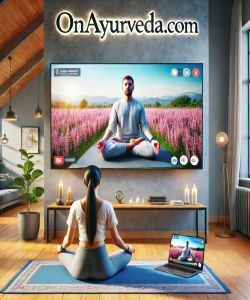
8. Online Nada Yoga Meditation
Engaging with Nada Yoga Meditation through an online modality demands an exceptionally high degree of self-discipline and environmental control. The digital platform serves merely as a conduit for instruction, not as a substitute for the internal rigour required by the practice.
Requirement of Absolute Self-Discipline: The online environment, by its very nature, is replete with potential distractions. The practitioner must possess the uncompromising will to create and enforce a sacrosanct space, free from all digital and physical interruptions. Success is contingent not on the quality of the stream, but on the practitioner’s capacity for resolute self-governance.
Primacy of High-Fidelity Audio: Unlike visual-centric practices, the efficacy of online Nada Yoga is entirely dependent on the quality of audio transmission and reception. The use of high-quality, noise-cancelling headphones is not a recommendation; it is a mandatory requirement. This is essential for clearly perceiving the instructional sounds and, more importantly, for blocking out ambient noise to facilitate the perception of subtle internal sounds.
Environmental Control is Non-Negotiable: The practitioner bears the full responsibility for creating a controlled and silent environment. This extends beyond merely closing a door. It necessitates ensuring the space is acoustically insulated as much as possible, free from the vibrations of appliances, traffic, or other household members. The online format transfers the responsibility of creating a meditative sanctuary entirely to the individual.
Cultivation of Independent Practice: The online format inherently limits the direct energetic transmission and subtle correction possible from an instructor in a physical setting. Consequently, the practitioner must be prepared to cultivate a more robust and independent practice. They must learn to become their own primary observer and guide, using the online instruction as a framework rather than a crutch. This fosters a powerful sense of self-reliance, which is central to advanced yogic discipline.
Accessibility and Consistency: The primary advantage of the online format is its unparalleled accessibility, which allows for unwavering consistency in practice. It removes geographical and logistical barriers, enabling the dedicated practitioner to engage with the discipline regularly. This regularity is the key to progress in Nada Yoga, and the online modality, when approached with the correct discipline, facilitates this better than any other.
9. Nada Yoga Meditation Techniques
The execution of Nada Yoga Meditation follows a precise and structured sequence. Adherence to this progression is not optional; it is fundamental to the efficacy of the practice.
Step One: Establish a Foundation of Stillness. Assume a stable and comfortable meditative posture (Asana), such as Siddhasana or Padmasana, with the spine erect and the body relaxed. The environment must be silent and free from interruption. The objective is to achieve complete physical immobility, as any movement will disturb the subtle perceptions that are to follow.
Step Two: Initial Focus on External Sound (Ahata Nada). Begin by directing your unwavering attention to a single, consistent external sound. This could be the subtle hum of a fan, the distant sound of traffic, or a pre-selected tone from a singing bowl or drone instrument. The purpose is to train the mind. Resist the urge to analyse or label the sound. Simply use it as an anchor to still the mind’s fluctuations. Maintain this focus until the mind becomes steady and one-pointed.
Step Three: The Practice of Bhramari Pranayama (Bee Breath). To transition from external to internal focus, perform several rounds of Bhramari Pranayama. Close the ears with the thumbs or fingers. Inhale deeply, and on the exhalation, produce a steady, low-pitched humming sound like a bee. Concentrate entirely on the vibration this sound creates within the skull. This practice powerfully directs the awareness inward and primes the consciousness for subtler listening.
Step Four: Active Listening for Internal Sounds (Anahata Nada). Following Bhramari, maintain the posture in absolute silence, keeping the ears sealed if necessary using fingers or earplugs (Shanmukhi Mudra is the formal technique). Adopt a state of receptive, passive awareness. Direct your attention to the inner acoustic space, specifically within the right ear, as tradition dictates this is where the subtlest sounds are first perceived. Do not strain or search. Simply wait and listen.
Step Five: Identification and Absorption in the Sound. Initially, you may perceive a gross sound, like a rushing or a pulse. With sustained practice, subtler sounds will emerge: a cricket, a bell, a flute, or a deep hum (Om). Once a clear sound is perceived, lock your attention onto it. Let this sound become your sole object of meditation. As your focus deepens, merge your awareness with the sound until the sense of being a separate 'listener' dissolves. Remain in this state of absorption (Laya) for the duration of the meditation.
10. Nada Yoga Meditation for Adults
Nada Yoga Meditation offers a formidable and mature path for adults seeking to command their inner world, rather than be commanded by it. For the adult mind, often entrenched in complex patterns of thought, responsibility, and chronic stress, this discipline provides a direct, non-ideological tool for deconstruction and mastery. It bypasses the need for belief systems or intricate visualisations, instead demanding engagement with the fundamental reality of vibration. This appeals to a pragmatic, results-oriented mindset. The practice requires and builds qualities essential in adult life: patience, discipline, and the capacity for sustained focus in the face of internal and external noise. It is not a passive relaxation technique but an active training of the consciousness. An adult practitioner, having experienced the limitations of a purely material or intellectual existence, is uniquely positioned to appreciate the profound depth of a practice that leads to the direct, experiential discovery of the subtle, non-physical dimensions of being. The progressive nature of Nada Yoga, starting with tangible external sounds and moving towards the esoteric internal ones, provides a logical and achievable framework that respects the adult need for structure and measurable progress. It is a sophisticated method for any adult committed to moving beyond superficial stress management and undertaking the serious work of cultivating a resilient, centred, and masterful state of mind. It is the practice of listening to the fabric of reality, a skill that provides unparalleled perspective on the challenges and complexities of adult life.
11. Total Duration of Online Nada Yoga Meditation
The prescribed total duration for a single, effective session of Online Nada Yoga Meditation is unequivocally established at 1 hr. This specific timeframe is not arbitrary but is a calculated necessity designed to facilitate the full arc of the meditative process, from initial settling to profound absorption and conscious re-integration. A shorter period is insufficient to move beyond superficial relaxation and achieve the requisite mental stillness for perceiving subtle inner sounds. Conversely, a significantly longer duration for an unguided online session can lead to mental fatigue or spiritual disorientation without the immediate grounding presence of an instructor. The 1 hr structure is deliberately partitioned. The initial phase is dedicated to establishing physical stillness and mental quietude, using preliminary techniques to disengage from the day’s cognitive residue. The central, most substantial portion of the hour is reserved for the core practice: the deep, unwavering focus on sound, progressing from the external to the internal. This requires a significant and uninterrupted block of time to allow the Anahata Nada to emerge and stabilise. The final segment of the 1 hr session is crucial for a gradual and controlled return to ordinary waking consciousness, ensuring the profound inner state is integrated smoothly, preventing any jarring psychic transition. Therefore, the 1 hr duration represents the optimal balance between depth and practicality for the online practitioner, providing a robust container for a genuine and transformative Nada Yoga experience.
12. Things to Consider with Nada Yoga Meditation
Engaging with Nada Yoga Meditation demands a serious and informed approach, as it is a powerful discipline with profound psychological and energetic effects. It is imperative to recognise that this is not a casual wellness practice but an advanced yogic technique for altering consciousness. Practitioners must consider their own psychological stability; individuals with a history of severe mental health conditions, particularly those involving auditory hallucinations or psychosis, must not undertake this practice without explicit clearance from both a medical professional and a highly qualified, experienced Nada Yoga master. The potential for misinterpreting inner sounds or becoming disoriented is real and must be respected. Furthermore, one must be prepared for the emergence of suppressed psychological material. As the mind quiets, long-buried thoughts and emotions can surface with considerable intensity. Without the proper grounding and emotional maturity, this can be destabilising. The practitioner must also understand the distinction between authentic Anahata Nada and physiological sounds such as tinnitus or blood pressure. While these can be used as initial focus points, a competent guide is necessary to help differentiate them from the more subtle, spiritual sounds. Finally, commitment is non-negotiable. Sporadic or half-hearted practice will yield little benefit and may only create mental agitation. Nada Yoga demands unwavering consistency and a deep respect for its transformative power. It is a path for the disciplined and the stable, not for the dabbler or the psychologically fragile.
13. Effectiveness of Nada Yoga Meditation
The effectiveness of Nada Yoga Meditation is both profound and absolute, provided the practitioner adheres to its principles with uncompromising discipline and intent. Its efficacy lies in its direct and systematic methodology, which operates on the fundamental mechanics of consciousness. Unlike practices that rely on belief or complex visualisation, Nada Yoga employs the tangible, ever-present phenomenon of sound as its singular tool. This provides a constant, unwavering anchor for the mind, making it one of the most potent techniques for achieving Dharana, or one-pointed concentration. The forced stilling of the mind’s incessant chatter is not a mere byproduct but a direct, engineered outcome of focusing on a single sonic point. Its effectiveness in inducing Pratyahara (sensory withdrawal) is unparalleled; by using the primary sense of hearing to turn awareness inward, it systematically starves the other senses of the attention they need to function, leading to a state of profound interiorisation. The ultimate measure of its effectiveness is its capacity to lead the practitioner to the direct experience of Anahata Nada, the internal, un-struck sound. The perception of this sound is a definitive sign that the mind has achieved a significant degree of stillness and subtlety. Sustained focus on this inner vibration directly leads to the dissolution of the egoic self—the state of Laya or Samadhi. Therefore, its effectiveness is not a matter of speculation; it is a guaranteed outcome of correct, sustained, and dedicated practice.
14. Preferred Cautions During Nada Yoga Meditation
It is imperative to approach the practice of Nada Yoga Meditation with a disciplined and cautious mindset, as its potency can precipitate significant challenges if undertaken improperly. Firstly, practitioners must rigorously avoid straining. The internal sounds, the Anahata Nada, cannot be forced into appearance through effortful seeking. They emerge spontaneously from a state of profound stillness and receptive awareness. Any attempt to 'hunt' for the sounds will only create mental tension and agitation, which is antithetical to the entire process. Secondly, one must exercise extreme caution against developing an attachment to the inner experiences. The emergence of beautiful or powerful inner sounds can be seductive, leading to egoic pride or a craving for repetition. This is a critical pitfall. The sounds are a tool, a means to an end—the end being dissolution (Laya), not a collection of pleasant experiences. The practitioner’s duty is to remain a detached witness. Furthermore, there must be a firm boundary against misinterpretation. The sounds are not communications from external entities nor should they be sensationalised. They are vibratory phenomena of one's own consciousness. Assigning fantastical meaning to them derails the practice from its sober purpose. Lastly, avoid practising in a state of extreme physical or mental fatigue. Nada Yoga requires a sharp and alert mind. Attempting it when exhausted can lead to dullness, sleep, or disorientation rather than heightened meditative awareness. These cautions are not mere suggestions; they are necessary safeguards for navigating this powerful path safely and effectively.
15. Nada Yoga Meditation Course Outline
Module I: Foundational Principles and Preparation
Introduction to the philosophy of Nada Yoga: The concept of Nada Brahma (Sound as the Absolute).
The distinction between Ahata (struck) and Anahata (un-struck) sound.
Instruction on establishing a stable and correct meditative posture (Asana) for prolonged sitting.
Techniques for achieving physical and mental stillness as a prerequisite for practice.
Module II: Mastery of External Sound Concentration (Ahata Nada)
Systematic training in Dharana (one-pointed concentration) using external sound sources.
Practice with consistent sounds (e.g., drone, singing bowl) to discipline the wandering mind.
Practice with ambient environmental sounds to develop focus amidst complexity.
Introduction to mantra chanting (Japa) as a form of Ahata Nada focus.
Module III: The Bridge to Internalisation
Intensive practice of Bhramari Pranayama (Bee Breath) to internalise awareness and stimulate inner vibration.
Introduction to Shanmukhi Mudra (the closing of the seven gates) to facilitate sensory withdrawal (Pratyahara).
Techniques for consciously transitioning focus from the external world to the internal acoustic space.
Module IV: Perception and Identification of Internal Sound (Anahata Nada)
Guided techniques for passively and receptively listening for the inner sounds.
Identification of the different types of Anahata Nada as described in classical texts (bell, flute, hum, etc.).
Strategies for stabilising the mind on a chosen internal sound once it has been clearly perceived.
Addressing common obstacles such as mental distraction, tinnitus, and the absence of sound.
Module V: Deepening the Practice and Absorption (Laya Yoga)
Advanced techniques for deepening concentration on the internal sound.
The process of merging the observer with the observed sound.
Understanding the state of Laya (dissolution) as the primary objective.
Guidance on integrating the profound states achieved in meditation into daily life and consciousness.
16. Detailed Objectives with Timeline of Nada Yoga Meditation
Weeks 1-4: Establishment of Foundational Discipline.
Objective: To master a stable, motionless meditative posture for a minimum continuous period. To develop the unwavering ability to focus the mind on a single, gross external sound (Ahata Nada) without deviation.
Timeline: By the end of this initial phase, the practitioner must demonstrate complete physical stillness and the capacity for sustained, one-pointed concentration on an external sound anchor.
Weeks 5-8: Achievement of Sensory Withdrawal (Pratyahara).
Objective: To gain proficiency in Bhramari Pranayama and Shanmukhi Mudra as primary tools for internalisation. To achieve a consistent state where external sensory stimuli no longer command the attention during practice.
Timeline: Within this period, the practitioner’s awareness must be firmly and consistently directed inward, with a marked reduction in distraction from the external environment.
Months 3-6: Initial Perception of Internal Sound (Anahata Nada).
Objective: To cultivate the necessary mental quietude and receptivity to begin perceiving the subtle, un-struck inner sounds. To successfully identify at least one consistent inner sound as a new object of meditation.
Timeline: The practitioner is expected to have had definitive, repeatable experiences of Anahata Nada. The primary challenge of this phase is shifting the meditative anchor from an external to an internal source.
Months 7-12: Stabilisation of Focus on Anahata Nada.
Objective: To move beyond fleeting perceptions of inner sound to a state where focus can be held steadily on a chosen Anahata Nada for the entire duration of the meditation session. To develop the ability to return to the sound immediately after any mental distraction.
Timeline: By the end of the first year, the practice of focusing on internal sound should be as stable and disciplined as the initial practice on external sound was.
Year 2 and Beyond: Deepening into Absorption (Laya).
Objective: To transcend the subject-object duality of listener and sound. To progressively deepen the meditative state until the individual sense of self begins to dissolve into the vibration of the Nada.
Timeline: This is an ongoing objective. Progress is measured by the increasing frequency and duration of states of profound absorption, where thought ceases and only the formless, vibrant consciousness remains. This stage represents the true mastery of the practice.
17. Requirements for Taking Online Nada Yoga Meditation
An Unwavering Commitment to Self-Discipline: The practitioner must possess a resolute and autonomous commitment to the practice. The online format offers no external enforcement; all motivation and discipline must be self-generated.
A High-Fidelity Audio Interface: The use of high-quality, over-ear, noise-cancelling headphones is not optional but mandatory. The entire practice depends on the clear reception of instructional sound and the effective blocking of ambient noise. Substandard audio equipment will render the practice ineffective.
A Secured and Silent Physical Space: The practitioner is solely responsible for securing a dedicated area that is guaranteed to be free from all human, animal, and electronic interruptions for the full duration of the session. This space must be acoustically isolated to the greatest extent possible.
A Stable, High-Speed Internet Connection: The connection must be robust and reliable. Any buffering, lag, or disconnection will shatter the meditative state and destroy the integrity of the session. A wired ethernet connection is superior to Wi-Fi.
Appropriate Physical Equipment: A proper meditation cushion (Zafu), bench, or chair that allows for an erect spine and complete physical stillness for an extended period is a strict requirement. Discomfort is a distraction that the practitioner must eliminate.
Psychological Stability and Maturity: The practitioner must be of sound mind and possess the emotional maturity to handle the potential emergence of suppressed psychological content. This is not a practice for the emotionally volatile or psychologically fragile.
A Willingness to Follow Instructions Precisely: The practitioner must relinquish their own preconceived notions and follow the instructor’s guidance with absolute precision. The methodology is systematic and non-negotiable.
Technical Proficiency: A basic competence in operating the required online platform (e.g., Zoom, etc.) and audio hardware is necessary to ensure that technical issues do not disrupt the meditative environment.
18. Things to Keep in Mind Before Starting Online Nada Yoga Meditation
Before embarking on the rigorous discipline of Online Nada Yoga Meditation, a candidate must conduct a severe and honest self-assessment. This is not a passive pursuit of relaxation; it is an active, demanding form of mental and spiritual training that places the onus of success squarely on the individual. You must understand that the digital interface is merely a tool for transmission; it does not create the sacred space—you do. Your environment becomes your temple or your prison, and its integrity is your sole responsibility. You must be prepared to enforce inviolable boundaries against all potential disruptions, both digital and domestic. The convenience of access is a double-edged sword that can breed complacency. You must approach each online session with the same gravity and preparation as you would attending a revered monastery. Furthermore, you must possess the internal fortitude to practise without the subtle energetic support and direct physical correction of an in-person guide. This requires a heightened level of self-awareness and honesty in your practice. You are accountable for your own posture, your own focus, and your own progress. Be prepared for the profound solitude of the practice; online Nada Yoga is a journey taken alone, together. It demands a robust psychological constitution, a high tolerance for stillness, and an uncompromising commitment to the process, irrespective of immediate results. If you seek a passive experience, look elsewhere. This path is for the self-reliant and the resolute.
19. Qualifications Required to Perform Nada Yoga Meditation
The authority to perform or, more accurately, to guide others in the profound discipline of Nada Yoga Meditation is not conferred by superficial certification but is earned through deep, long-term, and dedicated personal practice and lineage. The primary qualification is extensive, direct, and verifiable experience with the practice itself, particularly the advanced stages involving the perception of and absorption in Anahata Nada. A qualified guide must have navigated the territory themselves. This necessitates years, not weeks, of disciplined personal sadhana.
Beyond personal experience, the following qualifications are indispensable:
Transmission from a Recognised Lineage (Guru-Parampara): Authentic knowledge of Nada Yoga is traditionally passed down through an unbroken teacher-student lineage. A legitimate guide will have received instruction and, crucially, permission to teach from their own qualified Guru. This ensures the integrity and purity of the teachings are maintained.
A Profound Understanding of Yogic Philosophy and Psychology: The guide must possess a comprehensive knowledge of the theoretical frameworks of Yoga, including the Upanishads, the Yoga Sutras of Patanjali, and especially texts like the Hatha Yoga Pradipika and Nada Bindu Upanishad. They must understand the psychological effects of the practice and be able to guide students through potential difficulties.
Mastery of Preparatory Practices: A qualified instructor must be an expert in the prerequisite disciplines of Asana (posture) and Pranayama (breath control), as these are essential for preparing the student's body and mind for the subtleties of Nada Yoga.
Demonstrable Personal Integrity and Maturity: The guide must embody the qualities that the practice seeks to cultivate: stability, clarity, humility, and detachment. They must be psychologically robust and ethically unimpeachable, capable of holding a safe and sacred space for students.
A weekend workshop certificate is utterly insufficient. The qualification to guide others in Nada Yoga is a reflection of a life dedicated to the discipline. It is a mantle of responsibility, not a commercial credential.
20. Online Vs Offline/Onsite Nada Yoga Meditation
Online
The online modality for Nada Yoga Meditation is a paradigm of convenience and self-reliance. Its primary strength lies in its absolute accessibility, removing all geographical and logistical barriers to consistent practice. This format demands and cultivates an exceptionally high degree of personal discipline, as the practitioner is solely responsible for creating and maintaining a sacred, silent environment. Every session becomes a testament to one's commitment. The practitioner has complete control over their physical space, allowing for personalisation of comfort and acoustics, which can be advantageous. However, this modality is devoid of the subtle group energy and direct physical presence of a guide. The transmission of knowledge is purely instructional and lacks the energetic imprint of a shared physical space. The potential for digital and domestic distractions is immense, requiring an iron will to overcome. It is a path suited for the autonomous, introverted, or geographically isolated practitioner who possesses significant self-motivation and the capacity for rigorous self-observation. The audio interface, particularly high-quality headphones, becomes a critical and non-negotiable component, forming the primary conduit for the practice.
Offline/Onsite
The offline, or onsite, practice of Nada Yoga represents the traditional and energetically potent approach. Its core advantage is the presence of a qualified guide and the palpable energy of a dedicated meditative space (Shala). The guide can offer immediate, subtle corrections in posture and technique that are impossible to convey online. The collective energy of a group practising together creates a powerful resonant field that can accelerate progress and deepen the meditative state for all participants. This environment naturally minimises distractions, as the space is purpose-built for silence and introspection. The practitioner is relieved of the burden of creating this space, allowing them to focus entirely on the inner work. However, this modality is constrained by geography, scheduling, and the availability of a competent local teacher. It requires the practitioner to surrender a degree of personal control to the conventions of the class and the instructions of the guide. It is the superior choice for beginners who require direct supervision and for any practitioner seeking the profound, amplifying effect of group practice and direct transmission from a living lineage.
21. FAQs About Online Nada Yoga Meditation
Question 1. Is this a religious practice? Answer: No. Nada Yoga is a yogic science of consciousness based on the universal principle of vibration. It requires no adherence to any specific religious doctrine.
Question 2. Do I need prior meditation experience? Answer: While not strictly mandatory for introductory levels, prior experience is highly advantageous. The discipline demanded is significant.
Question 3. What if I hear nothing during the internal listening phase? Answer: This is common initially. It indicates the mind is not yet sufficiently still. The solution is persistent, non-straining practice of the preliminary stages to quieten the mental chatter.
Question 4. Are high-quality headphones really necessary? Answer: They are non-negotiable. They are essential for isolating you from external noise and for clearly perceiving the subtle sounds that are the focus of the practice.
Question 5. Can I use popular music as my external sound? Answer: It is strongly advised against. Music with lyrics, complex melodies, and emotional content will engage and distract the mind, which is the opposite of the objective. A simple, consistent drone or tone is correct.
Question 6. Is a specific posture mandatory? Answer: A stable, comfortable posture with an erect spine is mandatory. This can be on the floor or a chair. The key is absolute stillness.
Question 7. How do I know if the sounds I hear are real or just my imagination? Answer: Real Anahata Nada has a quality of being self-existent and continuous, independent of your effort. Imagined sounds require active mental creation. With practice, the distinction becomes clear.
Question 8. Is this practice safe if I have tinnitus? Answer: It can be. Many practitioners learn to use the sound of tinnitus as their object of focus, transforming it from an irritant to a meditative tool. However, professional medical advice should be sought.
Question 9. Can I practise lying down? Answer: It is not recommended. Lying down promotes sleep and mental dullness, whereas Nada Yoga requires sharp, alert awareness.
Question 10. How long until I see results? Answer: Results like increased calm may come quickly. Perceiving Anahata Nada requires sustained, patient practice over months or longer. There is no fixed timeline.
Question 11. What is Shanmukhi Mudra? Answer: It is a hand gesture (mudra) used to close the sensory openings of the head (ears, eyes, nose, mouth) to powerfully facilitate sensory withdrawal (Pratyahara).
Question 12. Why is the right ear often emphasised for listening? Answer: Yogic tradition and esoteric anatomy suggest the right side is connected to the solar, active energy channel (Pingala Nadi), and that the subtlest sounds are perceived here first.
Question 13. Can this practice cause psychological problems? Answer: If undertaken by an unstable individual or without proper guidance, its powerful effects could be destabilising. Psychological maturity is a prerequisite.
Question 14. Is the goal to stop the inner sound? Answer: No. The goal is to merge with it so completely that the 'listener' disappears.
Question 15. Can I practise for longer than the prescribed duration? Answer: Once experienced, and preferably with a guide's consent, yes. But quality of focus is more important than quantity of time.
Question 16. What is the difference between this and a sound bath? Answer: A sound bath is a passive, receptive experience of external sound. Nada Yoga is an active, disciplined practice of one-pointed concentration and inner listening.
22. Conclusion About Nada Yoga Meditation
In conclusion, Nada Yoga Meditation stands as a uniquely potent and uncompromising discipline within the vast corpus of yogic sciences. It is not a path of gentle suggestion but one of direct, empirical engagement with the fundamental vibratory nature of existence. Its methodology is rigorously systematic, demanding the practitioner move with unswerving focus from the tangible reality of external sound to the profound, esoteric discovery of the internal, un-struck sound current. This is not a practice for the dabbler or the faint-hearted; it demands discipline, psychological resilience, and an unwavering commitment to the process of inner exploration. The ultimate aim of Nada Yoga is nothing less than the complete dissolution of the egoic self into the primordial sound of consciousness, a state of Laya or Samadhi that constitutes the pinnacle of spiritual realisation. Whether pursued through the self-reliant rigour of an online format or the guided tradition of an onsite setting, its core challenge remains the same: to use sound not as an object of entertainment or distraction, but as the supreme tool for dismantling the conditioned mind and achieving absolute union with the source of all being. It is, in its truest form, a direct and formidable assault on the fortress of illusion.