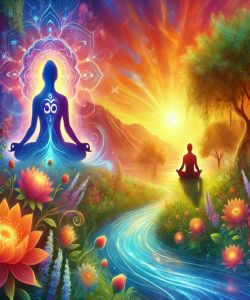
1. Overview of Rajyoga Meditation
Rajyoga Meditation constitutes a formidable and intellectually rigorous discipline aimed at achieving self-sovereignty through the mastery of the mind and intellect. It is imperative to understand that this practice is fundamentally distinct from physical forms of yoga; it does not involve bodily postures, breathing exercises, or mantras. Instead, its entire focus is directed towards the inner world of consciousness. The term 'Rajyoga' itself translates to 'Kingly Union' or 'Supreme Union', signifying its status as a path to attain ultimate control over the self, the inner kingdom of thoughts, feelings, and subconscious imprints. The practitioner learns to dis-identify from the corporeal form and its associated limitations, and to re-establish their identity in the true, eternal nature of the self as a non-physical being of light and consciousness—a soul. This process is not a passive contemplation but an active, directive engagement with one's own consciousness. It necessitates a profound shift in perspective, where the individual ceases to be a slave to external stimuli and internal turbulence, and instead becomes the master of their inner domain. The ultimate objective is to forge a direct, personal connection with the Supreme Source of consciousness, thereby drawing spiritual power and virtue. This connection facilitates a deep-seated transformation, enabling the practitioner to navigate the complexities of life with unwavering stability, clarity, and purpose. It is, therefore, a path of profound self-realisation and empowerment, designed for those who seek not temporary relief but a permanent and fundamental change in their state of being. The discipline is structured, systematic, and predicated on a coherent spiritual philosophy that provides the framework for this transformative inner work, demanding discipline, consistency, and a sincere desire for genuine self-improvement.
2. What are Rajyoga Meditation?
Rajyoga Meditation is a specific and advanced form of mental concentration and spiritual understanding, fundamentally concerned with the nature of the self and its relationship with the Supreme. It operates on the premise that the true identity of a human being is not the physical body but the soul—a sentient, non-physical point of conscious energy located in the centre of the forehead. The practice is, therefore, an exercise in consciousness itself.
Its core components are delineated as follows:
- A Redefinition of Self: The foundational step of Rajyoga is to shift one’s awareness from body-consciousness to soul-consciousness. This involves the deliberate and sustained thought, "I am a peaceful soul," separate and distinct from the physical machine I operate. It is an intellectual and experiential process of detaching one's identity from temporary labels such as nationality, profession, or relationships, and anchoring it in the eternal reality of the soul.
- The Concept of the Supreme Soul: Rajyoga posits the existence of a single, incorporeal Supreme Soul, a benevolent source of all positive attributes such as peace, love, and power. This being is considered the eternal parent of all souls. Meditation in this context is the act of directing one’s thoughts towards this Supreme Source in a focused and loving remembrance.
- The Law of Karma: The practice is underpinned by a precise understanding of the law of cause and effect. It asserts that every thought, word, and action creates a corresponding return. Rajyoga empowers the individual to become the master of their destiny by creating elevated and pure thoughts, thereby generating positive karma and neutralising past negative accounts.
- The World Drama Cycle: It presents a unique perspective on time, viewing it as a cyclical drama in which souls play their preordained parts. Understanding this cycle provides context for one's life journey and fosters a state of detachment and acceptance, viewing life's events as scenes in a vast, unfolding play. Rajyoga is thus a complete philosophical framework for self-mastery.
3. Who Needs Rajyoga Meditation?
- Individuals who are fundamentally dissatisfied with transient, material solutions for happiness and are actively seeking a source of lasting inner peace and contentment. This practice is designed for those who have concluded that external achievements and possessions are incapable of providing sustained fulfilment and are ready to embark upon a rigorous journey of internal discovery to reclaim their innate stability.
- Professionals and leaders operating in high-stress, demanding environments who require superior mental clarity, emotional resilience, and enhanced decision-making capabilities. The discipline equips them to manage pressure, maintain composure in the face of adversity, and lead with wisdom and integrity, detached from the influence of ego or emotional reactivity.
- Persons grappling with existential questions regarding their purpose, identity, and the meaning of life and death. Rajyoga provides a coherent, logical, and profound spiritual framework that addresses these fundamental enquiries, offering definitive answers that empower the individual with a clear sense of self and a purposeful direction for their life.
- Those who aspire to achieve absolute self-mastery and exercise complete sovereignty over their own minds, thoughts, and emotions. It is for the individual who is unwilling to remain a victim of their own moods, habits, and negative thought patterns, and who possesses the determination to become the directive force in their inner world.
- Individuals seeking to heal and improve their relationships, whether personal or professional. By transforming the self from a state of neediness and expectation to one of self-sufficiency and spiritual generosity, the practice enables the creation of harmonious, respectful, and genuinely loving interactions based on a foundation of soul-consciousness.
- Anyone who feels debilitated by anger, fear, anxiety, or attachment and is resolute in their desire to overcome these deep-seated weaknesses. Rajyoga provides the specific spiritual tools and power necessary to confront and systematically eradicate these negative traits, replacing them with the soul’s original virtues of peace, love, and fearlessness.
4. Origins and Evolution of Rajyoga Meditation
The origins of Rajyoga Meditation are asserted to be timeless, rooted in the primordial knowledge of the self that has existed eternally. The term 'Rajyoga' itself, meaning 'Kingly Yoga', has been referenced in ancient spiritual scriptures, where it was distinguished as the supreme path to self-realisation, focusing on the mind's dominion rather than physical austerities. Historically, it was regarded as an esoteric and profound knowledge, often reserved for those who had renounced the world in search of ultimate truth. It was a discipline of internal governance, a method by which the soul could reclaim its inherent sovereignty over the senses and the intellect, thereby achieving liberation from the bondage of material existence. This ancient wisdom, however, was largely lost or obscured over time, becoming fragmented and often misinterpreted, losing its practical, accessible methodology for the common individual.
The modern evolution and global promulgation of Rajyoga Meditation are inextricably linked to its re-emergence in the 1930s. It was at this juncture that the knowledge was systematised into a clear, accessible, and practical form that could be understood and applied by people from all walks of life, without the need for asceticism or renunciation. This modern interpretation preserved the philosophical profundity of the original teachings but translated them into a structured curriculum. The core tenets—the nature of the soul, the Supreme Soul, the law of karma, and the world cycle—were clarified and presented as a cohesive body of knowledge that could be studied and experienced directly.
This marked a pivotal shift from an obscure, ancient concept to a living, practical discipline. The evolution continued as this knowledge began to spread globally from the mid-20th century onwards. The methodology was adapted for a worldwide audience, transcending cultural, religious, and national boundaries. The establishment of teaching centres across the globe facilitated a consistent and standardised dissemination of the practice. The most recent phase of its evolution has been its adaptation to digital platforms, making the knowledge and guided practice available online. This has further democratised its accessibility, ensuring that this formidable tool for self-transformation is available to any individual with the will to learn, irrespective of their geographical location, thereby fulfilling its purpose as a universal spiritual science.
5. Types of Rajyoga Meditation
While Rajyoga is a singular, integrated discipline, its practice can be categorised into distinct stages or applications, each with a specific focus and objective. These are not separate "types" in the conventional sense, but rather progressive and complementary facets of a unified practice.
- Foundational Meditation (Self-Awareness Practice): This is the initial and most critical application of Rajyoga. Its sole purpose is to establish the practitioner in a stable state of soul-consciousness. The technique involves consciously withdrawing attention from the external world and the physical body, and focusing the mind on the conceptual point of the self as a soul—a non-physical, sentient point of light located in the forehead. This practice is characterised by the creation of affirmative thoughts such as "I am a soul, a being of peace." It is the bedrock upon which all other aspects of the meditation are built, as without this stable self-awareness, no further connection is possible.
- Meditative Study (Gyan Murli): This is a unique and integral aspect of Rajyoga, where meditation is combined with the intellectual assimilation of spiritual knowledge. Practitioners engage in the contemplative study of sacred teachings, allowing the profound concepts to penetrate the intellect and reshape their understanding of reality. It is an active form of meditation where the mind is disciplined to focus on divine knowledge, turning study itself into a powerful yogic practice. This process purifies the intellect and provides the philosophical clarity required for deep, experiential meditation.
- Experiential Meditation (Union with the Supreme): This is the ultimate aim of the practice, often considered the pinnacle of Rajyoga. Having stabilised in soul-consciousness, the practitioner then directs their thoughts upward, in a focused and loving remembrance of the Supreme Soul. This is not a petitionary prayer but a silent, mental communion. The objective is to forge a direct, personal relationship and experience a flow of divine energy, virtues, and powers from the Supreme Source. This meditative connection recharges the soul and purifies its subconscious traits.
- Karma Yoga (Meditation in Action): This advanced application involves maintaining a state of soul-consciousness and connection with the Supreme while engaged in everyday worldly activities. It is the practical test of one's meditative prowess. The aim is to perform actions without attachment to their outcome, free from the influence of ego, stress, or negativity. By performing actions from this elevated state of awareness, the practitioner transforms work into worship and ensures that every action is a positive, karmically pure creation.
6. Benefits of Rajyoga Meditation
- Profound Stress and Anxiety Eradication: The practice provides a systematic method for detaching from the sources of mental turmoil. By identifying as the soul, separate from life’s problems, the practitioner gains an immediate and powerful perspective that neutralises the impact of external pressures. This is not mere management but a fundamental dissolution of the root causes of stress.
- Enhanced Mental Clarity and Decisive Intellect: Rajyoga sharpens the intellect (buddhi) by purifying it of emotional bias and mental clutter. This results in a superior ability to analyse situations objectively, make swift and accurate decisions, and maintain focus without distraction. The mind ceases to be a chaotic storm and becomes a precise and powerful instrument.
- Cultivation of Innate Virtues: The connection with the Supreme Soul acts as a conduit for divine qualities. The practitioner systematically imbibes and manifests the original virtues of the soul—peace, purity, love, happiness, and power. Negative traits such as anger, greed, and ego are progressively weakened and ultimately replaced by these inherent strengths.
- Mastery Over Thoughts and Emotions: The practitioner learns to be the creator and director of their own thoughts, rather than a victim of them. This engenders supreme emotional stability. Moods and feelings cease to be reactive and instead become conscious choices, leading to a state of unwavering inner composure regardless of external circumstances.
- Improved Interpersonal Relationships: By viewing oneself and others as souls, relationships are transformed. Interactions become based on mutual respect and spiritual love, free from expectation, dependency, and conflict. The practitioner becomes a positive, stabilising influence on their family, workplace, and community.
- Spiritual Empowerment and Self-Realisation: The ultimate benefit is the attainment of self-sovereignty. The practitioner realises their true, eternal identity and their intrinsic worth. This deep self-realisation brings an end to the search for external validation and fills the individual with a sense of purpose, dignity, and inner power that is unshakeable.
- Freedom from Habitual and Addictive Behaviours: The spiritual power gained through the practice provides the necessary willpower to break free from negative habits and addictions. By strengthening the soul and clarifying the intellect, the individual is empowered to overcome dependencies that previously held them captive.
7. Core Principles and Practices of Rajyoga Meditation
- The Principle of Soul-Consciousness: The absolute foundation of Rajyoga is the understanding and experience of the self as a soul—an infinitesimal, non-physical point of sentient energy. The primary practice is to consciously shift identity away from the perishable body and its associated labels (gender, role, nationality) to this eternal, true self. This is achieved through the disciplined creation of thoughts affirming this identity, such as "I am a peaceful soul."
- The Principle of God-Consciousness (The Supreme Soul): The discipline posits a single, incorporeal Supreme Being, the Supreme Soul, who is the eternal source of all virtues and power, and the spiritual parent of all souls. A core practice is to establish a direct, mental, and loving connection with this Being. This remembrance (yaad) is not supplication but a silent communion, an alignment of consciousness that allows the individual soul to draw power and purity from the Supreme Source.
- The Inviolable Law of Karma: Rajyoga operates on a precise understanding that every thought, word, and action is a seed that will inevitably bear fruit. There is no escape from the consequences of one's creations. The practice, therefore, is to become a master of the creative process, consciously choosing to generate only elevated, positive, and benevolent thoughts and actions, thereby creating a superior destiny and settling past karmic accounts.
- The Concept of the World Drama Cycle (Kalpa): This principle provides a cosmic perspective, viewing time as a finite, 5000-year cycle that repeats identically. Souls descend from a state of purity into matter, playing their unique roles throughout the cycle. This understanding fosters a state of profound detachment (sakshi-bhav), allowing the practitioner to view life's events as scenes in a grand, predestined play, thereby freeing them from worry and anxiety about the past or future.
- The Practice of Purity (Pavitrata): Purity is held as the mother of peace and happiness. This principle extends beyond physical celibacy, which is a requirement for dedicated practitioners, to encompass purity in thoughts, words, vision, and actions. The practice is to maintain a consciousness free from negativity, vice, and waste thoughts, thereby preserving spiritual energy and facilitating a clear connection with the Supreme.
- The Imperative of Spiritual Service (Seva): The knowledge and power gained through Rajyoga are not for personal aggrandisement but are to be used for the upliftment of humanity. The practice of service involves sharing this spiritual wisdom and radiating vibrations of peace and power into the world. True service is performed in a state of egolessness and unconditional benevolence, considering it a duty to help other souls awaken to their own inner truth.
8. Online Rajyoga Meditation
The provision of Rajyoga Meditation through an online modality represents a strategic adaptation of ancient wisdom to the imperatives of the modern world. It is not a diluted version of the practice but a structured, facilitated delivery method with distinct and powerful advantages.
- Unrestricted Global Accessibility: The primary and most formidable benefit of the online format is its complete disregard for geographical constraints. It provides immediate access to this profound spiritual education for any individual on the planet who possesses a digital connection. This democratises the knowledge, making it available to those in remote locations or regions without physical teaching centres, thereby fulfilling its mission as a universal discipline.
- A Structured and Consistent Curriculum: Online courses are meticulously structured to ensure a coherent and logical progression of learning. Modules are presented in a standardised format, guaranteeing that every participant receives the same core teachings and foundational principles, regardless of the facilitator. This maintains the integrity and purity of the knowledge being imparted and provides a reliable, systematic path for the student.
- Provision of Anonymity and Personal Space: The online environment offers a degree of privacy and anonymity that can be highly conducive to the initial stages of spiritual exploration. Individuals may feel more comfortable confronting personal weaknesses or asking fundamental questions from the security of their own private space, free from the perceived judgement of a group. This allows for a more honest and introspective engagement with the material.
- Flexible and Disciplined Learning: While offering flexibility in terms of location, online Rajyoga demands a high degree of self-discipline. The practitioner is solely responsible for creating a conducive learning environment, free from domestic or digital distractions. This in itself is a powerful exercise in self-mastery, compelling the individual to take command of their surroundings and commit fully to the scheduled session. The structure of scheduled, facilitated sessions ensures accountability and momentum.
- Direct Access to Experienced Facilitators: High-quality online courses are not passive, pre-recorded lectures. They are live, interactive sessions led by experienced and long-standing practitioners of Rajyoga. This provides participants with the invaluable opportunity to receive guidance, ask direct questions, and benefit from the wisdom and experiential authority of a seasoned teacher, ensuring a supported and authentic learning journey.
9. Rajyoga Meditation Techniques
The practical application of Rajyoga Meditation follows a systematic, step-by-step process designed to shift consciousness from the external to the internal, and ultimately, to the transcendental. It is an active and directive mental exercise.
- Step One: Preparation of the Environment and Posture: Select a time and place where interruptions are impossible. The external environment must be quiet and calm to support internal stillness. Sit in a comfortable and relaxed posture, with the back straight but not rigid. The imperative is to adopt a position that can be maintained without physical distraction or discomfort. The eyes must remain open; this is a meditation of conscious awareness, not a trance or sleep state.
- Step Two: The Practice of Conscious Detachment: Begin the process of withdrawing your attention from the external world. Consciously instruct your mind to detach from the sounds around you and from the sensations of the physical body. Acknowledge the body as a vehicle or an instrument you are using, but assert your identity as separate from it. You are the driver, the operator of the machine, not the machine itself.
- Step Three: Affirmation of the True Self (Soul-Consciousness): This is the pivotal step. Begin to create a focused stream of thoughts about your true nature. Concentrate your awareness in the centre of your forehead, the seat of the soul, and generate the core thought: "I am a soul. I am a subtle, non-physical point of conscious light." Repeat and deepen this thought, exploring its implications. Visualise yourself as this star of energy, distinct from the physical form.
- Step Four: Contemplation on Original Qualities: Once stabilised in the awareness of being a soul, contemplate your innate, original qualities. Create thoughts such as: "My original nature is peace. I am a peaceful soul." "I am a being of love." "I am a powerful soul." This is not an empty affirmation but a process of re-awakening and experiencing these dormant, eternal virtues.
- Step Five: Establishing the Connection (Remembrance of the Supreme): From this stable platform of soul-consciousness, gently turn your thoughts upward, towards the Supreme Soul. Visualise this being as a supreme, benevolent Point of Light, a source of infinite peace, love, and power, residing in a dimension beyond the physical world. This is not an act of straining but a simple, loving remembrance, like a child turning their thoughts to a beloved parent.
- Step Six: Absorption and Sustenance: In this state of connection, remain silent and receptive. The objective is to absorb the vibrations and qualities emanating from the Supreme Source. Focus on experiencing the flow of peace, power, and purity into your being, recharging the soul. The technique is to keep the mind focused in this single, elevated thought of connection, gently bringing it back whenever it wanders.
- Step Seven: Gradual Return to Awareness: After the period of meditation, do not abruptly return to activity. Gradually bring your awareness back to your physical surroundings. Carry the peace and power experienced in meditation into your first thoughts and actions, ensuring a seamless transition from inner contemplation to outer engagement.
10. Rajyoga Meditation for Adults
Rajyoga Meditation is a discipline uniquely suited to the adult mind, addressing the specific challenges and existential inquiries that arise with maturity and life experience. For adults, life is no longer a theoretical construct but a complex reality, often characterised by immense responsibilities, professional pressures, relational dynamics, and a confrontation with one's own ingrained habits and limitations. The practice offers not a palliative escape but a robust, pragmatic toolkit for navigating this complexity with authority and grace. It directly confronts the weariness and disillusionment that can accumulate over years of striving, offering a logical and profound framework for understanding one's journey and purpose. The adult intellect, having been honed by experience, is capable of grasping the deep philosophical principles of karma, time, and consciousness that underpin the practice. It is not a path of blind faith but one of intellectual conviction followed by experiential validation. Furthermore, adults often seek more than mere relaxation; they seek genuine transformation. They have a clearer perception of their own character flaws—be it anger, anxiety, or ego—and are more motivated to find a definitive method for overcoming them. Rajyoga provides this method, empowering the individual to systematically dismantle negative 'sanskars' (subconscious traits) and replace them with their original, positive virtues. It is a mature path for those who are ready to take absolute responsibility for their inner state and to become the sovereign rulers of their own consciousness, transforming from a reactive being shaped by circumstance into a proactive creator of their own peace and destiny.
11. Total Duration of Online Rajyoga Meditation
The standard, foundational unit for a single session of an online Rajyoga Meditation course is rigorously structured to be exactly one hour. This duration is not arbitrary; it has been determined with pedagogical precision to be the optimal timeframe for effective spiritual learning and practice in a digital environment. A period of 1 hr allows sufficient time for a comprehensive and unhurried exploration of one of the core philosophical principles of the discipline. It provides the necessary space for a detailed explanation by the facilitator, interactive questions and answers to ensure clarity, and, most critically, a dedicated segment for guided meditative practice. This allows the participant to move directly from intellectual understanding to experiential application within the same session. A duration shorter than this would necessitate a superficial treatment of the profound subjects involved, while a significantly longer period risks mental fatigue and a decline in the participant’s ability to maintain the high level of concentration required. The one-hour structure respects the demands on the modern individual’s time while being substantial enough to facilitate genuine insight and a tangible experience of peace and inner power. It is a contained, powerful, and complete unit of spiritual work, designed for maximum impact and assimilation.
12. Things to Consider with Rajyoga Meditation
Before embarking upon the path of Rajyoga Meditation, it is imperative to approach it with the correct understanding and a realistic appraisal of what it demands. This is not a casual hobby or a quick-fix relaxation technique to be sampled intermittently; it is a profound and disciplined spiritual science that necessitates a serious and sustained commitment. The practitioner must be prepared for a fundamental paradigm shift in their understanding of self, reality, and purpose. This can be intellectually and emotionally challenging, as it requires the dismantling of long-held, ego-based beliefs and identities. One must consider their readiness to engage in rigorous self-observation and to confront the deeper, often uncomfortable, aspects of their own character. The practice demands unwavering consistency; sporadic efforts will yield negligible results. A daily commitment to both study and meditation is non-negotiable for tangible progress. Furthermore, one must understand that the goal is not merely to feel calm for a few moments but to achieve a permanent transformation of character. This process requires immense patience and perseverance, as deep-seated negative traits are not eradicated overnight. It is a marathon, not a sprint. The potential practitioner must honestly assess their willingness to adopt the lifestyle disciplines that support the meditation, particularly with regard to purity in thought, which is the cornerstone of the practice. It is a path for the determined and the courageous, for those who are truly ready to take absolute responsibility for their inner world.
13. Effectiveness of Rajyoga Meditation
The effectiveness of Rajyoga Meditation is absolute and demonstrable, yet it is entirely contingent upon the sincerity, discipline, and consistency of the practitioner. Its efficacy is not a matter of subjective belief but is proven through tangible and observable transformations in an individual's character, disposition, and quality of life. The practice works by systematically addressing the root cause of all human suffering: the mistaken identification of the self with the physical body and the external world. By rectifying this fundamental error and re-establishing the practitioner in the consciousness of the soul, a profound and positive chain reaction is initiated. The immediate effect is a marked reduction in mental and emotional turbulence. Anger, fear, and worry lose their grip as the individual learns to observe life from a detached, soul-conscious perspective. The intellect becomes clear and decisive, freed from the fog of emotional reactivity. Over time, this results in improved relationships, as interactions become based on spiritual respect rather than on need or expectation. The effectiveness is further measured by the individual’s increased capacity to handle crises and adversity with unwavering stability and inner calm. The ultimate proof of its effectiveness, however, lies in the attainment of self-sovereignty—a state where the individual is no longer a slave to their senses, habits, or circumstances, but is the undisputed master of their inner kingdom. This is not a theoretical goal but a practical, achievable state of being for those who apply the principles with rigour and integrity.
14. Preferred Cautions During Rajyoga Meditation
It is imperative that the practice of Rajyoga Meditation be undertaken with a clear and disciplined mind, adhering to specific cautions to prevent misinterpretation and ensure genuine progress. Firstly, one must guard against the insidious trap of spiritual ego. As one begins to experience peace and power, there is a significant risk of developing a sense of superiority over others. This must be actively and ruthlessly counteracted by cultivating genuine humility and recognising that all souls possess the same intrinsic value. Secondly, this discipline must never be mistaken for a mere relaxation technique or a tool for selfish gain, such as enhancing worldly performance for material ends. Its purpose is profound self-purification and world service, and to use it for lesser aims is to defile its integrity and halt spiritual progress. Practitioners must be cautioned against impatience and the demand for instant results. The purification of deep-seated subconscious traits is a gradual and methodical process; expecting overnight miracles leads only to disillusionment. Furthermore, one must avoid the pitfall of intellectualism, where the knowledge is accumulated as a collection of interesting concepts but is not applied in practice. The philosophy is a map, not the destination; its value is realised only through the diligent, practical application of meditation and the transformation of one's own character and behaviour. Lastly, do not engage in the practice mechanically. It must be a heartfelt, conscious engagement, a loving communion with the Supreme, not a dull, repetitive chore. A lack of sincerity will render the practice inert.
15. Rajyoga Meditation Course Outline
The foundational course in Rajyoga Meditation is a systematic and logical progression of spiritual knowledge designed to build a comprehensive framework for self-realisation.
Module One: Introduction to the Self - The Consciousness of the Soul:
Defining the self as a non-physical, sentient point of light (the soul).
Differentiating between the soul (the driver) and the body (the vehicle).
Exploring the faculties of the soul: mind, intellect, and subconscious traits (sanskars).
Practical meditation exercise to experience the state of soul-consciousness.
Module Two: The Supreme Source - Understanding God Consciousness:
Introduction to the concept of the Supreme Soul as a single, incorporeal entity.
Defining the attributes and role of the Supreme as the ultimate source of peace, love, and power.
Clarifying the relationship between the individual soul and the Supreme Soul.
Practical meditation to establish a mental connection with the Supreme Source.
Module Three: The Law of Action and Consequence - The Philosophy of Karma:
A detailed examination of the inviolable law of karma.
Understanding the three types of karma: action, neutral action, and sinful action.
Learning how to create positive karma through elevated thoughts and actions.
The methodology for neutralising past negative karmic accounts through yogic power.
Module Four: The Cycle of Time - The World Drama:
Introducing the concept of the 5000-year cyclical nature of time.
The journey of the soul through the different ages of the cycle (Golden, Silver, Copper, Iron).
Understanding one's own role within this vast cosmic play.
Cultivating the attitude of a detached observer (sakshi) to life’s events.
Module Five: The Original Qualities of the Soul - A Return to Virtue:
Identifying the seven primary, innate virtues of the soul: peace, purity, love, happiness, knowledge, bliss, and power.
Understanding how these virtues become dormant and are replaced by vices.
Practical meditation techniques to re-awaken and emerge these original qualities.
Module Six: The Method of Rajyoga - A Lifestyle of Meditation:
Integrating all previous concepts into a coherent daily practice.
Guidance on establishing a disciplined routine for meditation and contemplative study.
The principles of a yogic lifestyle that supports the meditative state.
Introduction to the concept of Karma Yoga: maintaining awareness in action.
16. Detailed Objectives with Timeline of Rajyoga Meditation
The progression through Rajyoga Meditation follows a structured timeline with clear objectives at each phase, moving from conceptual understanding to embodied reality.
Initial Phase (First Week of Study):
Objective: To achieve a firm intellectual conviction in the core concepts of the self as a soul and the existence of the Supreme Soul. The practitioner must be able to articulate these principles clearly and begin the initial, guided practice of differentiating self from body.
Timeline Benchmark: By the end of the first few sessions, the practitioner should be able to hold the thought "I am a soul" for brief, stable periods during meditation without significant mental distraction.
Foundational Phase (First to Third Month):
Objective: To establish a non-negotiable daily discipline of both early morning meditation and contemplative study. The focus is on moving from intellectual agreement to the beginning of genuine experience. The practitioner's primary goal is to begin consciously observing their own thoughts and speech throughout the day, catching negative or waste thoughts before they gain momentum.
Timeline Benchmark: Within this period, a noticeable reduction in reactive anger and an increased sense of inner calm during stressful situations should become apparent. The experience of peace during meditation should become more frequent and tangible.
Consolidation Phase (Three to Twelve Months):
Objective: To deepen the experiential connection with the Supreme Soul, feeling a tangible flow of power and purity during meditation. The understanding of the law of karma and the world cycle should be fully integrated, leading to a profound state of detachment and acceptance in daily life. The practice of purity in thought must become a primary focus.
Timeline Benchmark: By the end of the first year, the practitioner should have established mastery over at least one significant negative trait. Relationships should show marked improvement, and the ability to remain stable amidst chaos should be a consistent reality.
Advanced Phase (One Year and Beyond):
Objective: To achieve a state of effortless soul-consciousness, where awareness of the true self is the natural and default state of being. The practitioner aims to become a 'Karma Yogi', performing all actions in a state of elevated awareness and connection. The objective shifts from personal transformation to world service, radiating powerful vibrations of peace and purity into the environment.
Timeline Benchmark: This is an ongoing state of mastery. Success is measured by the ability to remain completely unshakeable and to be a constant source of spiritual strength and stability for others, embodying the virtues of the soul in every thought and action.
17. Requirements for Taking Online Rajyoga Meditation
To engage effectively with an online Rajyoga Meditation course, a specific set of practical and attitudinal requirements must be met. These are not suggestions but prerequisites for a successful and authentic learning experience.
- Reliable Technological Infrastructure: The participant must possess a stable, high-speed internet connection and a functional digital device (computer, laptop, or tablet) equipped with a working camera and microphone. Inconsistent connectivity or faulty equipment will disrupt the learning process for both the individual and the group, and is therefore unacceptable.
- A Sanctified and Private Environment: It is mandatory to participate from a location that is completely private, silent, and free from any potential interruptions. This is not a casual webinar to be observed amidst household chores or office work. The space must be treated as a sacred classroom for the duration of the session to facilitate deep concentration.
- Unyielding Punctuality and Commitment: Attendance at all scheduled sessions is obligatory. Participants must log in several minutes prior to the designated start time to ensure they are ready when the session commences. This demonstrates respect for the facilitator and fellow participants and is fundamental to the discipline of the course. A commitment to completing the entire course is expected.
- An Open and Receptive Intellect: The participant must approach the course with a mindset devoid of prejudice and preconceived notions. A willingness to listen, learn, and contemplate profound spiritual concepts is essential. The intellect must be open to a radically different paradigm of reality, without immediately resorting to cynicism or debate.
- The Discipline of Active Participation: This is not a passive learning experience. Participants are required to engage fully, which includes enabling their camera to foster a sense of collective presence and accountability. They must be prepared to participate in discussions when invited and to apply themselves with full concentration during the guided meditation practices.
- Sincere Intention for Self-Transformation: The most critical requirement is a genuine and resolute desire for profound personal change. The course is intended for individuals who are serious about spiritual progress and are prepared to undertake the rigorous inner work required. A motive of mere curiosity is insufficient.
18. Things to Keep in Mind Before Starting Online Rajyoga Meditation
Before commencing an online Rajyoga Meditation course, it is crucial to internalise the understanding that the digital format, while convenient, places an even greater onus of discipline and responsibility squarely upon the practitioner. One must rigorously disabuse oneself of the notion that this is a passive form of content consumption. The screen is merely a conduit for the knowledge; the actual laboratory for the practice is one's own consciousness, and the work is entirely internal. You must be prepared to become the master of your own environment, proactively creating a sanctuary for learning that is impervious to the distractions endemic to a home or office setting. This requires a level of self-governance far exceeding that of an in-person class, where the environment is provided for you. Acknowledge that the anonymity of the online space can be a double-edged sword; while it may offer initial comfort, it can also foster a lack of accountability. You must therefore resolve to engage with absolute sincerity and integrity, as if you were in the physical presence of the facilitator. It is essential to approach each session not as a detached observer but as an active participant in a profound process of self-discovery and transformation. The commitment must be unwavering, as the temptation to miss a session or become distracted is significantly higher in a remote setting. Your success will be directly proportional to the seriousness and discipline you bring to each and every session.
19. Qualifications Required to Perform Rajyoga Meditation
The practice of Rajyoga Meditation is, at its core, universally accessible and requires no formal academic, religious, or social qualifications from the individual who wishes to learn and apply it for their own self-improvement. The sole prerequisites are a functioning intellect capable of understanding the concepts and a sincere desire for inner transformation. However, the qualifications required to teach or facilitate this profound spiritual knowledge for others are exceptionally stringent and non-negotiable. It is a position of immense responsibility that cannot be self-appointed. An authorised facilitator of Rajyoga Meditation must meet the following exacting standards:
- Extensive and Deep Personal Practice: A teacher must have been a dedicated and consistent practitioner of Rajyoga for many years, not months. They must have a deep, experiential understanding of the principles, having applied them rigorously in their own life to achieve a significant degree of self-mastery and inner stability.
- Complete Assimilation of the Philosophy: The facilitator must possess a comprehensive and nuanced command of the entire body of knowledge. They must be able to articulate the concepts with absolute clarity, precision, and authority, and to answer questions from a place of deep, lived understanding, not mere intellectual repetition.
- Adherence to a Disciplined and Pure Lifestyle: A teacher of Rajyoga must embody the principles they espouse. This necessitates adherence to a disciplined, pure lifestyle, including the observance of celibacy, a sattvic (pure vegetarian) diet, and a commitment to early morning meditation. Their life must be a practical demonstration of the teachings.
- Authorisation by a Recognised Institution: Crucially, a legitimate teacher of Rajyoga Meditation as it is taught today must be trained and authorised by the Brahma Kumaris World Spiritual University, the organisation that is the custodian of this specific body of knowledge. This ensures that the teaching is standardised, authentic, and maintains its integrity.
20. Online Vs Offline/Onsite Rajyoga Meditation
A clear distinction must be made between the two primary modalities through which Rajyoga Meditation is taught, as each offers a different experience and set of demands.
Online
The online delivery of Rajyoga Meditation is defined by its supreme accessibility and convenience. It eradicates all geographical barriers, allowing any individual with an internet connection to access the foundational teachings from anywhere in the world. This format offers a degree of privacy and anonymity which can be beneficial for those initially hesitant to engage in a group setting. The structured, modular nature of online courses ensures a consistent and standardised curriculum. However, this modality places a significant demand on the individual’s self-discipline. The practitioner is solely responsible for creating and maintaining a quiet, interruption-free environment conducive to deep concentration. They must actively combat the myriad digital and domestic distractions that are absent in a dedicated centre. The online experience, while facilitated, is fundamentally a more solitary journey that requires a high degree of personal motivation and accountability. The energetic atmosphere of a collective is experienced through a digital medium, which is powerful but inherently different from physical co-presence.
Offline/Onsite
The offline, or onsite, experience of learning Rajyoga Meditation at a physical centre is characterised by its immersive and potent environment. The greatest advantage is the power of the collective atmosphere, or 'sakaash'. Meditating in a room with other focused individuals and an experienced teacher creates a powerful field of concentrated, pure vibrations that can significantly deepen and accelerate one's own practice. Direct, face-to-face interaction with a long-standing practitioner allows for nuanced guidance, subtle corrections, and a level of personal connection that is difficult to replicate online. The physical centre is a purpose-built sanctuary, completely free from the distractions of the outside world, allowing the student to focus entirely on the inner work at hand. This environment inherently fosters a greater sense of community and shared purpose. The commitment required to physically travel to a centre also reinforces the seriousness of the undertaking. The primary limitation is, of course, geographical accessibility, as one must be located near a physical centre to benefit from this modality.
21. FAQs About Online Rajyoga Meditation
Question 1. Is this a religion? Answer: No. Rajyoga is a spiritual science and a discipline of self-mastery. It is open to people of all faiths and none, as it deals with the universal identity of the self as a soul.
Question 2. Do I need any prior meditation experience? Answer: No. The foundational online course is designed for absolute beginners. All that is required is an open mind and a sincere desire to learn.
Question 3. Must I sit on the floor? Answer: No. You are required to sit comfortably on a chair, with your back straight, to ensure physical comfort does not distract you from the mental exercise.
Question 4. Do I have to close my eyes? Answer: No. Rajyoga is practised with the eyes open. This is to remain in a state of conscious awareness and to practise mastery over the senses, not to withdraw from the world into a trance.
Question 5. Is there any chanting or mantras? Answer: No. This meditation is entirely silent and thought-based. It involves directing your own thoughts in a focused and positive way.
Question 6. What if my mind wanders? Answer: This is normal. The technique involves gently and persistently bringing the mind back to the chosen thought. Discipline is built through this consistent practice.
Question 7. Must I become a vegetarian? Answer: While a pure, vegetarian diet is highly recommended as it supports mental clarity, it is not a mandatory prerequisite for taking the initial online course.
Question 8. Is the online course live or pre-recorded? Answer: Authentic courses are conducted live by an experienced facilitator to allow for interaction, questions, and a collective, focused energy.
Question 9. What is the main difference from mindfulness? Answer: Mindfulness focuses on non-judgmental awareness of the present moment. Rajyoga is more directive; it involves creating specific, elevated thoughts and establishing a connection with a Supreme Source.
Question 10. Will I have to speak or share personal things? Answer: Participation is encouraged, but you will never be forced to share personal information. You control your level of interaction.
Question 11. How long until I see results? Answer: Some experience a sense of peace in the very first session. Lasting transformation, however, is directly proportional to the consistency and sincerity of your personal practice.
Question 12. Is it connected to the physical postures of Hatha Yoga? Answer: No. There is absolutely no connection. Rajyoga is an exclusively mental and intellectual discipline.
Question 13. Can I practice while lying down? Answer: No. Lying down is associated with sleep and relaxation. Sitting upright is required to maintain a state of alert, conscious concentration.
Question 14. Do I need to change my lifestyle immediately? Answer: The primary change is the addition of a daily meditation practice. Other lifestyle refinements are adopted gradually as your own understanding and experience grow.
Question 15. Is there any physical exertion involved? Answer: None whatsoever. The entire effort is mental and intellectual.
Question 16. Is this a form of hypnosis? Answer: Absolutely not. Rajyoga increases self-awareness and self-control, whereas hypnosis induces a state of reduced awareness and increased suggestibility. You remain fully conscious and in charge.
22. Conclusion About Rajyoga Meditation
In conclusion, Rajyoga Meditation stands as a pre-eminent and formidable discipline for the attainment of absolute self-sovereignty. It must be unequivocally understood not as a fleeting technique for relaxation, but as a complete and coherent spiritual science that provides a definitive path to inner mastery. The practice demands a fundamental and courageous shift in identity—from the finite, perishable body to the eternal, indestructible soul. This is not a matter for philosophical debate but a practical, experiential reality to be achieved through rigorous mental discipline. The principles of soul-consciousness, supreme connection, karma, and the world cycle form an unshakeable intellectual foundation upon which a transformed life is built. Its methodology is precise, its demands are high, and its results are profound. It is a path for those who have exhausted the superficial remedies offered by the world and seek a permanent solution to the perennial problems of stress, fear, and sorrow. For the individual who is prepared to invest the necessary effort, consistency, and sincerity, Rajyoga Meditation offers the ultimate prize: freedom. It is the freedom from the tyranny of one's own negative thoughts and emotions, freedom from the bondage of past karma, and the ultimate empowerment of becoming the true king of one's own inner kingdom.