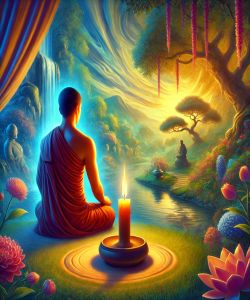
1. Overview of Trataka Meditation
Trataka meditation constitutes a formidable yogic discipline, a Shatkarma (one of the six purification techniques) designed to cleanse the physical and subtle bodies with uncompromising rigour. Its fundamental mechanism involves a fixed, unwavering gaze upon a single point, most iconically a candle flame, to arrest the ceaseless chatter of the mind and channel consciousness into a state of profound one-pointedness. This practice is not a passive observation but an assertive act of mental domination, compelling the restless mind to submit to the will of the practitioner. By systematically training the eyes to remain still, one simultaneously trains the mind, as the two are inextricably linked. The process forces a purification of the optical system and, more significantly, prepares the consciousness for deeper states of Dhyana (meditation) and Samadhi (union). It is a direct and powerful method for stimulating the Ajna chakra, the third eye or centre of intuition, thereby awakening latent psychic and spiritual faculties. Trataka is therefore positioned within yogic science not merely as a concentration exercise but as a critical gateway to higher awareness, demanding absolute discipline, unwavering focus, and a relentless commitment to mastering the inner landscape. It systematically dismantles mental distractions, fortifies willpower, and cultivates an inner stillness that is both potent and resilient. The practice is a testament to the yogic principle that control over the external senses is the foundational step towards achieving ultimate control over the internal self, establishing a state of unshakable mental and spiritual equilibrium. This is not a technique for the faint-hearted but for the serious aspirant dedicated to the path of self-mastery.
2. What is Trataka Meditation?
Trataka meditation is a highly disciplined practice of concentrated gazing, central to the Hatha Yoga tradition. The Sanskrit term ‘Trataka’ translates directly to ‘to gaze’ or ‘to look steadily’, which precisely defines its core activity. It is formally classified as a Shatkarma, one of the six fundamental purification techniques intended to cleanse the body and mind, preparing the practitioner for more advanced spiritual work. The practice mandates fixing one's gaze, without blinking, upon a specific object until tears begin to flow, which is considered a sign of physiological and pranic cleansing.
The process is deceptively simple in its instruction yet profoundly challenging in its execution. The objective extends far beyond mere visual exercise; it is a direct method for achieving Ekagrata, or one-pointed concentration. By stabilising the otherwise constantly moving eyes, the practitioner forces a corresponding stillness upon the mind. The incessant stream of thoughts, known as vrittis in yogic philosophy, is gradually brought to a halt, creating a state of mental vacuum and clarity.
There are two primary forms of this discipline:
- Bahiranga Trataka (External Gazing): This is the foundational stage where the practitioner focuses on an external object. The most traditional object is the flame of a ghee or oil lamp, but other objects such as a black dot on a white wall, a symbol like Om, or the tip of one's nose can be utilised. The purpose is to train the physical eyes and the faculty of concentration.
- Antaranga Trataka (Internal Gazing): This is the advanced stage, undertaken only after mastery of the external form. Here, the practitioner closes their eyes and focuses intently on the after-image of the object held within the Chidakasha, the dark space of consciousness behind the forehead. This internal focus is a powerful tool for awakening the Ajna chakra, the seat of intuition and higher wisdom.
Ultimately, Trataka is a systematic process of withdrawing consciousness from the external world and directing it inward with formidable control.
3. Who Needs Trataka Meditation?
- Individuals afflicted by a lack of mental focus and a perpetually wandering mind. Those who find their attention fragmented and are unable to sustain concentration on a single task will find this discipline corrective and strengthening.
- Practitioners seeking to deepen their meditative states. For those whose progress in meditation is hindered by mental chatter and an inability to achieve profound stillness, Trataka serves as an essential preparatory and a powerful standalone practice.
- Persons experiencing sleep disturbances, including insomnia. The calming effect of Trataka on the pineal gland and the nervous system as a whole can regulate sleep-wake cycles and promote restorative rest.
- Those suffering from mild anxiety, stress, and nervous tension. The practice induces a state of deep calm by pacifying the sympathetic nervous system, providing a potent tool for managing psychological distress.
- Students and professionals whose work demands high levels of concentration and memory recall. The practice directly enhances cognitive functions, sharpens memory, and fortifies the intellectual faculties required for demanding mental labour.
- Individuals aiming to strengthen their willpower and self-discipline. The sheer mental fortitude required to hold an unblinking gaze builds a resilient and commanding will that translates into all other areas of life.
- Spiritual aspirants intent on awakening the Ajna chakra (the third eye). Trataka is one of the most direct and potent methods prescribed in yogic texts for stimulating this energetic centre, the gateway to higher intuition and perception.
- People with weak eyesight or strained eye muscles, subject to professional medical advice. The practice, when performed correctly, can act as a therapeutic exercise for the eyes, improving their function and relieving tension.
- Anyone seeking to improve emotional stability and reduce mental agitation. By stilling the mind, Trataka helps to dissolve negative thought patterns and cultivate a state of inner equilibrium and emotional resilience.
- Individuals who feel disconnected from their inner selves. The introspective nature of the practice facilitates a deeper connection with one's core consciousness, fostering self-awareness and inner clarity.
4. Origins and Evolution of Trataka Meditation
The origins of Trataka meditation are rooted in the ancient and esoteric traditions of Indian Yoga, with its most definitive codification appearing in classical Hatha Yoga texts. The practice is explicitly detailed in the Hatha Yoga Pradipika, a seminal 15th-century Sanskrit manual attributed to Swami Svatmarama. Here, Trataka is listed as one of the Shatkarmas, or six purificatory actions, that are considered essential for preparing the body and mind for the rigours of advanced Raja Yoga. The text describes it as “looking intently with an unwavering gaze at a small point until tears are shed.” This description underscores its dual purpose from the outset: the physiological cleansing of the eyes and the psychological cleansing of a restless mind. Its inclusion as a Shatkarma signifies its importance not as an end in itself, but as a foundational prerequisite for achieving higher states of consciousness.
Prior to its formal documentation in such texts, the principles of concentrated gazing were likely part of more ancient tantric and ascetic practices. The concept of Drishti, or focused gaze, is a common thread running through many yogic disciplines, including asana practice, where a specific gazing point is used to stabilise the body and mind. Trataka can be seen as the ultimate, most intense form of Drishti, isolated and refined into a singular, powerful meditative technique. Its emphasis on the Ajna chakra, the third eye, also connects it to the tantric traditions that mapped the subtle energy body and developed specific techniques to awaken its latent powers. The practice was seen as a direct method to channel prana (life force energy) to this crucial psychic centre, thereby unlocking intuition and transcendental perception.
The evolution of Trataka has seen its transition from the secluded ashrams of ancient yogis to the modern world. Whilst its core principles remain immutable, its application has broadened. Initially a practice for dedicated renunciates, it is now employed by individuals from all walks of life for its tangible benefits on mental health, concentration, and cognitive function. The dissemination of yoga to the West in the 20th century saw Trataka introduced as a key meditative tool. Its modern interpretation often places greater emphasis on its psychological and neurological benefits, supported by contemporary understanding of how focused attention affects brain activity. However, serious practitioners and traditional schools continue to uphold its original, profound purpose: the purification of consciousness and the attainment of unwavering mental mastery as a gateway to spiritual realisation.
5. Types of Trataka Meditation
- Bahiranga Trataka (External Gazing): This is the foundational and most commonly practised form of Trataka. It involves the fixed, unwavering gaze upon a physical object external to the practitioner. The objective is to discipline the physical eyes and, by extension, the mind, training them to remain stable and focused. The practice is performed in a quiet, dimly lit, and draft-free environment to minimise external distractions and prevent the chosen flame from flickering. The chosen object is placed at eye level, approximately an arm's length away. The practitioner gazes at the object intently and without blinking for as long as possible, until the eyes begin to water. After this period of intense focus, the eyes are closed, and the practitioner directs their attention to the after-image that appears in the mental space. This type is a prerequisite for the more advanced internal practice. Common objects include:
- Jyoti Trataka: Gazing at the flame of a candle or a ghee lamp. This is the most classical and highly recommended form, as the flame has a unique quality that holds attention and purifies the visual sense.
- Bindu Trataka: Focusing on a small, single dot, typically black or red, on a white background. This removes the dynamic element of a flame and demands even greater mental control.
- Murti Trataka: Gazing at a picture or statue of a deity or a revered spiritual figure. This adds a devotional element (Bhakti) to the practice of concentration.
- Antaranga Trataka (Internal Gazing): This is the advanced and more subtle form of the practice, which should only be attempted after considerable proficiency in Bahiranga Trataka has been achieved. In Antaranga Trataka, there is no external object of focus. The practitioner closes their eyes and directs their unwavering gaze towards a point or image visualised internally, within the Chidakasha (the space of consciousness perceived behind the closed eyes, often associated with the forehead). This may be the residual after-image from an external gazing session, or it could be a self-generated image, symbol, or point of light. This practice requires a significantly higher degree of mental control and concentration, as the mind must create and sustain the object of focus without any external support. Its primary purpose is the direct and potent stimulation of the Ajna chakra, leading to the development of intuition, psychic clarity, and deeper states of meditation. It is considered a direct bridge between Dharana (concentration) and Dhyana (meditation).
6. Benefits of Trataka Meditation
- Enhancement of Concentration: The practice directly trains the mind to maintain a single point of focus, systematically dismantling the habit of mental wandering and building formidable powers of concentration.
- Fortification of Willpower: The discipline required to hold a steady, unblinking gaze against the body's natural impulses cultivates immense mental fortitude and strengthens the practitioner's will.
- Improvement of Memory and Cognitive Function: By calming the mind and improving focus, Trataka enhances the brain's ability to retain and recall information, leading to a marked improvement in overall cognitive performance.
- Alleviation of Mental Agitation: It serves as a powerful antidote to anxiety, stress, and mental turbulence by inducing a state of deep calm and bringing the nervous system into a state of equilibrium.
- Stimulation of the Ajna Chakra: The practice is a direct and potent method for awakening the third eye, the energetic centre associated with intuition, insight, and higher perception.
- Therapeutic for the Eyes: When performed correctly, Trataka strengthens the ocular muscles, improves blood circulation to the eyes, and can help correct minor visual defects through its cleansing and toning action.
- Promotion of Quality Sleep: It has a profoundly calming effect on the mind and regulates the function of the pineal gland, which is responsible for melatonin production, thereby aiding in the treatment of insomnia and improving sleep quality.
- Cultivation of Inner Stillness: The cessation of eye movement leads to a corresponding cessation of mental activity, allowing the practitioner to experience a profound state of inner silence and peace.
- Increased Self-Awareness: The introspective nature of the practice, particularly internal Trataka, fosters a deeper connection with the inner self, leading to greater self-understanding and clarity.
- Balancing of the Nervous System: By engaging the parasympathetic nervous system, Trataka counteracts the effects of chronic stress, leading to a more balanced and resilient physiological and psychological state.
- Purification of Latent Impressions (Samskaras): The intense focus and subsequent mental clarity can help to bring deep-seated subconscious impressions to the surface, allowing them to be observed and released.
- Preparation for Advanced Meditation: Trataka is an essential preparatory practice (Sadhana) that builds the foundational concentration necessary to enter and sustain deeper states of Dhyana (meditation) and Samadhi (absorption).
7. Core Principles and Practices of Trataka Meditation
- Ekagrata (One-Pointedness): The absolute, fundamental principle is the cultivation of unwavering, single-pointed concentration. The entire practice is an exercise in channelling all mental and sensory energy towards one focal point, to the exclusion of all else. This principle dictates that any distraction, internal or external, must be ruthlessly dismissed.
- Nishpanda (Stillness): The practice demands complete physical and mental stillness. The body must be held in a stable, comfortable meditative posture (Asana) without any movement. Crucially, the eyes must remain completely still and, in the initial stages, unblinking. This external stillness is the key to inducing internal mental stillness.
- Uninterrupted Gaze: The core practice involves a continuous and unbroken gaze. The practitioner must resist the natural urge to blink or allow the eyes to wander. This assertive act of control over a physiological reflex is what builds mental discipline and forces the mind into submission.
- Progressive Duration: The duration of the unblinking gaze must be increased systematically and gradually. A practitioner begins with a short period and, through consistent practice, extends the time until tears naturally form, signalling a point of release and cleansing. This progression must be disciplined, not forced.
- Integration of the After-Image: The practice does not end when the eyes are closed. A critical phase is the focused observation of the residual after-image of the object within the Chidakasha (the dark space of consciousness). This bridges the gap between external focus (Bahiranga) and internal focus (Antaranga), training the mind to hold an image without sensory input.
- Sattvic Environment: The practice must be conducted in a suitable environment. This entails a location that is clean, quiet, dimly lit, and free from drafts. This control over the external environment is necessary to minimise sensory input and prevent disturbances that could compromise the state of concentration.
- Systematic Progression from External to Internal: There is a mandated hierarchy in practice. Mastery of Bahiranga Trataka (external gazing) is an absolute prerequisite before attempting Antaranga Trataka (internal gazing). Attempting the advanced internal practice without a solid foundation in the external form is futile and counterproductive.
- Regularity and Discipline: The benefits of Trataka are contingent upon consistent and disciplined practice. It must be undertaken regularly, preferably at the same time each day (such as early morning or late evening), to establish a powerful psycho-physiological rhythm and achieve cumulative results. Haphazard practice yields negligible outcomes.
8. Online Trataka Meditation
- Structured Guidance and Accessibility: Online platforms provide access to structured, guided Trataka sessions led by experienced instructors, irrespective of geographical location. This removes physical barriers, making the discipline available to a global audience that might otherwise lack access to qualified teachers. The guidance ensures correct methodology is followed from the outset.
- Controlled and Consistent Environment: An online setting allows the practitioner to establish a perfectly controlled, personal environment for their practice. They can ensure the room is suitably dark, quiet, and free from the specific disturbances that a group setting might present, thereby optimising the conditions for deep concentration.
- Enhanced Personal Discipline: Without the physical presence of an instructor to enforce compliance, online practice places a greater onus on the individual's self-discipline. This forces the practitioner to cultivate a higher degree of personal responsibility and inner motivation, which are essential qualities for any serious spiritual aspirant.
- Flexibility in Scheduling: Online sessions offer unparalleled flexibility, allowing individuals to integrate this demanding practice into their lives without being constrained by the fixed schedules of a physical institution. This adaptability encourages consistency, which is fundamental to achieving tangible results with Trataka.
- Repetition and Reinforcement: Digital platforms often provide recorded sessions, which permit the practitioner to revisit instructions and repeat guided practices as many times as necessary. This capacity for repetition is invaluable for mastering the subtle technicalities of the gaze and the internalisation of the after-image.
- Access to Specialised Instruction: The online model grants access to a wider array of specialised Trataka workshops and courses that focus on specific aspects, such as its application for cognitive enhancement, spiritual awakening, or therapeutic benefits. This allows for a more tailored and in-depth exploration of the practice.
- Anonymity and Reduced Self-Consciousness: For some, the privacy of an online session can be a significant benefit. Practising alone removes any potential self-consciousness or competitive feelings that can arise in a group environment, allowing the individual to focus entirely on their internal experience without distraction or social pressure.
- Cost-Effectiveness and Resource Management: Engaging with Trataka online can often be more economically viable than attending physical retreats or workshops. It eliminates costs associated with travel and accommodation, directing the practitioner's resources solely towards the instruction and practice itself, ensuring a focused and efficient use of their commitment.
9. Techniques Used in Trataka Meditation
- Preparation (Asana and Environment): Assume a stable and comfortable meditative posture, such as Padmasana, Siddhasana, or Sukhasana, ensuring the spine, neck, and head are erect and aligned. The practice must be conducted in a darkened room, free from drafts and any auditory or visual distractions. The chosen object of focus, traditionally a candle, must be placed at eye level, approximately an arm’s length away from the practitioner.
- Object Placement and Initial Relaxation: Position the candle or object so that the flame is perfectly steady and directly in line with the eyes. Before commencing the gaze, close the eyes for a brief period. Regulate the breath and consciously relax the entire body, especially the muscles of the face, jaw, and forehead. This initial relaxation is critical for preventing physical tension during the practice.
- Commencement of the Gaze (Bahiranga Trataka): Open the eyes and fix the gaze directly on the designated point. If using a candle, focus on the very tip of the wick, just above the dark core, where the flame is brightest. The gaze must be absolute and unwavering. It is not a vacant stare but a focused, penetrating, and intense concentration.
- Maintaining the Unblinking State: The primary technical challenge is to keep the eyes open without blinking for as long as is comfortably possible. The mind and body will resist; the eyes will feel the urge to blink. This urge must be met with calm, assertive willpower. Maintain the focus with resolute determination, allowing no other thoughts or sensory data to enter the field of awareness.
- Tears as a Cleansing Point: Continue the unwavering gaze until the eyes begin to well up with tears. This is a natural physiological response and a sign that a point of release has been reached. It signifies a cleansing of the eyes and the release of emotional and nervous tension. Do not force the gaze beyond this point to the level of sharp pain.
- Closing the Eyes and Observing the After-Image: Once the eyes have watered, close them gently. Do not rub them. Immediately bring the full force of your awareness to the internal screen of the mind (Chidakasha), located behind the forehead. An after-image of the flame or object will be clearly visible.
- Internal Gazing (Antaranga Trataka): Hold your concentration firmly on this after-image. Observe its colours, its form, and its movements as it fades. Keep the mind completely one-pointed on this internal impression until it dissolves entirely into the darkness. This phase is as critical as the external gazing.
- Repetition and Conclusion: Once the after-image has completely disappeared, the cycle may be repeated one or two more times, depending on the practitioner's capacity. After the final round, keep the eyes closed for several minutes, observing the state of inner silence and stillness that has been created. Conclude by gently rubbing the palms together and placing the warm palms over the closed eyelids.
10. Trataka Meditation for Adults
Trataka meditation presents an uncompromisingly effective discipline for the modern adult, who is perpetually besieged by sensory overload and mental fragmentation. In a world that demands constant multitasking and fosters a chronically short attention span, this practice serves as a powerful corrective. It is not a gentle suggestion to relax but a rigorous training regimen for the mind, demanding and cultivating the very faculties that contemporary life seeks to erode: sustained concentration, mental fortitude, and profound inner stillness. For the professional adult, the enhancement in focus and cognitive clarity translates directly into improved performance, decision-making, and problem-solving capabilities. The practice systematically dismantles the mental clutter and psychological stress accumulated through high-pressure careers and complex personal responsibilities. It is a tool for forging a resilient, unshakable mind, capable of navigating challenges with equanimity and precision. Furthermore, for adults grappling with the existential questions that arise in mid-life, Trataka provides a direct pathway to deeper self-awareness. By stilling the turbulent surface of the mind, it allows for a connection to be made with the deeper, more intuitive aspects of the self. The stimulation of the Ajna chakra is not a fanciful notion but a targeted practice for awakening a more profound sense of perception and purpose. The discipline required is in itself a significant benefit, building a foundation of willpower that empowers the individual to exert greater control over their habits, emotions, and life trajectory. It is, therefore, an essential practice for any adult committed to achieving not just external success, but sovereign mastery over their own internal world.
11. Total Duration of Trataka Meditation
The total duration allocated for a comprehensive and effective online Trataka meditation session is precisely 1 hr. This timeframe is not arbitrary but is structured to facilitate a complete and methodical progression through all requisite stages of the practice, ensuring that the practitioner derives maximum benefit without undue haste or superficial engagement. This 1 hr period is meticulously partitioned to include essential preparatory phases, the core gazing practice itself, and a crucial concluding period for integration and stillness. The initial segment is dedicated to assuming the correct posture, stabilising the body, and calming the mind through focused breathing techniques (Pranayama). This preparation is non-negotiable, as attempting Trataka with a restless body or agitated mind is utterly counterproductive. The central portion of the session involves the sustained gazing itself, which may be conducted in several cycles. Each cycle consists of the unwavering external gaze (Bahiranga Trataka) until tears form, followed by a period of internal gazing (Antaranga Trataka) on the after-image. Allocating a substantial part of the 1 hr to these cycles allows for a deepening of concentration with each repetition. The final segment of the session is reserved for deep relaxation and silent meditation, allowing the profound stillness generated by the practice to permeate the practitioner's entire being. This integration phase is critical for absorbing the neurological and psychological benefits and for ensuring a smooth transition back to normal waking consciousness. Adherence to this structured 1 hr duration demonstrates the seriousness and discipline required for the practice, transforming it from a mere exercise into a profound meditative experience.
12. Things to Consider with Trataka Meditation
Engaging in the practice of Trataka meditation demands a high degree of diligence and an awareness of several critical considerations. Firstly, it is imperative that individuals with pre-existing, serious eye conditions—such as glaucoma, cataracts, or recent eye surgery—refrain from this practice or proceed only under the explicit guidance of both a qualified ophthalmologist and an expert yoga instructor. The sustained gaze can exert significant pressure on the ocular system, which may be detrimental in such cases. Secondly, the choice of environment is paramount; the practice must be conducted in a location that is scrupulously clean, dimly lit, and entirely free from drafts to ensure the flame of the candle remains stable and the eyes are not irritated by airborne particles. The psychological state of the practitioner is another vital factor. One should not undertake Trataka when feeling emotionally turbulent, highly agitated, or excessively fatigued, as the intense concentration required can exacerbate these states rather than pacify them. Furthermore, the object of focus must be chosen with care. While a candle flame is traditional, it is essential that it be a steady, smokeless flame to avoid irritation. When beginning, the duration of the unblinking gaze must be increased with extreme gradualness, never forced to the point of sharp pain, as this indicates strain rather than healthy practice. Finally, Trataka is not a standalone curiosity but a component of a larger yogic system. Its effects are amplified and balanced when integrated with other practices such as Asana, Pranayama, and silent meditation. Ignoring these considerations transforms a potent tool for purification and insight into a potential source of physical and mental strain.
13. Effectiveness of Trataka Meditation
The effectiveness of Trataka meditation is both profound and multifaceted, operating on physiological, psychological, and psycho-spiritual levels with remarkable precision. Its potency lies in its direct and uncompromising methodology. On a physiological level, the practice serves as a powerful therapeutic exercise for the eyes, strengthening the ocular muscles, improving circulation, and cleansing the tear ducts, which contributes to enhanced visual acuity and resilience. Neurologically, the sustained, focused attention required by Trataka has a demonstrably calming effect on the entire nervous system. It deactivates the sympathetic (fight-or-flight) response and powerfully stimulates the parasympathetic nervous system, inducing a state of deep relaxation and reducing the chronic physiological stress that underpins a multitude of modern ailments. Psychologically, its effectiveness is unparalleled as a tool for cultivating concentration (Ekagrata). In an age of digital distraction, Trataka systematically retrains the brain, forging new neural pathways for sustained focus and dismantling the habit of mental fragmentation. This heightened concentration directly translates into improved memory, cognitive function, and problem-solving abilities. On a deeper, psycho-spiritual plane, its efficacy is most pronounced in its ability to still the relentless stream of thoughts (vrittis). By stabilising the gaze, the mind is compelled into a state of silence, providing a direct gateway to deeper meditative states. The intense focus on a single point, particularly when directed towards the space between the eyebrows, directly stimulates the Ajna chakra, the centre of intuition and higher consciousness. Thus, its effectiveness is not a matter of subjective belief but a predictable outcome of a disciplined psychophysical process that purifies the senses, calms the nerves, sharpens the intellect, and awakens a profound inner awareness.
14. Preferred Cautions During Trataka Meditation
It is imperative to approach the practice of Trataka with stringent caution and an unwavering commitment to safety. This is not a casual exercise to be undertaken lightly. Individuals with serious ophthalmological conditions, including but not limited to glaucoma, cataracts, retinal disorders, or recent eye surgery, must abstain from this practice entirely, unless they have received explicit, informed consent from a qualified medical specialist. The increased intra-ocular pressure and muscular exertion can be severely detrimental. Similarly, those with epilepsy or severe psychiatric conditions such as schizophrenia must avoid Trataka, as the intense internal focus and potential for altered states of consciousness can act as a trigger for adverse events. The practice environment must be meticulously controlled; a flickering flame caused by a draft can induce strain, and performing Trataka in a brightly lit room is counterproductive and harmful. Contact lenses must be removed without exception before commencing the practice, as they can cause extreme dryness and irritation during the prolonged unblinking gaze. One must never force the gaze to the point of sharp, searing pain; the natural welling of tears is the designated endpoint of a cycle, not agonising discomfort. Over-practising, especially for beginners, can lead to headaches, dizziness, and persistent eye strain. The discipline must be built gradually and patiently. Finally, after a session, the eyes are in a sensitive state. Avoid immediate exposure to bright lights, digital screens, or tasks that require intense visual focus. A period of gentle, quiet rest is non-negotiable to allow the eyes and the nervous system to integrate the effects of the practice safely.
15. Trataka Meditation Course Outline
- Module 1: Foundational Principles and Preparation
- Introduction to Trataka as a Shatkarma (Purification Technique).
- Philosophical and scientific basis of the eye-mind connection.
- Establishing the correct posture (Asana) for stability and alignment.
- Creating the optimal environment: light, temperature, and silence.
- Techniques for physical and mental relaxation prior to practice.
- Module 2: The Technique of External Gazing (Bahiranga Trataka)
- Correct placement of the object (candle flame, Bindu).
- Mastering the steady, unwavering gaze.
- Systematic training to extend the duration of the unblinking state.
- Understanding the role of tears as a cleansing mechanism.
- Detailed instruction on the correct method for closing the eyes post-gazing.
- Module 3: The After-Image and Internal Space (Chidakasha)
- The art of observing the residual after-image.
- Techniques for stabilising and holding the after-image in the mental space.
- Understanding the significance of the Chidakasha.
- Developing concentration on the internal object.
- Module 4: Advanced Practice - Internal Gazing (Antaranga Trataka)
- Transitioning from external dependency to internal generation of the focal point.
- Techniques for visualising a point of light or symbol internally.
- Sustaining focus in Antaranga Trataka.
- The connection between Antaranga Trataka and the Ajna Chakra.
- Module 5: Integration and Lifestyle
- Integrating the benefits of Trataka into daily life: focus, calm, and clarity.
- Combining Trataka with other yogic practices like Pranayama and Dhyana.
- Guidelines for practice frequency, duration, and progression.
- Troubleshooting common issues: eye strain, headaches, and mental distractions.
- Concluding practices for grounding and returning to daily activities.
16. Detailed Objectives with Timeline of Trataka Meditation
- Week 1: Establishment of Foundational Discipline
- Objective: To master the correct physical posture and establish a consistent daily practice routine. The practitioner will successfully hold a stable meditative asana for the duration of the session and create an optimal, distraction-free environment.
- Timeline: By day 7, the practitioner shall be able to sit motionless for 15 minutes and will have established a fixed time and place for daily practice. The initial unblinking gaze will be maintained for 30-60 seconds per cycle.
- Weeks 2-3: Development of Unwavering Gaze (Bahiranga Trataka)
- Objective: To significantly increase the duration of the unblinking gaze and to develop proficiency in focusing exclusively on the object, eliminating mental chatter.
- Timeline: By the end of week 3, the practitioner must be able to hold the gaze until tears form naturally, without excessive strain. The ability to maintain mental silence during the gaze will be noticeably improved.
- Week 4: Mastery of After-Image Retention
- Objective: To develop the capacity to clearly perceive, hold, and observe the residual after-image within the Chidakasha after closing the eyes.
- Timeline: By the end of week 4, the practitioner will be able to hold a stable and clear after-image for a sustained period, observing its characteristics until it completely dissolves. This demonstrates a successful transition of focus from the external to the internal.
- Weeks 5-6: Deepening Concentration and Internalisation
- Objective: To refine the entire process, achieving a seamless flow from external gazing to internal observation, and to begin preliminary exploration of internal gazing without an external stimulus.
- Timeline: By the end of week 6, the practice will feel more integrated and less mechanical. The practitioner will experience prolonged periods of mental silence and may begin to sustain a self-generated point of light internally for brief periods.
- Weeks 7-8: Integration and Advanced Application (Antaranga Trataka)
- Objective: To achieve proficiency in Antaranga Trataka, focusing on an internally generated point of awareness, and to begin integrating the state of focused calm into daily activities.
- Timeline: By the end of week 8, the practitioner shall be capable of performing Antaranga Trataka with a stable, internally generated focal point. The benefits of enhanced focus, mental clarity, and emotional equilibrium will become consistently observable outside of formal practice sessions.
17. Requirements for Practicing Trataka Meditation
- A Dedicated and Uncluttered Physical Space: The practitioner must have access to a private, quiet room that can be made suitably dark. This space must be free of physical clutter and potential interruptions for the entire duration of the practice.
- Stable and High-Speed Internet Connection: For online practice, a reliable and uninterrupted internet connection is non-negotiable. Any buffering, lag, or disconnection will shatter the state of concentration, rendering the practice ineffective.
- High-Quality Audio-Visual Equipment: A clear webcam and a functional microphone are essential for sessions that involve instructor interaction. A high-resolution screen is required to view any instructional material or the instructor's demonstration with clarity.
- A Stable Meditative Seat: The practitioner must possess a meditation cushion (zafu), bench, or a straight-backed chair that allows for an erect, stable, and comfortable seated posture to be maintained without strain for the duration of the session.
- The Object of Focus: A high-quality, dripless, and smokeless candle is required. Alternatively, a printed card with a clear, appropriately-sized black or coloured dot (Bindu) must be prepared and available.
- A Stand or Platform for the Object: A stable, non-flammable surface or stand is necessary to position the candle or object at a precise, consistent eye level. This cannot be improvised; it must be secure.
- Absolute Commitment to Uninterrupted Time: The practitioner must schedule and commit to a block of time where they will be completely unreachable. All digital devices not being used for the session must be silenced and placed out of reach. All household members must be informed not to interrupt.
- Appropriate Attire: Loose, comfortable clothing that does not restrict breathing or movement is required. Constrictive or distracting attire is unacceptable.
- A Disciplined and Receptive Mindset: The most critical requirement is the mental disposition. The practitioner must approach the session with seriousness, discipline, and a willingness to follow instructions with precision. A casual or sceptical attitude will create an insurmountable barrier to progress.
18. Things to Keep in Mind Before Starting Trataka Meditation
Before embarking upon the formidable practice of Trataka meditation via an online medium, it is imperative to establish a mindset of absolute seriousness and disciplined preparation. This is not a passive digital consumption but an active, rigorous engagement with a potent yogic technique. You must understand that the virtual environment places the entirety of the responsibility for creating a sanctified and effective practice space squarely upon your shoulders. It is your non-negotiable duty to ensure that your chosen location is not merely quiet, but hermetically sealed from all potential intrusions—be they auditory, visual, or digital. All notifications must be disabled; all other browser tabs closed; all household members must be strictly instructed not to interfere. The stability of your technological apparatus is paramount; a faltering internet connection or malfunctioning equipment will not just be an inconvenience, it will be a complete negation of your efforts. Furthermore, you must approach the instructor, even through a screen, with the respect and attentiveness due to a guide in a profound discipline. Your commitment cannot be partial. You must be prepared to follow instructions with meticulous precision, resisting the urge to deviate or self-diagnose. Critically, perform an honest self-assessment of your physical and psychological readiness. If you have any pre-existing medical conditions, particularly related to your eyes or mental health, seeking professional clearance is not a recommendation, it is a mandatory prerequisite. Undertaking this practice without these foundational elements of discipline, preparation, and self-awareness is an exercise in futility and potential harm.
19. Qualifications Required to Perform Trataka Meditation
To guide others in the practice of Trataka meditation, an instructor must possess a qualification that extends far beyond a mere certificate of completion from a generic yoga teacher training programme. The required credentials must be robust, specific, and indicative of a deep, personal, and sustained engagement with the practice. The foundational qualification is extensive, long-term training under a recognised and authentic yogic lineage that explicitly teaches the Shatkarmas. This is not a technique to be learned from books or weekend workshops. The instructor must have undergone rigorous personal practice over a period of many years, demonstrating not just theoretical knowledge but embodied mastery of the discipline.
Specifically, the following qualifications are considered essential:
- Certified Expertise in Hatha Yoga: The instructor must hold an advanced certification (e.g., 500-hour level or higher) from a reputable school that has a strong emphasis on the traditional and therapeutic aspects of Hatha Yoga, including detailed training in Pranayama, the Shatkarmas, and meditation.
- Direct Mentorship and Lineage: Verifiable proof of having studied Trataka and other advanced practices directly under an experienced and senior guru or teacher is critical. This ensures the correct transmission of the technique's subtle yet crucial details, which are often lost in standardised training formats.
- Profound Personal Practice: The instructor must have their own deep and consistent personal Trataka practice. They must be able to speak from a place of direct experience regarding its challenges, its benefits, and its contraindications. This experiential authority is non-negotiable.
- Knowledge of Anatomy and Physiology: A thorough understanding of ocular anatomy, neurology, and the physiology of the nervous system is mandatory. The instructor must be able to explain the effects of the practice and, most importantly, recognise the contraindications and safety precautions for individuals with specific health conditions.
An instructor lacking this depth of training and personal experience is not qualified to lead others. They would be incapable of providing the necessary nuanced guidance, ensuring participant safety, or transmitting the authentic power of this profound meditative practice.
20. Online Vs Offline/Onsite Trataka Meditation
Online
The online modality for Trataka meditation offers unparalleled accessibility and environmental control. Practitioners can engage with expert instruction from any location globally, transcending geographical limitations. This format places a premium on self-discipline, as the onus of creating a sacred, distraction-free space falls entirely upon the individual. The practitioner has absolute authority over the lighting, temperature, and silence of their environment, which can lead to a highly optimised and personalised practice setting. The inherent privacy of practising at home can reduce the self-consciousness that sometimes arises in a group setting, allowing for a more deeply introspective experience. Furthermore, online platforms often provide recorded sessions, enabling the practitioner to repeat and reinforce their learning at their own pace. However, this modality lacks the direct energetic presence and immediate, subtle correction from a physically present teacher. The instructor cannot physically adjust posture or perceive the subtle energetic shifts in a practitioner, relying instead on verbal cues and visual observation through a screen. The potential for technological failure—a dropped connection or poor video quality—presents a significant risk of disrupting the fragile state of deep concentration.
Offline/Onsite
Offline, or onsite, Trataka meditation provides an immersive experience within a dedicated and controlled environment, such as an ashram or a specialised studio. The primary advantage is the physical presence of a qualified instructor who can offer immediate, hands-on adjustments and personalised guidance based on direct observation. The collective energy, or satsang, of a group practising together can create a powerful, supportive atmosphere that deepens individual concentration and commitment. This setting removes the practitioner from their everyday environment and its associated distractions, enforcing a singular focus on the practice. The structure and discipline are externally imposed, which can be highly beneficial for those who struggle with self-motivation. The risk of technological failure is eliminated. However, onsite practice is geographically restrictive and often less flexible in terms of scheduling. It may involve additional costs for travel and accommodation. The presence of other practitioners, while potentially supportive, can also be a source of distraction for some individuals. The specific environment is controlled by the institution, not the individual, which may not be perfectly suited to every practitioner's personal preference.
21. FAQs About Trataka Meditation
Question 1. Is online Trataka meditation as effective as in-person?
Answer: Its effectiveness is contingent on the practitioner's discipline. While lacking a teacher's physical presence, the control over one's environment and the demand for self-motivation can yield profound results.
Question 2. What is the primary purpose of Trataka?
Answer: Its primary purpose is to achieve one-pointed concentration (Ekagrata) and mental stillness by fixing the gaze, thereby preparing the mind for deeper states of meditation.
Question 3. Why does the practice make my eyes water?
Answer: The continuous gaze stimulates the lacrimal glands. This is a natural cleansing process for the eyes and is considered a sign that the gaze has been held for an appropriate duration.
Question 4. Can Trataka improve my eyesight?
Answer: It can strengthen the eye muscles and improve focus. However, it is not a cure for major ophthalmological diseases and should be approached with caution.
Question 5. How often must I practise?
Answer: For tangible results, daily practice is mandated. Consistency is more critical than duration.
Question 6. What time of day is best?
Answer: Early morning or late evening, when the atmosphere is calm and distractions are minimal, is ideal.
Question 7. Can I use an object other than a candle?
Answer: Yes, a black dot on a white wall or a symbol can be used, but the candle flame is traditional due to its unique ability to hold attention.
Question 8. Is Trataka dangerous?
Answer: It can be if performed incorrectly or by individuals with contraindications like glaucoma or epilepsy. Strict adherence to safety guidelines is essential.
Question 9. I get headaches after practising. Why?
Answer: This is typically due to excessive eye strain. Reduce the duration of your unblinking gaze and ensure your facial muscles are relaxed.
Question 10. What is the difference between external and internal Trataka?
Answer: External (Bahiranga) uses a physical object. Internal (Antaranga) is an advanced practice focusing on a visualised image in the mind's eye.
Question 11. How do I know if I am ready for internal Trataka?
Answer: You are ready when you can effortlessly hold the after-image from your external practice with perfect stability and clarity until it dissolves.
Question 12. Must I sit in a specific posture?
Answer: A stable, comfortable meditative posture with an erect spine, such as Padmasana or Sukhasana, is required.
Question 13. Can Trataka help with anxiety?
Answer: Yes, its profound calming effect on the nervous system makes it a highly effective practice for managing anxiety and stress.
Question 14. What is the Ajna chakra?
Answer: The Ajna chakra, or third eye, is the energetic centre located between the eyebrows, associated with intuition, insight, and higher consciousness. Trataka is a primary method for its stimulation.
Question 15. Do I need a special candle?
Answer: A simple, unscented, dripless candle made of wax, ghee, or oil is sufficient. The flame must be steady.
Question 16. What if I cannot stop my thoughts during the practice?
Answer: Acknowledge them without engagement and persistently, assertively return your focus to the object. This is the core of the training.
Question 17. Can I practise with contact lenses in?
Answer: No. Contact lenses must be removed without exception to prevent severe dryness and irritation.
22. Conclusion About Trataka Meditation
In conclusion, Trataka meditation stands as a rigorous and unequivocally potent discipline within the yogic sciences, engineered for the explicit purpose of mastering the mind through the gateway of the senses. It is not a passive relaxation technique but an assertive, systematic method for cultivating unwavering concentration, formidable willpower, and profound inner stillness. Its dual action of purifying the physical eyes while simultaneously arresting the ceaseless fluctuations of thought makes it a uniquely comprehensive practice. The methodology, rooted in the uncompromising principle of a fixed and steady gaze, serves as a direct and powerful tool for pacifying the nervous system, enhancing cognitive function, and, most significantly, for stimulating the Ajna chakra to awaken higher faculties of perception and intuition. Whether practised in a traditional onsite setting or through a modern online platform, its core demands for discipline, consistency, and precision remain immutable. The practice is a testament to the ancient insight that true control over one's internal state is achievable through deliberate and sustained command over the physical body. For the serious aspirant committed to the path of self-mastery, Trataka is not merely a beneficial exercise but an essential and transformative sadhana, capable of forging a mind that is clear, powerful, and utterly unshakable. Its relevance has only intensified in the contemporary world, offering a formidable antidote to the pervasive culture of distraction and a direct path to reclaiming one's innate capacity for deep, penetrating focus