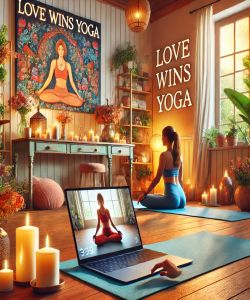
1. Overview of Love Wins Yoga
Love Wins Yoga represents a formidable and contemporary evolution of yogic practice, engineered not merely for physical conditioning but as a rigorous system for cultivating profound emotional resilience and radical self-compassion. It is an assertive discipline that unequivocally rejects superficiality, demanding instead a practitioner’s full commitment to introspective honesty and the deliberate dismantling of internalised judgment. This modality operates on the foundational premise that authentic strength is forged through the integration of mind, body, and emotional spirit, asserting that love—for oneself and, by extension, for others—is the ultimate victor over fear, shame, and societal discord. It is not a gentle or passive pursuit; it is a strategic framework for developing an unshakeable core of self-worth and an expansive capacity for empathy. The practice mandates a direct confrontation with personal narratives of inadequacy and translates abstract philosophical concepts into tangible, embodied experiences. Through its unique synthesis of dynamic asana, targeted pranayama, and potent meditative techniques, Love Wins Yoga provides a structured pathway for individuals to reclaim their sovereignty, build formidable inner fortitude, and champion a philosophy of inclusive strength in a world that often rewards division. It is, in essence, a declaration of personal power actualised through disciplined, compassionate action.
2. What are Love Wins Yoga?
Love Wins Yoga is a structured, philosophy-driven system of personal development that utilises the core components of yoga—postures (asana), breath control (pranayama), and meditation (dhyana)—to achieve specific emotional and psychological outcomes. It is fundamentally distinct from performance-oriented or purely fitness-based yoga, as its primary objective is the cultivation of intrinsic self-worth, emotional regulation, and a robust capacity for empathy. The name itself signifies its central tenet: the triumph of compassionate self-acceptance and connection over the internal and external forces of negativity, such as self-criticism, fear, and prejudice. The practice is characterised by its deliberate and methodical approach to linking physical movements with emotional states. Each sequence is designed not just to build physical strength or flexibility, but to evoke and process feelings, enabling the practitioner to develop greater resilience and emotional intelligence. Key components include:
- Philosophical Grounding: The practice is deeply rooted in the principle that emotional well-being is a prerequisite for a fully actualised life. It actively teaches practitioners to challenge and reframe limiting beliefs.
- Emotive Asana Sequencing: Postures are sequenced in a way that encourages emotional release and empowerment. For example, heart-opening poses are not merely physical stretches but are framed as exercises in vulnerability and courage.
- Targeted Breathwork: Pranayama techniques are specifically chosen to manage the nervous system, enabling practitioners to calm anxiety or energise themselves from a state of lethargy, thereby gaining mastery over their physiological responses to stress.
- Affirmative Meditation: Meditations and visualisations are not passive. They are active, commanding practices focused on reinforcing core messages of self-worth, forgiveness, and unconditional love. This is a proactive discipline for rewiring negative thought patterns.
3. Who Needs Love Wins Yoga?
- Individuals grappling with chronic self-criticism and diminished self-worth who require a structured, somatic-based methodology to rebuild their internal foundation of value from a position of unshakeable strength.
- Persons recovering from emotional trauma or significant life upheavals who seek a safe, empowering, and self-directed practice to process complex feelings and reclaim a sense of personal agency and control over their emotional landscape.
- Professionals in high-stress, demanding careers, such as emergency services, healthcare, or corporate leadership, who must cultivate exceptional emotional resilience and prevent burnout by developing robust self-regulation skills.
- Activists, community leaders, and advocates who are exposed to secondary trauma and emotional fatigue, and who need a sustainable practice to replenish their inner resources, maintain empathy, and continue their work effectively without succumbing to despair.
- Individuals who feel alienated, marginalised, or disconnected from their communities, and who desire a practice that explicitly fosters a sense of belonging, starting with a profound and non-negotiable connection to oneself.
- Anyone seeking to transition from a purely intellectual understanding of compassion and self-love to an embodied, experiential reality, moving these concepts from abstract ideals to lived, practical truths.
- Practitioners of other yoga forms who find the physical aspects fulfilling but seek a deeper, more psychologically substantive dimension to their practice that directly addresses the challenges of modern emotional life.
- Individuals in the process of breaking destructive relational patterns, who require the inner fortitude and clarity to establish and maintain healthy boundaries, grounded in a deep-seated respect for their own well-being.
4. Origins and Evolution of Love Wins Yoga
The genesis of Love Wins Yoga is not found in a single ancient text but is a direct, assertive response to the perceived deficiencies within modern Western yoga culture. It arose from a critical observation that many mainstream practices had become overly commercialised and fixated on physical aesthetics, thereby neglecting the profound psychological and emotional healing potential inherent in yoga's foundational philosophies, particularly Bhakti Yoga (the yoga of devotion) and the principles of Jnana Yoga (the yoga of self-knowledge). Its conceptual origins can be traced to a confluence of thought from practitioners and teachers who demanded a more substantive, inclusive, and emotionally intelligent framework. They sought to create a system that addressed the pervasive issues of self-esteem, trauma, and social division head-on, rather than as an afterthought.
In its initial formulation, Love Wins Yoga was a grassroots movement, developed within focused communities that prioritised psychological safety and radical acceptance. Early pioneers synthesised traditional asana and pranayama with contemporary insights from trauma-informed care and somatic psychology. The objective was clear and uncompromising: to weaponise yogic tools for the purpose of profound self-liberation. This was not about gentle relaxation; it was about building the strength to confront and integrate the most challenging aspects of the human experience. The name "Love Wins" was chosen as a defiant and powerful declaration against the internal and external forces of fear and judgment.
The evolution of the practice has been marked by its formalisation and adaptation to broader audiences, most notably through its expansion into the digital realm. This transition necessitated a rigorous codification of its principles and techniques to ensure the integrity and safety of the practice could be maintained without direct physical supervision. The curriculum was refined to be even more explicit in its instruction, guiding practitioners with commanding clarity through complex emotional territory. The evolution of Love Wins Yoga continues, steadfastly maintaining its core mission to provide a robust, non-negotiable pathway to self-empowerment, proving its resilience and relevance in an increasingly complex world.
5. Types of Love Wins Yoga
- Foundation Practice: This is the mandatory entry point into the Love Wins Yoga system. It rigorously drills the core principles, focusing on establishing a non-negotiable baseline of self-respect. The practice is characterised by slower, deliberate movements and an intense focus on linking foundational asanas with affirmative internal dialogue and stabilising breathwork. The objective is to build the practitioner’s capacity for introspection and emotional self-regulation in a controlled environment.
- Dynamic Flow Practice: A more physically demanding and vigorous type, this practice uses Vinyasa-style sequences to challenge the practitioner's ability to maintain a compassionate mindset under physical stress. The flow is continuous and powerful, designed to break through emotional inertia and cultivate resilience. It is not for the uninitiated; it requires a solid grounding in the Foundation Practice to ensure that the intensity serves empowerment, not ego.
- Restorative Integration Practice: This is a deceptively powerful type that utilises props to support the body in long-held, passive postures. Its purpose is not mere relaxation but deep, somatic processing. By placing the body in a state of complete support, the nervous system is calmed, creating the optimal conditions for integrating the emotional and psychological work undertaken in more dynamic practices. It is a strategic tool for deep healing and is considered essential for long-term progress.
- Empathy in Action Practice: A partner- or group-based modality that extends the principles of Love Wins Yoga outward. It involves synchronised breathwork, mirrored postures, and carefully facilitated exercises designed to cultivate a profound sense of connection and empathy for others. This is an advanced practice that requires a high degree of personal stability and is focused on translating internal self-love into tangible, compassionate action in the world.
6. Benefits of Love Wins Yoga
- Cultivation of Unconditional Self-Worth: Establishes a profound and resilient sense of intrinsic value, independent of external validation, achievements, or the opinions of others. This is a foundational, non-negotiable outcome.
- Enhanced Emotional Regulation: Develops a masterful ability to identify, process, and manage emotional states. Practitioners gain the capacity to respond to life’s challenges with clarity and composure, rather than reacting from a place of volatility.
- Increased Somatic Awareness: Forges a powerful connection between mind and body, enabling the practitioner to understand and release stored emotional tension held within the physical form, leading to greater overall well-being.
- Development of Authentic Empathy: By first cultivating radical compassion for oneself, the practice builds the genuine capacity to extend that same understanding and empathy to others, fostering deeper and more meaningful relationships.
- Fortified Psychological Resilience: Builds a robust mental and emotional defence system against stress, anxiety, and despair. Practitioners are better equipped to navigate adversity without compromising their core sense of self.
- Establishment of Strong Personal Boundaries: The inherent self-respect cultivated through the practice empowers individuals to establish and maintain healthy, firm boundaries in all areas of life, protecting their energy and well-being.
- Dismantling of Limiting Beliefs: Provides a structured method for actively identifying and deconstructing the internalised negative narratives and limiting beliefs that sabotage personal growth and happiness.
- Profound Sense of Purpose and Connection: Moves beyond a feeling of isolation to foster a deep sense of connection—first to oneself, then to others, and finally to a broader sense of purpose and participation in the human experience.
7. Core Principles and Practices of Love Wins Yoga
- The Primacy of Self-Compassion: The foundational principle is that unconditional love for oneself is not an indulgence but a discipline. Every practice begins and ends with the reinforcement of this tenet. The practitioner is mandated to approach every posture and every breath with kindness, especially during moments of difficulty.
- Radical Honesty as a Non-Negotiable Tool: Practitioners must commit to a rigorous and unflinching examination of their internal state. The practice demands the acknowledgement of all emotions—including anger, fear, and shame—without judgment, viewing them as data to be understood, not as flaws to be eradicated.
- The Body as the Arena for Integration: Love Wins Yoga asserts that emotional and psychological change must be embodied to be effective. The physical body is not merely a vessel to be stretched but the primary site where trauma is held and where healing is actualised. Asanas are executed with the specific intention of accessing and transforming these somatic imprints.
- Breath as the Agent of Regulation: Pranayama is not treated as a preliminary or secondary exercise. It is the central mechanism for regulating the autonomic nervous system. Specific breathing techniques are taught as powerful, immediate tools to de-escalate anxiety, overcome lethargy, and maintain composure under duress.
- Actionable Affirmation Over Passive Hope: The practice rejects vague positive thinking. It employs strong, commanding affirmations and meditations that are actively integrated with physical movement. The objective is to forcefully overwrite negative cognitive patterns with powerful, self-affirming truths.
- Courage Over Comfort: The practice deliberately and safely guides practitioners to the edge of their emotional and physical comfort zones. Growth is understood to occur not in a space of ease, but in the managed confrontation with challenge, thereby building true resilience.
- Empathy as a Consequence of Self-Love: The system maintains that genuine empathy for others is impossible without first establishing a foundation of radical self-love. The outward expression of compassion is taught as the natural and inevitable overflow of a well-tended inner world.
8. Online Love Wins Yoga
- Sovereignty of Personal Space: The online format grants the practitioner absolute control over their environment. This creates a sanctuary free from the perceived judgment or comparison that can arise in a public studio. This privacy is not a mere convenience; it is a strategic advantage, fostering the vulnerability required for deep emotional work.
- Unyielding Accessibility: Digital delivery removes geographical and logistical barriers, making the transformative power of this practice available to anyone with an internet connection. It democratises access, ensuring that location or scheduling constraints do not prevent committed individuals from participating.
- Intensified Focus on Internal Experience: Without the physical presence of an instructor to provide hands-on adjustments, the practitioner is compelled to cultivate a heightened state of internal awareness, or interoception. The verbal cues are designed to be precise and commanding, forcing a deeper reliance on and trust in one’s own bodily sensations and intuition.
- Disciplined Self-Reliance: The online modality demands and builds a superior level of personal discipline. The responsibility for showing up, creating a sacred space, and remaining present rests squarely on the practitioner. This cultivates a powerful sense of ownership and agency over one's practice and, by extension, one's life.
- Global Community Connection: Paradoxically, the online format can foster a unique and potent form of community. Practitioners connect based on shared intention and commitment rather than geographical proximity, creating a powerful, diverse, and supportive network that transcends physical boundaries. Participation in this community, though virtual, reinforces the universal nature of the human experiences being addressed.
9. Love Wins Yoga Techniques
- The Anchor Breath (Prarambhik Sthirata): Begin by assuming a seated or standing position of absolute stability. Inhale deeply through the nostrils for a count of four, focusing on the expansion of the diaphragm. Hold the breath for a count of two, establishing a point of stillness. Exhale forcefully but smoothly through the mouth for a count of six. This is not a sigh of relief but a deliberate expulsion of tension. Repeat this a minimum of five times before any physical movement, establishing unwavering presence.
- Heart-Shield Posture (Hridaya Kavacha Asana): Stand with feet firmly planted. On an inhalation, sweep the arms out and up, palms facing forward, opening the chest with assertive power. This is a declaration of vulnerability as strength. On the exhalation, draw the hands to the heart centre, crossing the forearms in front of the chest as if creating a shield. This is not an act of hiding but of conscious protection and self-preservation. Repeat this dynamic movement, synchronising it with the powerful affirmation: “I am open; I am safe.”
- Grounding Push (Bhu Sparsha Shakti): From a standing forward bend, with knees generously bent, press the palms or fingertips firmly into the mat or the floor. Actively push the ground away as if trying to create space. Feel the rebound of energy travelling up through the arms and into the core. This technique transforms a posture of surrender into an act of drawing strength and stability directly from the earth. Hold for five deep breaths, reinforcing your connection to a solid foundation.
- Gaze of Unwavering Self-Acceptance (Atma-Drishti): During balancing postures, fix your gaze (drishti) on an unmoving point. However, the technique is to imbue this gaze with the quality of unconditional acceptance. If you wobble or fall, you are mandated to maintain this compassionate gaze, both externally and internally. You will not look away in frustration. You will meet instability with steady kindness, re-engage, and continue. This retrains the mind’s response to imperfection.
- Integration Seal (Samapti Mudra): To conclude the practice, lie in Savasana. Place the right hand over the heart and the left hand over the solar plexus. Apply firm, steady pressure. Breathe deeply into the space beneath your hands. With each exhale, consciously absorb the strength, resilience, and compassion cultivated during the practice into your very cells. This is not passive rest; it is an active sealing-in of the work that has been done.
10. Love Wins Yoga for Adults
Love Wins Yoga for adults is a rigorous and unflinching discipline designed for mature individuals who are prepared to engage in substantive personal work. It dispenses with platitudes and demands a commitment to radical self-inquiry and emotional accountability. The practice operates on the understanding that adulthood brings with it a complex tapestry of experiences, responsibilities, and often, deeply ingrained patterns of thought and behaviour. Therefore, the methodology is not one of mere relaxation but of strategic deconstruction and reconstruction. It provides a robust framework for adults to confront and dismantle limiting beliefs acquired over a lifetime, to heal from past emotional wounds with dignity and strength, and to cultivate the resilience necessary to navigate the pressures of career, relationships, and personal responsibilities. The asana sequences are often physically demanding, not for the sake of performance, but to serve as a crucible—a controlled environment in which to practice maintaining composure, compassion, and mental clarity under stress. The meditative and pranayama components are direct and commanding, engineered to give adults tangible tools for managing anxiety, combating burnout, and fostering an unshakeable sense of inner authority. This is not a practice for those seeking a gentle escape; it is a formidable toolkit for adults determined to take full ownership of their emotional well-being and live with greater purpose, integrity, and power.
11. Total Duration of Online Love Wins Yoga
The standard, non-negotiable duration for a complete online session of Love Wins Yoga is precisely one hour. This timeframe is not arbitrary; it is a meticulously engineered container designed to facilitate a profound and integrated experience. The 1 hr session is strategically partitioned to ensure a comprehensive journey from initial grounding to final integration, leaving no aspect of the practice underdeveloped. The session commences with a dedicated period for centering and intention-setting, mandating the practitioner’s full mental and emotional presence. This is followed by targeted pranayama, or breathwork, which serves to regulate the nervous system and prepare the mind for the deeper work ahead. The central portion of the hour is dedicated to the dynamic asana sequence, the physical crucible where principles of resilience and self-compassion are tested and forged. This is followed by a specific period for emotional processing, often involving restorative postures, which allows the somatic and psychological impact of the practice to settle. The final segment of the 1 hr session is reserved for a powerful, guided meditation and Savasana, which is not treated as mere rest but as an active process of sealing in the benefits of the practice. Every minute of the hour is purposeful, creating a complete arc that honours the complexity of the work and respects the practitioner’s commitment by delivering a potent, self-contained, and transformative experience.
12. Things to Consider with Love Wins Yoga
Before embarking on the formidable path of Love Wins Yoga, a practitioner must engage in a sober and honest self-assessment. This discipline is not a panacea, nor is it a passive form of self-care; it is an active and often intense process of self-confrontation. One must consider their genuine readiness to face uncomfortable emotional truths. The practice will inevitably bring suppressed feelings and challenging memories to the surface, and while the framework is designed to handle this, the individual’s willingness to meet this experience with courage instead of avoidance is paramount. Furthermore, it is imperative to understand that Love Wins Yoga is a supplement to, not a substitute for, professional mental health treatment. Individuals navigating acute psychological distress or severe trauma must seek the guidance of a qualified therapist, ideally in conjunction with this practice. A prospective practitioner must also evaluate their capacity for self-discipline, particularly in an online context where the structure is self-imposed. The results of this work are directly proportional to the consistency and integrity of one’s commitment. One must consider that progress is not linear; there will be moments of profound breakthrough and periods of frustrating stagnation. A mature understanding of this dynamic is essential to persevere with the unwavering resolve that the practice demands for its transformative potential to be fully realised.
13. Effectiveness of Love Wins Yoga
The effectiveness of Love Wins Yoga is potent and unequivocal, provided the practitioner engages with the discipline’s core tenets with absolute commitment and integrity. Its efficacy is not measured in superficial metrics such as physical flexibility or the aesthetic execution of postures, but in tangible, observable shifts in a practitioner’s internal state and external behaviour. The primary measure of its success lies in the cultivation of a robust and stable sense of self-worth that is not contingent on outside approval. This manifests as a marked decrease in self-critical thought patterns and a corresponding increase in self-compassionate actions. Furthermore, its effectiveness is evident in an enhanced capacity for emotional regulation; practitioners report a significant improvement in their ability to navigate stress, disappointment, and conflict with a newfound sense of composure and clarity. The practice is demonstrably effective at dismantling the somatic armouring that results from chronic stress and trauma, leading to a greater sense of physical and emotional freedom. The ultimate proof of its effectiveness, however, is behavioural: the establishment of healthier boundaries in relationships, the courage to pursue authentic life goals, and the ability to extend genuine empathy to others without succumbing to emotional depletion. The system is effective because it is not a temporary fix; it is a strategic retraining of the mind, body, and spirit to operate from a baseline of strength, love, and resilience.
14. Preferred Cautions During Love Wins Yoga
Engaging in Love Wins Yoga demands an unwavering commitment to personal safety, both physical and psychological. It is imperative that practitioners honour their body’s limitations with uncompromising honesty, rejecting any impulse towards ego-driven performance. The line between a challenging edge and a potential injury must be respected at all times; sharp or shooting pain is an unequivocal signal to retreat from a posture immediately. This is not weakness; it is wisdom. Psychologically, while the practice is designed to surface and process emotion, one must exercise profound caution. If an emotional state becomes overwhelmingly intense or destabilising, the mandated response is not to push through indiscriminately but to return to a grounding posture, focus on the Anchor Breath technique, and re-establish a sense of safety before proceeding. The practitioner must hold a clear understanding that this practice is a powerful tool for self-exploration, not a clinical intervention for acute mental health crises. Comparing one's journey to that of others is a forbidden act within this discipline, as it directly contradicts the core principle of self-acceptance and is detrimental to progress. Particularly within the online space, the practitioner must assume full responsibility for creating a physically safe environment, clear of obstacles, and for ensuring their emotional space is private and secure from interruption during the session.
15. Love Wins Yoga Course Outline
- One: The Foundation of Unshakeable Self-Worth
- Introduction to the Core Philosophy: The Discipline of Self-Compassion.
- Mastery of the Anchor Breath (Prarambhik Sthirata).
- Foundational Asanas for Stability and Grounding (Tadasana, Virabhadrasana I).
- Technique: The Gaze of Unwavering Self-Acceptance (Atma-Drishti).
- Introductory Meditation: Acknowledging the Inner Critic without Judgment.
- Two: Opening to Vulnerability as Strength
- The Principle of Courage Over Comfort.
- Dynamic Asana: The Heart-Shield Posture (Hridaya Kavacha Asana).
- Introduction to Heart-Opening Poses (Ustrasana and Bhujangasana variations).
- Pranayama for Emotional Expansion: Full Yogic Breath.
- Integration: Somatic Journaling on Themes of Openness and Protection.
- Three: Harnessing Power and Reclaiming Agency
- The Principle of the Body as an Arena for Integration.
- Power Poses and a Dynamic Flow Sequence (Virabhadrasana II, Utkata Konasana).
- Technique: The Grounding Push (Bhu Sparsha Shakti).
- Pranayama for Energy and Focus: Kapalabhati (Skull Shining Breath).
- Meditation: Visualising and Reinforcing Personal Boundaries.
- Four: The Art of Restorative Integration
- Understanding Somatic Processing and Nervous System Regulation.
- Introduction to Restorative Postures using Props (Supported Supta Baddha Konasana, Supported Viparita Karani).
- Pranayama for Deep Calm: Nadi Shodhana (Alternate Nostril Breathing).
- Technique: Integration Seal (Samapti Mudra).
- Concluding Meditation: Absorbing and Embodying Compassionate Strength.
16. Detailed Objectives with Timeline of Love Wins Yoga
- Weeks 1-2: Establishing the Foundational Mandate.
- Objective: The practitioner will master the Anchor Breath technique as an immediate tool for nervous system regulation. They will demonstrate proficiency in the foundational standing postures with a clear focus on stability over depth. The primary psychological objective is to begin consistently identifying self-critical thoughts without engagement.
- Weeks 3-4: Cultivating Courageous Vulnerability.
- Objective: The practitioner will execute dynamic heart-opening sequences while maintaining steady breath and a compassionate internal dialogue. They will be able to hold restorative heart-opening postures for extended periods, tolerating the emotional sensations that arise. The timeline goal is a demonstrable shift from fear of vulnerability to seeing it as a controlled act of strength.
- Weeks 5-6: Embodying Personal Power and Agency.
- Objective: The practitioner will confidently execute power-focused sequences, integrating the Grounding Push technique to feel a tangible connection to their own strength. They will articulate and reinforce a key personal boundary through guided meditation. The objective is to translate the felt sense of power on the mat into a clearer sense of agency off the mat.
- Weeks 7-8: Mastering Integration and Resilience.
- Objective: The practitioner will be proficient in setting up and utilising props for a full restorative practice, understanding its role in deep emotional integration. They will be able to self-guide through a sequence combining dynamic and restorative elements, responding adeptly to their body’s needs. The timeline culminates in the practitioner’s ability to use the entire toolkit of Love Wins Yoga to navigate a real-world stressor with increased resilience and self-compassion.
17. Requirements for Taking Online Love Wins Yoga
- Unyielding Personal Commitment: A non-negotiable willingness to engage in rigorous self-inquiry and to confront uncomfortable emotional truths is the foremost requirement. Passive participation is unacceptable.
- A Private and Secure Space: You must designate a physical area where you will be free from all interruptions for the entire duration of the session. This space is to be treated as a sanctuary, essential for the psychological safety required for this work.
- Stable Internet Connection and Adequate Technology: A reliable, high-speed internet connection is mandatory to ensure an uninterrupted session. A device with a screen large enough to clearly view the instructor’s demonstrations is required. Poor technical setup is not an acceptable excuse for lack of engagement.
- A Standard Yoga Mat: This is the minimum equipment necessary for providing a safe, non-slip surface for the asana practice. It defines your personal practice space.
- Essential Props: At a minimum, two firm blankets or large towels and two firm cushions or pillows are required. These are not optional comforts; they are essential tools for executing restorative postures safely and effectively, which is a core component of the practice.
- Sober and Unimpaired State: You must undertake this practice in a state of complete sobriety. The use of alcohol or any mind-altering substances prior to or during a session is strictly prohibited, as it compromises the integrity of the work and poses a safety risk.
- Absolute Personal Accountability: The practitioner must assume full responsibility for their physical and emotional well-being. This includes the discipline to honour physical limits and the maturity to manage emotional responses as guided by the instructor.
18. Things to Keep in Mind Before Starting Online Love Wins Yoga
Before commencing your engagement with the online practice of Love Wins Yoga, it is imperative to conduct a rigorous internal audit of your intentions and readiness. You must understand, unequivocally, that this is not a passive fitness class; it is an active, commanding discipline of self-transformation. Be prepared for the practice to be emotionally evocative. Its very design is intended to bring latent feelings to the conscious surface for processing, and you must be resolute in your willingness to meet whatever arises with the courage and compassion the practice itself teaches. Acknowledge that the virtual environment places the onus of discipline squarely upon your shoulders. There is no external authority to ensure your focus; you must cultivate an unshakeable inner commitment. You must also proactively create a physical environment that is not merely convenient but sacred—free from distraction, clutter, and potential interruption. This space is your laboratory for personal growth, and its integrity is paramount. Finally, release any expectations of a linear, predictable journey. Progress will be punctuated by both profound breakthroughs and challenging plateaus. Your task is to show up with unwavering consistency, regardless of your mood or perceived progress, and to trust that the disciplined application of these principles will, inevitably, forge the resilient and compassionate self you seek to build.
19. Qualifications Required to Perform Love Wins Yoga
The authority to guide others through the formidable practice of Love Wins Yoga is not granted lightly and requires a stringent set of qualifications that extend far beyond a standard yoga teacher certification. A certified instructor must possess a robust and multifaceted skill set, ensuring they can hold a space that is not only physically safe but psychologically sound. The baseline requirement is an advanced yoga teacher training certification (a minimum of 500 hours) from a reputable school, ensuring a deep understanding of asana, pranayama, anatomy, and yogic philosophy. However, this is merely the starting point. The essential, distinguishing qualifications are:
- Mandatory Certification in Love Wins Yoga: The instructor must have completed the official, proprietary certification programme for Love Wins Yoga. This intensive training specifically covers the unique philosophy, emotive sequencing, specialised techniques, and the ethical considerations inherent to this emotionally focused modality.
- Demonstrable Training in Trauma-Informed Practices: A non-negotiable requirement is formal training or certification in trauma-informed or trauma-sensitive yoga. The instructor must be proficient in the language, modifications, and nervous system science necessary to guide individuals who may be working with past trauma.
- Substantial Personal Practice: The instructor must have a deep, long-standing, and dedicated personal practice of Love Wins Yoga. They cannot teach from a place of theory; they must guide from a place of embodied, lived experience and unwavering belief in the system’s principles.
- Exceptional Communication Skills: They must be masters of precise, commanding, and compassionate verbal cueing. Given the online focus and the lack of physical adjustments, the ability to guide practitioners into deep internal states through language alone is a paramount skill.
20. Online Vs Offline/Onsite Love Wins Yoga
Online
The online modality of Love Wins Yoga offers a unique and powerful container for this deeply personal work. Its primary advantage is the creation of a private, self-controlled sanctuary. Practitioners are liberated from the potential for comparison or self-consciousness that can arise in a group setting, allowing for a more profound and uninhibited exploration of vulnerable emotional states. The format demands and cultivates a superior level of interoception and self-reliance, as the practitioner must learn to interpret verbal cues and trust their own bodily wisdom without the aid of physical adjustments. This fosters a formidable sense of personal agency and ownership over the practice. Furthermore, online access removes geographical and scheduling barriers, making the practice radically accessible to a global community of committed individuals, united by shared intention rather than physical proximity. The focus is intensified on the internal experience, making it a potent choice for those dedicated to deep introspective work.
Offline/Onsite
The offline, or onsite, practice of Love Wins Yoga provides a different but equally valid set of advantages. The primary benefit lies in the palpable energy of the collective (sangha) and the direct presence of the instructor. Being in a shared physical space can create a powerful sense of community and mutual support, reminding the practitioner that they are not alone in their journey. The instructor can offer immediate, nuanced feedback and physical adjustments, which can be invaluable for understanding the alignment and energetic intention of a posture. The dedicated studio environment eliminates the distractions of home and serves as a powerful ritualistic cue, signalling to the mind and body that it is time for focused practice. For those who thrive on interpersonal connection and direct, in-person guidance, the offline experience offers a tangible sense of containment and community that can powerfully amplify the impact of the work.
21. FAQs About Online Love Wins Yoga
Question 1. Is this practice suitable for absolute beginners to yoga? Answer: Yes, provided the beginner starts with the Foundation Practice. The focus is on internal experience, not complex postures, making it accessible to all physical levels.
Question 2. What if I am not physically flexible? Answer: Flexibility is not a prerequisite or a goal. The practice mandates that you work with your body as it is, with uncompromising self-acceptance.
Question 3. What technology do I need? Answer: A stable internet connection and a device (computer, tablet, or television) with a screen large enough to see the instructor clearly.
Question 4. Is this a religious practice? Answer: No. It is a philosophy-driven system of self-development. It is compatible with any or no religious beliefs.
Question 5. Will I need to purchase expensive equipment? Answer: No. A yoga mat and common household items like firm blankets and cushions are sufficient for the mandatory prop work.
Question 6. Can Love Wins Yoga replace therapy? Answer: Absolutely not. It is a powerful supplement to, but never a substitute for, professional mental health care.
Question 7. What if I become very emotional during a session? Answer: This is expected. The instructor will provide specific techniques to ground yourself and process the emotion safely within the session’s framework.
Question 8. How is an online class kept safe without an instructor physically present? Answer: Safety is maintained through precise verbal cueing, a strict emphasis on listening to your own body, and teaching practitioners how to self-regulate.
Question 9. Is there any interaction with other participants in an online class? Answer: This depends on the specific class format, but the primary focus is always on individual introspection. Some courses may offer optional community forums.
Question 10. Is it a physically demanding workout? Answer: Some types, like the Dynamic Flow, are physically vigorous. The focus, however, is on emotional resilience under stress, not calorie expenditure.
Question 11. How do I know if I am doing the poses correctly online? Answer: The instruction focuses on the internal feeling of the pose, not perfect external form. You are taught to become your own best teacher.
Question 12. Must I have my camera on during the session? Answer: While often encouraged for a sense of community, it is rarely mandatory. Your privacy and comfort are paramount.
Question 13. What is the core difference between this and other online yoga? Answer: The explicit, non-negotiable focus on cultivating emotional resilience and self-worth as the primary goal of the practice.
Question 14. Can I practice if I have physical injuries? Answer: You must consult your physician first. It is your responsibility to modify the practice to honour your body’s limitations.
Question 15. How quickly will I see results? Answer: This is not a quick fix. Results are measured in gradual, tangible shifts in your mindset and emotional regulation, which requires consistent practice.
Question 16. Is chanting or using mantras required? Answer: The practice uses strong, commanding affirmations. While you may be guided to repeat them, the focus is on their internalisation.
22. Conclusion About Love Wins Yoga
In conclusion, Love Wins Yoga stands as a resolute and sophisticated system for human development, engineered for the express purpose of forging unshakeable self-worth and profound emotional resilience. It is an uncompromising discipline that moves beyond the superficialities of aesthetic physical performance, demanding instead a practitioner’s full engagement in the rigorous work of self-inquiry and compassionate action. The practice asserts with unwavering authority that true strength is born from the integration of mind, body, and spirit, and that the cultivation of love—first for oneself, then for others—is the most potent strategy against the pervasive forces of fear, judgment, and alienation. Its principles are not gentle suggestions but commanding directives for living a more authentic, powerful, and connected life. Whether practiced in the sovereign space of an online session or the collective energy of a studio, its objective remains constant: to provide a structured, effective, and transformative pathway for individuals to reclaim their inner authority. It is not merely a style of yoga; it is a definitive declaration that in the battle for personal peace and integrity, a disciplined and courageous heart will always be victorious. This is its fundamental, non-negotiable truth.