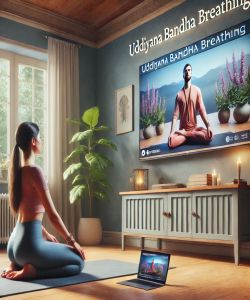
Overview of Uddiyana Bandha Breathing
Uddiyana Bandha Breathing represents a formidable and advanced technique within the canon of Hatha Yoga, demanding absolute precision and disciplined execution. It is not merely a breathing exercise but a powerful abdominal lock, the name itself translating from Sanskrit as the "upward flying lock." This practice involves a complete exhalation of air from the lungs, followed by a vigorous contraction and upward lift of the abdominal wall and its internal organs into the thoracic cavity. This action creates a significant internal vacuum, which is held for a prescribed duration whilst the breath is suspended externally. The physiological and energetic impacts of this manoeuvre are profound and far-reaching. It is fundamentally a method for manipulating and directing prana, the vital life force, upwards through the central energy channel, the sushumna nadi. On a physical level, it acts as a powerful massage for the abdominal viscera, including the stomach, intestines, liver, and spleen, thereby stimulating digestive fire (agni) and enhancing metabolic function. Its practice strengthens the diaphragm and core musculature with an intensity that few other exercises can replicate. However, its mastery is a gradual process, requiring foundational strength, breath control, and the vigilant guidance of a competent instructor. It is considered a cornerstone practice for serious yoga practitioners aiming to progress towards higher states of pranayama and meditation, serving as a critical gateway to more subtle energetic work. Its application is therefore highly specific, demanding respect for its potency and a rigorous, non-negotiable adherence to correct form and contraindications. It is, without question, a master practice for internal purification and energetic ascent, reserved for those with the requisite discipline and preparation.
What is Uddiyana Bandha Breathing?
Uddiyana Bandha Breathing is a sophisticated yogic technique centred on the creation of an powerful abdominal lock following a full exhalation. It is classified as one of the principal bandhas, or energetic locks, within Hatha Yoga, designed explicitly to control and redirect the flow of prana (vital energy) within the body. The execution of the practice is precise and unwavering. The practitioner first expels all air from the lungs, creating a state of external breath retention known as bahya kumbhaka. Immediately following this, a mock inhalation is performed without allowing any air to enter the nostrils; this action utilises the respiratory muscles to lift the diaphragm high into the rib cage. Simultaneously, the abdominal muscles are drawn inwards and upwards, pulling the entire abdominal wall towards the spine and deep into the thoracic cavity. This creates a distinct and deep hollow in the abdomen.
The primary characteristics of Uddiyana Bandha can be delineated as follows:
Breath Suspension: The technique is fundamentally performed on an empty-lung state. The breath is held out, not in, which is a critical distinction from other pranayama practices. This external retention is the canvas upon which the lock is applied.
Abdominal Contraction and Lift: It is not a simple tensing of the stomach muscles. It is a specific, coordinated action of drawing the rectus abdominis, obliques, and transverse abdominis inwards and, crucially, upwards underneath the rib cage, creating a powerful internal vacuum.
Energetic Upward Flow: The Sanskrit name, "upward flying lock," directly refers to its primary energetic purpose. The vacuum and muscular action are believed to force apana vayu (the downward-moving energy) to reverse its course and move upwards to unite with prana vayu (the life force energy) at the navel centre. This union is a key objective in advanced yoga.
Physiological Impact: The intense internal massage stimulates the digestive organs, adrenal glands, and pancreas. It systematically tones the diaphragm and the deep core stabilising muscles, contributing to enhanced respiratory efficiency and visceral health. Its performance requires complete focus and should never be approached casually.
Who Needs Uddiyana Bandha Breathing?
Advanced Yoga Practitioners: Individuals who have established a consistent and proficient yoga practice, including a solid foundation in asana and basic pranayama. For these practitioners, Uddiyana Bandha is the logical and necessary next step to deepen their control over breath and energy, and to prepare the body for more subtle and intensive meditative states. It is an indispensable tool for progressing in the traditional yogic path.
Individuals Seeking to Enhance Core Strength and Stability: Beyond superficial abdominal muscles, this technique targets the deep internal musculature, including the transverse abdominis and the diaphragm. Athletes, dancers, and anyone requiring exceptional core control and power will find its practice provides a level of internal conditioning that is difficult to achieve through conventional exercises alone.
Those Aiming to Optimise Digestive and Metabolic Function: The powerful internal massage and stimulation of the abdominal organs, a process known as hara shuddhi, directly invigorates the digestive system. It is systematically employed by those seeking to stoke the metabolic fire (agni), improve nutrient assimilation, and regulate eliminatory processes through a non-invasive, potent physical technique.
Practitioners of Pranayama and Meditation: Mastery of Uddiyana Bandha is often considered a prerequisite for advanced pranayama techniques and deeper states of meditation. By directing prana upwards through the central channel (sushumna), it facilitates the clearing of energetic blockages and promotes the stillness of mind required for profound meditative absorption.
Individuals Focused on Improving Respiratory Efficiency: The practice provides an intense workout for the diaphragm, the primary muscle of respiration. Strengthening and increasing the control over the diaphragm leads to more efficient, deeper, and calmer breathing patterns in daily life and during other physical activities, enhancing overall vitality and endurance.
Those Committed to Internal Cleansing Practices (Kriyas): Uddiyana Bandha is a core component of the yogic system of internal purification. It is sought by individuals dedicated to a holistic regimen of detoxification, as it mechanically and energetically purges stagnation from the abdominal region, promoting a state of lightness and internal purity.
Origins and Evolution of Uddiyana Bandha Breathing
The origins of Uddiyana Bandha are firmly rooted in the classical Hatha Yoga tradition, with its earliest and most authoritative descriptions appearing in seminal mediaeval texts. The Hatha Yoga Pradipika, a foundational manual from the 15th century, dedicates specific verses to its instruction, proclaiming it as the greatest of the bandhas and a means by which "the great bird prana is forced to fly up the sushumna." Similarly, the Gheranda Samhita and the Siva Samhita, other key scriptures of Hatha Yoga, elaborate on its technique and extol its virtues, positioning it not as a mere physical exercise but as a profound mudra (energetic seal) for spiritual liberation. In these early contexts, its practice was esoteric, passed down directly from guru to a worthy disciple, and was considered an advanced technique reserved for serious ascetics aiming for mastery over the body’s subtle energies.
Over the centuries, as yoga began its slow migration from secluded ashrams to a more public sphere, the understanding and application of Uddiyana Bandha evolved. In the early 20th century, pioneers like T. Krishnamacharya, often called the father of modern yoga, played a crucial role in integrating such powerful techniques into more dynamic, asana-based systems. He taught it to his prominent students, including B.K.S. Iyengar and K. Pattabhi Jois, who in turn incorporated its principles into the Iyengar and Ashtanga Vinyasa methods, respectively. In Ashtanga, for example, a subtle form of Uddiyana Bandha is maintained throughout the practice to foster core stability and internal heat.
In contemporary yoga, Uddiyana Bandha is taught more widely, yet its evolution has brought a dual perspective. On one hand, its potent physiological benefits—such as toning the abdomen and improving digestion—are emphasised, sometimes stripping it of its deeper energetic context. On the other hand, traditional schools and dedicated practitioners continue to honour its original purpose as a powerful tool for pranic control and spiritual advancement. The modern evolution, therefore, is a careful balancing act: making the practice accessible without diluting its formidable power or disregarding the critical safety protocols and contraindications that have always accompanied its instruction. This ensures that its legacy as a master technique for internal transformation endures.
Types of Uddiyana Bandha Breathing
Bahya Uddiyana Bandha (External Lock): This is the classical and most widely recognised form of the practice. It is executed strictly on bahya kumbhaka, or external breath retention, after a complete and forceful exhalation. The practitioner expels all air from the lungs, then performs a mock inhalation to lift the diaphragm whilst simultaneously pulling the abdominal wall inwards and upwards towards the spine. This creates a pronounced, hollow vacuum in the abdomen. This type is held for a short to moderate duration before a slow, controlled inhalation. Its primary purpose is intense visceral massage, purification, and the powerful upward redirection of apana vayu. It is a preparatory and standalone practice of immense power.
Antara Uddiyana Bandha (Internal Lock): This is a more subtle and advanced variation, performed on antara kumbhaka, or internal breath retention. In this form, the practitioner inhales fully and holds the breath inside. A gentle and controlled contraction of the abdominal muscles is then applied to create a subtle lift and support, preventing the prana from dissipating downwards. It is not the deep, hollow lock seen in the external version. Instead, it is a refined muscular control that supports the held breath and directs its energy upwards. This type is typically integrated within specific pranayama sequences and is not practised as a standalone, high-intensity exercise. Its focus is purely on subtle energetic management rather than intense physiological stimulation.
Uddiyana Bandha Kriya (Dynamic Abdominal Churning): Also known as Agni Sara Kriya or Nauli Kriya (in its advanced form), this is a dynamic application of the Uddiyana Bandha principle. After establishing the external lock (Bahya Uddiyana Bandha), the practitioner rhythmically contracts and releases the abdominal muscles, creating a churning or pumping motion. This action vigorously massages the internal organs and generates intense internal heat (agni), hence its name. In its most advanced stage, Nauli, the practitioner learns to isolate and roll the rectus abdominis muscles from side to side. These dynamic variations are powerful cleansing techniques (kriyas) used to purify the digestive tract and stoke the metabolic fire to its highest potential.
Benefits of Uddiyana Bandha Breathing
Intense Stimulation of Abdominal Organs: The practice performs a vigorous internal massage on the stomach, liver, pancreas, spleen, and intestines, enhancing their function, improving circulation to these areas, and stimulating glandular secretions.
Fortification of the Diaphragm and Respiratory System: It provides an unparalleled workout for the diaphragm, the primary muscle of breathing. This strengthens respiratory capacity, improves the efficiency of gaseous exchange, and builds foundational power for all other pranayama techniques.
Enhancement of Digestive Fire (Agni): By mechanically and energetically stimulating the solar plexus region, Uddiyana Bandha is renowned for its ability to stoke agni, the digestive and metabolic fire, leading to improved digestion, assimilation of nutrients, and elimination of waste.
Profound Core Musculature Strengthening: The technique engages and tones the deepest layers of the abdominal wall, including the transverse abdominis, which is critical for lumbar spine stability, posture, and overall core strength.
Energetic Purification and Upward Redirection of Prana: It is a primary tool for reversing the downward flow of apana vayu and directing it upwards to unite with prana vayu at the navel centre. This purifies the energy channels (nadis) and facilitates the ascent of energy through the sushumna nadi.
Toning of the Autonomic Nervous System: The practice directly stimulates the solar plexus, a major nerve plexus, and tones the parasympathetic nervous system, which can induce a state of calm and reduce the physiological impact of stress.
Relief from Constipation and Indigestion: The powerful massaging and churning action on the intestines directly addresses sluggishness in the digestive tract, promoting regular peristalsis and alleviating common digestive complaints.
Preparation for Advanced Yogic Practices: Mastery of Uddiyana Bandha is considered an essential prerequisite for higher practices in yoga, including advanced pranayama, mudras, and deep meditative states, as it provides the necessary control over the body’s core energy.
Core Principles and Practices of Uddiyana Bandha Breathing
Prerequisite of Emptiness: The foundational principle is that the practice must be performed on a completely empty stomach and bowels. This is a non-negotiable safety and efficacy requirement. Execution with food in the digestive system is dangerous and counterproductive. Furthermore, it is executed on empty lungs (bahya kumbhaka), a state of total exhalation.
The Principle of Complete Exhalation: The practitioner does not simply breathe out casually. A forceful and complete exhalation through the mouth or nose is required to expel the maximum possible volume of air from the lungs. This creates the necessary negative pressure differential for the subsequent abdominal lift.
The Mock Inhalation (Jalandhara Bandha Application): After exhaling, the glottis is closed and a 'false' or 'mock' inhalation is performed. This action involves expanding the rib cage as if to inhale, but without allowing any air to enter. This muscular effort is what lifts the relaxed diaphragm high into the thoracic cavity. This is often performed in conjunction with Jalandhara Bandha (the chin lock) to seal the upper end of the torso.
Abdominal Retraction and Upward Lift: This is the core action. The abdominal wall, fully relaxed after the exhalation, is actively and powerfully drawn inwards towards the spine and, crucially, upwards to tuck deep underneath the rib cage. This is not a mere tensing of the muscles but a controlled, dynamic suction.
Steadfast and Controlled Breath Retention: The lock is held for a specific duration, determined by the practitioner's capacity, without strain. The duration of this external breath hold must be managed with absolute precision. Gasping for air upon release indicates the hold was maintained for too long.
Systematic and Gradual Release: The release of the bandha is as critical as its application. The abdominal muscles must be released first, allowing the viscera to return to their natural position before any inhalation occurs. The subsequent inhalation must be slow, smooth, and fully controlled to avoid putting sudden pressure on the heart and lungs.
Progressive and Consistent Practice: Mastery is not achieved overnight. The practice demands regular, disciplined application, starting with short holds and gradually increasing the duration and number of rounds as strength and control develop. Consistency is paramount to realising its profound benefits and ensuring safety.
Online Uddiyana Bandha Breathing
Unprecedented Accessibility to Expert Guidance: Online platforms demolish geographical barriers, granting practitioners access to highly specialised and authoritative instructors from anywhere in the world. This is particularly crucial for an advanced practice like Uddiyana Bandha, where expert instruction is not merely beneficial but essential for safe and effective learning. A practitioner is no longer limited by the expertise available in their immediate vicinity.
Structured, Self-Paced Learning Environment: Online courses provide a meticulously structured curriculum that can be navigated at the practitioner's own pace. This allows for the repeated viewing of instructional modules on the precise mechanics of the exhalation, the mock inhalation, and the abdominal lift. This capacity to review complex instructions on demand is a significant advantage over a one-time, in-person class, ensuring every detail is absorbed before attempting the practice.
Requirement for Absolute Self-Discipline and Bodily Awareness: The online environment places the onus of responsibility squarely on the practitioner. Without the physical presence of an instructor to provide hands-on corrections, the individual must cultivate an exceptionally high degree of self-awareness and integrity. They must be honest about their physical limitations, adhere strictly to contraindications, and resist the temptation to progress faster than their body allows. This fosters a deeper sense of internal discipline.
Creation of a Controlled and Private Practice Space: Learning online allows the practitioner to create a personal, non-judgmental, and distraction-free environment. This privacy is conducive to the intense focus required for Uddiyana Bandha and removes any performance anxiety that may arise in a group setting. It allows the individual to fully connect with the internal sensations of the practice without external interference.
Utilisation of High-Definition Visual Aids: Modern online platforms utilise high-quality video to provide clear, detailed demonstrations of the technique from multiple angles. Close-up shots of the abdominal hollowing, animations of diaphragmatic movement, and slow-motion replays offer a level of visual clarity that can surpass what is observable in a crowded physical classroom, ensuring the mechanical subtleties are accurately conveyed.
Uddiyana Bandha Breathing Techniques
Preparation and Stance: Assume a standing position with feet approximately shoulder-width apart. Hinge forward slightly from the hips, placing the palms of your hands firmly on your thighs, just above the knees. Keep the arms straight to provide leverage and support for the torso. The back should remain relatively straight. This position provides the optimal mechanical advantage for the abdominal lift.
Complete and Forceful Exhalation: Take a deep preparatory inhalation through the nose. Now, exhale forcefully and completely through the mouth, making a 'ha' sound to ensure all air is expelled from the lungs. Actively contract the abdominal muscles at the end of the exhalation to push out any residual air. You must achieve a state of true emptiness in the lungs.
Application of Jalandhara Bandha (Chin Lock): Immediately after the full exhalation, lower your chin to your chest, resting it in the notch between the collarbones. This is the chin lock. It seals the top of the pranic channel and prevents any upward pressure on the head and neck during the abdominal vacuum. This step is critical for safety and energetic containment.
Execution of the Mock Inhalation and Abdominal Lift: With the breath held out and the chin lock engaged, perform a 'mock' or 'false' inhalation. Expand your rib cage as if you are about to take a deep breath, but do not allow any air to enter through the nose or mouth. This action will create a powerful vacuum in your chest, which will automatically suck the relaxed abdominal organs and wall inwards and upwards deep under the rib cage. Do not use your abdominal muscles to pull in; the vacuum does the work.
Holding the Lock (Kumbhaka): Maintain this abdominal lock for a comfortable duration. Do not strain. The focus is on stillness and feeling the intense lift and stretch internally. Initially, this may only be for a few seconds. With practice, the duration can be extended, but never to the point of distress or gasping for air upon release.
Controlled and Sequential Release: To release the bandha, first relax the abdominal muscles, allowing them to return to their normal position. This must be done before you inhale. Once the abdomen is released, lift your chin to release Jalandhara Bandha, and only then, take a slow, smooth, and controlled inhalation through the nose. The release sequence is as crucial as the application. Repeat for the desired number of rounds.
Uddiyana Bandha Breathing for Adults
Uddiyana Bandha is an exceptionally potent technique for adults, provided they possess the requisite physical health and discipline. Its application is not determined by chronological age but by physiological readiness and the absence of specific contraindications. For the mature adult, the practice offers a direct method to counteract the common age-related decline in metabolic rate and digestive efficiency. The powerful internal massage stimulates the abdominal organs, promoting better circulation and glandular function, which can invigorate a sluggish system. Furthermore, it serves as a formidable tool for maintaining core stability and strength. As adults often face challenges with postural integrity and lower back health, the deep conditioning of the transverse abdominis and diaphragm provided by Uddiyana Bandha offers unparalleled internal support for the lumbar spine. Energetically, it provides a method to cultivate and manage vitality, counteracting feelings of lethargy by stimulating the solar plexus, the body’s primary energy centre. However, the responsibility for safe practice is paramount. Adults must be rigorously honest about their health, particularly regarding blood pressure, heart conditions, hernias, or any gastrointestinal issues like ulcers, all of which are strict contraindications. The practice demands a mature approach—one that prioritises precision over ambition, respects bodily signals, and proceeds with patience under qualified instruction. It is not a competitive sport but a profound internal practice. For the disciplined adult practitioner, it is a master key to unlocking enhanced physiological function, core power, and a tangible sense of internal control and vitality that can be sustained throughout their life.
Total Duration of Online Uddiyana Bandha Breathing
The total duration allocated for a comprehensive and responsibly conducted online instructional session on Uddiyana Bandha Breathing is precisely 1 hr. This specific timeframe is not arbitrary; it is a meticulously structured period designed to ensure thorough preparation, safe execution, and proper integration of this advanced practice. A session of this length is absolutely essential to accommodate all the non-negotiable components of safe instruction. The initial segment of the 1 hr session is dedicated to theoretical orientation and safety protocols, wherein the instructor explicitly details the mechanics, benefits, and, most critically, the stringent contraindications. This is followed by a period of physical preparation, involving specific asanas (postures) that stretch the diaphragm and abdominal wall, and preliminary pranayama (breathing exercises) to establish breath awareness and control. The core of the 1 hr session is the instructional and practical phase. Here, the technique is broken down step-by-step, with the instructor providing clear, live demonstrations. Participants are guided through several rounds of the practice, starting with very short breath retentions. This central phase requires ample time for repetition and refinement. The concluding part of the 1 hr duration is reserved for integration and neutralisation. This involves counter-stretches and a period of deep relaxation, such as Savasana (corpse pose), to allow the nervous system and abdominal organs to settle and assimilate the powerful effects of the practice. Attempting to condense this essential process into a shorter timeframe would be irresponsible, risking improper technique and compromising participant safety. Therefore, the 1 hr duration is the professional standard for a single, complete, and effective online session.
Things to Consider with Uddiyana Bandha Breathing
Engaging with Uddiyana Bandha Breathing demands a high degree of consideration and unwavering respect for its potency. Foremost among these considerations is the absolute necessity of a qualified instructor. This is not a technique to be learned from a book or a cursory video; its subtleties and potential for harm if performed incorrectly are too significant. An instructor’s guidance is paramount for learning the correct mechanics of the mock inhalation and for understanding the nuanced difference between a muscular contraction and a true vacuum lift. Secondly, one must conduct a rigorous and honest self-assessment of their physical condition. The practice is strictly contraindicated for individuals with high blood pressure, heart disease, hernias, glaucoma, stomach or intestinal ulcers, and for women during pregnancy or menstruation. To ignore these contraindications is to court serious injury. The principle of an empty stomach is not a suggestion but an inviolable rule; practicing on a full stomach can cause significant harm to the digestive organs. Practitioners must also cultivate immense patience and relinquish ambition. The desire to achieve a deep abdominal hollow or a long breath hold quickly can lead to strain, dizziness, or internal discomfort. Progress must be incremental, measured in millimetres and seconds, not in grand leaps. Finally, one must consider the energetic and psychological effects. Uddiyana Bandha can release stored emotional tension from the abdominal area, and practitioners should be prepared to manage any such releases with equanimity. It is a powerful tool for purification on all levels, and this process requires a stable and prepared mindset.
Effectiveness of Uddiyana Bandha Breathing
The effectiveness of Uddiyana Bandha Breathing is unequivocal and profound when executed with precision and regularity under correct guidance. Its efficacy operates on multiple, interconnected levels: physiological, energetic, and mental. Physiologically, its effectiveness as a tool for visceral toning and digestive optimisation is unparalleled. The intense internal massage and the pressure changes created by the abdominal vacuum stimulate peristalsis, enhance blood flow to the digestive organs, and invigorate glandular secretions, leading to a demonstrable improvement in metabolic function and eliminatory processes. As a method for strengthening the deep core musculature, particularly the diaphragm and transverse abdominis, its results are potent and direct, fostering superior spinal support and respiratory efficiency. Energetically, its effectiveness is central to the goals of Hatha Yoga. It is a highly efficient mechanism for manipulating prana, specifically for reversing the course of apana vayu to initiate its upward movement through the sushumna nadi. For practitioners dedicated to the subtle body, this is not a theoretical concept but a tangible experience of internal energy redirection, which is a critical precursor to higher states of awareness. Mentally, the intense focus required to coordinate the breath, locks, and muscular control instils a state of single-pointed concentration (dharana), effectively purging the mind of distracting thoughts. The practice commands total presence, and its consistent application cultivates a resilient and focused mental state. Its effectiveness is therefore not a matter of belief but a direct consequence of its powerful, multi-layered mechanics, making it one of the most transformative and impactful techniques in the entire yogic repertoire.
Preferred Cautions During Uddiyana Bandha Breathing
Adherence to a strict set of cautions during the practice of Uddiyana Bandha Breathing is not optional; it is an absolute requirement for safety and long-term efficacy. The primary caution is an unwavering vigilance regarding contraindications. The practice must be avoided entirely by individuals with cardiovascular conditions, including hypertension, as the internal pressure changes can place undue stress on the heart and vascular system. Similarly, any form of abdominal hernia, whether inguinal or umbilical, is an absolute contraindication, as the vacuum effect could exacerbate the condition severely. Individuals suffering from gastrointestinal issues such as ulcers or colitis must abstain, as the intense mechanical pressure on these sensitive tissues is highly inadvisable. Glaucoma is another critical contraindication due to the potential for increased intraocular pressure. Pregnant and menstruating women must avoid the practice without exception. Beyond these medical conditions, caution must be exercised regarding the duration of the breath hold. The practitioner must never hold the breath to the point of strain, indicated by a need to gasp for air upon release. The inhalation following the hold must always be calm and controlled. Caution must also be applied to the force of the abdominal lift itself; it should feel like a deep, powerful stretch, not a painful or jarring action. The release of the bandha must be performed with equal care, relaxing the abdomen fully before initiating the inhale. Finally, a overarching sense of caution must be maintained against ambition and ego. Progress is slow and must be honoured. Pushing beyond one's current capacity is the surest path to injury.
Uddiyana Bandha Breathing Course Outline
Module 1: Foundational Principles and Absolute Contraindications
Theoretical Framework: Understanding the purpose of Uddiyana Bandha in Hatha Yoga.
Anatomy and Physiology: A detailed review of the diaphragm, abdominal muscles, and visceral organs involved.
Safety Protocol: A non-negotiable and exhaustive review of all contraindications (cardiovascular, gastrointestinal, etc.).
The Principle of the Empty Stomach: Establishing the critical importance of proper timing.
Module 2: Preparatory Asanas and Breathwork
Asana Practice: Guided sequence of postures designed to stretch the abdominal wall and increase diaphragmatic mobility (e.g., Cat-Cow, Downward-Facing Dog).
Introduction to Pranayama: Foundational breath control techniques, focusing on complete exhalation and diaphragmatic breathing.
Cultivating Breath Awareness: Exercises to build the mind-body connection necessary for advanced control.
Module 3: Mastering the Exhalation and Breath Retention
Technique of Forceful Exhalation: Drills for achieving a complete expulsion of air.
Introduction to Bahya Kumbhaka (External Retention): Practising holding the breath out comfortably and without strain.
Application of Jalandhara Bandha (Chin Lock): Detailed instruction on how to correctly and safely apply the chin lock post-exhalation.
Module 4: The Mechanics of the Abdominal Lock
The Mock Inhalation: Step-by-step instruction on creating the thoracic vacuum without inhaling.
Achieving the Abdominal Lift: Guided practice in allowing the vacuum to draw the abdomen inwards and upwards.
Differentiating Muscular Contraction from Vacuum Lift: Common errors and tactile cues for correction.
Module 5: Holding, Releasing, and Integration
Sustaining the Bandha: Techniques for holding the lock with stability and stillness.
The Controlled Release Sequence: A precise, step-by-step guide to releasing the abdomen before the inhalation.
The Recovery Breath: Mastering the slow, smooth inhalation post-release.
Structuring a Personal Practice: Guidance on the number of rounds and frequency.
Module 6: Advanced Refinements and Dynamic Variations
Introduction to Agni Sara Kriya: Using the Uddiyana Bandha foundation for dynamic abdominal pumping.
Deepening the Lock: Techniques for refining the lift for greater depth and effect.
Integrating Uddiyana Bandha into a broader yoga practice.
Detailed Objectives with Timeline of Uddiyana Bandha Breathing
Week 1: Establishment of Foundational Safety and Breath Control.
Objective: To fully comprehend all contraindications and safety protocols. To demonstrate proficient control over complete exhalation and to comfortably hold the breath out (bahya kumbhaka) for a minimum of 5-8 seconds without strain. To correctly perform preparatory asanas that increase abdominal and diaphragmatic flexibility.
Week 2: Mastery of Component Locks and the Mock Inhalation.
Objective: To execute Jalandhara Bandha (chin lock) correctly and in perfect sequence following the exhalation. To successfully perform the mock inhalation, demonstrating the ability to expand the rib cage and create a thoracic vacuum without allowing air to enter the body. The primary goal is to isolate this action from the abdominal lift itself.
Week 3: Initial Application of the Full Uddiyana Bandha.
Objective: To integrate the preceding steps into the first attempts at the full bandha. The practitioner will aim to achieve a noticeable, albeit shallow, abdominal lift and hold it for 3-5 seconds over 3-5 rounds. The main objective is the correct sequencing of application and release, not depth or duration.
Week 4: Refinement of the Abdominal Lift and Hold.
Objective: To deepen the abdominal hollowing and increase the duration of the hold to 8-10 seconds per round, maintaining complete control and comfort. The practitioner will focus on relaxing the abdominal wall completely before the mock inhalation to allow for a deeper vacuum effect.
Month 2: Consolidation of Practice and Increased Capacity.
Objective: To consistently perform 5-7 rounds of Uddiyana Bandha in a single session, with hold times extending towards 15 seconds as capacity allows. The release and subsequent inhalation must remain perfectly smooth and controlled, with no gasping. The practitioner should feel a clear sense of internal massage and warmth.
Month 3 and Beyond: Introduction to Dynamic Variation and Integration.
Objective: To have fully mastered the static Uddiyana Bandha. The practitioner will now be introduced to dynamic variations like Agni Sara Kriya (abdominal pumping). The long-term objective is to begin exploring the subtle energetic effects of the practice and to integrate a light, subtle form of the bandha into other aspects of their asana or pranayama practice where appropriate.
Requirements for Taking Online Uddiyana Bandha Breathing
A Stable, High-Speed Internet Connection: This is non-negotiable. The practitioner requires an uninterrupted connection to receive clear, real-time instruction and visual demonstration. Any lag or disconnection can lead to missed safety cues or incorrect technique application.
A Functional Audio-Visual Device: A computer, tablet, or large-screen smartphone with a high-resolution screen and a clear webcam is mandatory. The instructor must be able to visually assess the practitioner's form, specifically the abdominal lift, and provide corrective feedback. The practitioner must be able to see the instructor’s detailed demonstrations clearly.
A Private, Uncluttered, and Distraction-Free Space: The practice requires intense concentration. The designated area must be free from household traffic, noise, and other interruptions. It must be large enough to allow for standing and basic preparatory movements without obstruction.
Appropriate Attire: The practitioner must wear clothing that is form-fitting around the torso. Baggy shirts or loose garments will completely obscure the instructor’s view of the abdominal wall, making it impossible to verify if the technique is being performed correctly and safely.
Prerequisite Yogic Experience: The candidate must possess a foundational understanding and consistent practice of basic yoga asana and pranayama. This is not a course for absolute beginners to yoga. A baseline of bodily awareness, breath control, and core engagement is required before attempting this advanced technique.
A Commitment to Absolute Honesty and Self-Responsibility: The practitioner must be willing to provide a full and honest disclosure of their health status regarding any and all contraindications. In the absence of a physically present instructor, the onus is on the individual to practise with integrity, respect their body’s limits, and never push into pain or strain.
A Yoga Mat and Potentially a Prop (e.g., Blocks): A standard yoga mat is required for grip and comfort during preparatory postures. While not always essential for the standing version, having blocks nearby can sometimes be useful for alternative hand placements.
Things to Keep in Mind Before Starting Online Uddiyana Bandha Breathing
Before commencing any online instruction in Uddiyana Bandha Breathing, it is imperative to adopt a mindset of extreme diligence and self-responsibility. Acknowledge that you are engaging with a powerful and advanced technique in a remote setting, which fundamentally shifts the dynamic of learning. The absence of a physically present instructor means there is no external safety net; you are wholly accountable for your own wellbeing. Therefore, you must rigorously vet the credentials and experience of the online instructor. Do not engage with any programme that does not conduct a thorough health screening or fails to repeatedly emphasise the contraindications. You must commit to creating a truly sanctified practice space, free from any potential distractions that could break your concentration at a critical moment, such as during a breath hold. Critically, you must be prepared to subordinate your ego to the instructions. The online format can create a sense of isolation that may tempt you to push your limits prematurely. This impulse must be resisted at all costs. Your progress is measured by the quality and precision of your technique, not by the depth of your abdominal hollow or the length of your breath retention in the first few weeks. Be prepared for the learning curve to be steep and potentially frustrating. The coordination it requires is non-intuitive and takes time to develop. Finally, understand that while the visual instruction online can be excellent, you must cultivate a heightened state of internal, kinaesthetic awareness to feel whether you are performing the actions correctly. You are your own primary instructor, and the online guide is your expert consultant.
Qualifications Required to Perform Uddiyana Bandha Breathing
The qualifications required to perform Uddiyana Bandha Breathing are not based on certifications one can acquire, but rather on a specific set of developed physical and mental prerequisites. These are non-negotiable capacities that an individual must possess to ensure the practice is both safe and effective. An absolute prerequisite is a robust and established yoga asana practice. The individual must have developed significant core strength, bodily awareness, and flexibility, particularly in the thoracic spine and diaphragm. Without this physical intelligence, the subtle mechanics of the bandha are inaccessible.
Furthermore, a practitioner must be qualified in foundational pranayama. This includes:
Diaphragmatic Breath Mastery: The ability to breathe deeply and consciously using the diaphragm, independent of the chest and shoulder muscles.
Breath Retention Capability: The practitioner must be comfortable and proficient with both internal (antara kumbhaka) and, more importantly for this practice, external breath retention (bahya kumbhaka). They must be able to hold the breath out without any sense of panic, anxiety, or strain.
Knowledge of the Three-Part Breath: A full understanding of how to fill and empty the lungs systematically from the abdomen to the clavicle.
Physiologically, the individual must be in good health, completely free from any of the well-documented contraindications such as hypertension, hernias, or ulcers. This is a qualification of health status. Mentally, the required qualification is discipline and patience. The practitioner must possess the mental fortitude to approach the practice systematically, without ambition or ego, respecting the slow, incremental nature of progress. They must be able to maintain intense, single-pointed focus and follow multi-step instructions with precision. Finally, the most critical qualification is having access to and the humility to submit to the guidance of a senior, experienced teacher. The true qualification, therefore, is a synthesis of physical preparedness, breath mastery, good health, mental discipline, and the wisdom to learn from a legitimate source.
Online Vs Offline/Onsite Uddiyana Bandha Breathing
Online
The online modality for learning Uddiyana Bandha offers unparalleled convenience and access to elite instruction, transcending all geographical limitations. A practitioner can learn from a world-renowned master without leaving their home. This format promotes a high degree of self-discipline and internal awareness, as the individual is solely responsible for interpreting cues and sensing the correct application within their own body. The ability to record and re-watch sessions allows for meticulous study of the technique’s finer points, a benefit not available in a live class. The learning is self-paced, enabling the practitioner to spend as much time as necessary on a particular step before progressing. However, the critical drawback is the lack of direct, hands-on feedback. An instructor cannot provide tactile adjustments or physically verify the nature of the abdominal lock. This places an immense burden of responsibility on the student to practice with integrity and caution, as subtle mistakes in technique may go unnoticed, potentially hindering progress or, in a worst-case scenario, leading to injury. It demands a mature and highly self-aware practitioner.
Offline/Onsite
The offline, or onsite, learning environment provides the invaluable benefit of direct, in-person supervision from a qualified instructor. This is the traditional and, for many, the superior method for learning a technique of this complexity. The instructor can offer immediate verbal and physical corrections, ensuring the practitioner’s safety and the precise execution of the mechanics. For instance, an instructor can physically feel if a student is merely tensing their abdomen versus creating a true vacuum lift. The group energy of an onsite class can also be motivating. Misinterpretations of instructions are corrected in real time, drastically reducing the risk of developing improper habits. However, this modality is constrained by geography, scheduling, and availability. Access to a truly qualified teacher of Uddiyana Bandha may be impossible depending on one's location. The pace of the class is set by the instructor and may not suit every individual’s learning speed, and some may feel self-conscious or rushed in a group setting. The cost and time commitment of travel are also significant factors.
FAQs About Online Uddiyana Bandha Breathing
Question 1. Is learning Uddiyana Bandha online safe?
Answer: It can be safe, but only if undertaken with a highly reputable and experienced instructor who conducts thorough health screenings and provides clear, detailed instruction. The responsibility for safety ultimately rests with the practitioner.
Question 2. What are the absolute contraindications I must know before starting?
Answer: You must not practise if you have high blood pressure, heart conditions, hernias, glaucoma, stomach or intestinal ulcers. It is also strictly forbidden during pregnancy and menstruation.
Question 3. Do I need prior yoga experience?
Answer: Yes, absolutely. This is an advanced technique. A solid foundation in yoga asana and basic pranayama is a mandatory prerequisite. This is not for beginners.
Question 4. What technology do I require?
Answer: A stable, high-speed internet connection, a device with a clear screen and a high-quality webcam, and good audio capabilities are essential.
Question 5. Why must I wear tight-fitting clothing?
Answer: The instructor must be able to clearly see the movement and hollowing of your abdominal wall to provide accurate feedback. Loose clothing makes this impossible.
Question 6. How can an instructor correct me online?
Answer: Correction is purely visual and verbal. The instructor will observe your form via webcam and provide precise verbal cues to adjust your technique. There are no physical adjustments.
Question 7. What does the 'mock inhalation' feel like?
Answer: It feels like you are expanding your ribs to take a breath, but your throat is closed so no air enters. This creates a powerful suction or vacuum sensation in your chest and abdomen.
Question 8. Is it normal to feel dizzy at first?
Answer: Mild light-headedness can occur if you hold your breath for too long. This is a signal to reduce the duration of your hold immediately. It should not be a recurring issue.
Question 9. How long should I hold the lock?
Answer: As a beginner, only for 3-5 seconds. The hold must be comfortable and never lead to gasping for air upon release. Duration is built up very gradually over months of practice.
Question 10. Must I practise on a completely empty stomach?
Answer: Yes, this is a non-negotiable rule. Wait at least 4-5 hours after a main meal. Practising with food in your stomach is dangerous.
Question 11. How many rounds should I do in one session?
Answer: Start with 3 rounds. As you become proficient, you may slowly increase to 5-7 rounds. Quality is always more important than quantity.
Question 12. My abdomen doesn't hollow very much. What am I doing wrong?
Answer: This is common. It may be due to incomplete exhalation, insufficient relaxation of the abdominal muscles before the lift, or a weak mock inhalation. Consistent, correct practice is key.
Question 13. Can this practice cause pain?
Answer: No. It should feel like an intense stretch, not pain. If you experience sharp pain, you must stop immediately and consult your instructor.
Question 14. What is the most common mistake made by online learners?
Answer: Confusing a forceful muscular contraction of the abdomen with a genuine vacuum-assisted lift. They are mechanically and energetically entirely different.
Question 15. Can I combine this with other exercises?
Answer: Uddiyana Bandha should be practised as a standalone technique initially. Only very advanced practitioners integrate it into other sequences.
Question 16. How often should I practise?
Answer: A consistent practice of 3-4 times per week is more beneficial than a sporadic, intense session.
Conclusion About Uddiyana Bandha Breathing
In conclusion, Uddiyana Bandha Breathing stands as a formidable and highly specialised technique within the discipline of Hatha Yoga, not to be approached with triviality or inadequate preparation. It is far more than a physical exercise for abdominal toning; it is a profound tool for physiological regulation, core integration, and, most importantly, for the conscious and deliberate manipulation of vital energy. Its correct practice yields unequivocal benefits, ranging from the invigoration of the digestive system to the strengthening of the primary respiratory muscles and the cultivation of immense mental focus. However, its power is matched by its potential for misuse. The stringent prerequisites—a foundation in yoga, the absence of specific medical conditions, and a state of complete emptiness—are not mere guidelines but absolute laws governing its safe application. The path to mastering this 'upward flying lock' is one of patience, discipline, and unwavering respect for the body’s limits. Whether pursued online or in person, the non-negotiable element is the guidance of a competent and experienced instructor capable of imparting the critical subtleties of the technique. Ultimately, Uddiyana Bandha is a master practice, a testament to the sophisticated understanding of the human system developed by the yogis of old, and it remains a key for the serious practitioner seeking to unlock deeper levels of control, vitality, and internal awareness.