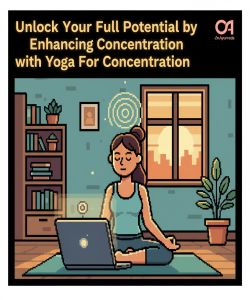
1. Overview of Yoga For Concentration
Yoga for Concentration is a specialised and rigorous discipline engineered to systematically cultivate and fortify the cognitive faculty of attention. It is not merely a sequence of physical exercises but a sophisticated methodology that integrates corporeal postures (Asana), controlled respiratory techniques (Pranayama), and advanced meditative practices (Dhyana) with the singular objective of enhancing mental focus. This potent synthesis works to discipline the incessant fluctuations of the mind, a state described in classical yogic philosophy as citta vritti nirodha, or the cessation of mental turmoil. The practice is predicated on the principle that a stable, controlled body and a regulated breath are prerequisite to achieving a stable, focused mind. Practitioners are guided to develop an unwavering single-pointed awareness, or Ekagrata, enabling them to direct their mental energy with precision and power, free from the debilitating influence of internal and external distractions. It serves as a formidable tool for individuals operating in high-demand environments, demanding intellectual rigour and sustained mental acuity. This is not a passive pursuit of relaxation; it is an active, assertive training of the mind, demanding commitment, discipline, and a profound will to master one's own consciousness. The ultimate aim is to forge a mind that is not a chaotic repository of fleeting thoughts, but a sharp, resilient, and obedient instrument, capable of deep, sustained concentration on any chosen object or task, thereby unlocking superior levels of performance, clarity, and cognitive control. This framework represents a direct and powerful intervention designed to reclaim authority over one's own mental landscape, transforming it from a source of distraction into a powerhouse of focused intent.
2. What are Yoga For Concentration?
Yoga for Concentration constitutes a specific and intentional application of yogic sciences aimed squarely at the enhancement of cognitive focus and mental discipline. It is a structured system that deliberately isolates and amplifies those elements of traditional yoga most conducive to developing sustained attention. This is not general-purpose yoga; it is a targeted mental conditioning programme. The core components of this practice are systematically integrated to create a powerful synergistic effect on the practitioner's ability to concentrate.
These components are:
- Asana (Postures): The physical postures selected for this discipline are not arbitrary. They are chosen for their capacity to demand and cultivate stability, balance, and unwavering physical stillness. Poses like Tree Pose (Vrikshasana) or Eagle Pose (Garudasana) require intense focus to maintain, thereby training the mind to remain fixed and steady. The physical discipline of holding a challenging posture becomes a direct metaphor and training ground for holding mental focus.
- Pranayama (Breath Control): This involves specific breathing techniques designed to regulate the autonomic nervous system and calm the mind. Practices such as Anulom Vilom (Alternate Nostril Breathing) or Bhramari (Humming Bee Breath) directly impact brainwave patterns, moving the mind from a state of scattered agitation to one of calm, collected awareness. By controlling the breath, the practitioner learns to control the torrent of compulsive thinking.
- Dharana (Concentration): This is the central pillar of the practice. Dharana is the formal act of holding the mind's attention on a single point or object, such as the breath, a visual symbol (yantra), or a sound (mantra). It is the active and wilful binding of consciousness to one place, fiercely resisting the mind's natural tendency to wander. This practice directly strengthens the "muscle" of attention.
- Pratyahara (Sensory Withdrawal): A crucial preparatory stage, Pratyahara involves the conscious withdrawal of energy from the external senses. This practice trains the practitioner to become less reactive to environmental stimuli—sights, sounds, and other sensations—thereby creating an internal sanctuary free from distraction, which is essential for deep concentration.
3. Who Needs Yoga For Concentration?
- Professionals in High-Stakes Environments. Executives, surgeons, pilots, and legal professionals who must make critical decisions under immense pressure. For these individuals, a lapse in concentration carries severe consequences. This discipline provides the mental fortitude required to maintain clarity and execute tasks with precision amidst chaos.
- Academics, Researchers, and Scholars. Individuals engaged in deep intellectual work require the ability to sustain focus for extended periods. This practice equips them to delve into complex subject matter, synthesise information, and produce high-calibre work without succumbing to mental fatigue or intellectual drift.
- Students at All Educational Levels. Those preparing for examinations or engaged in rigorous academic curricula must absorb and retain vast quantities of information. Yoga for Concentration provides a systematic method to enhance memory, improve learning capacity, and manage the stress associated with academic performance.
- Creatives and Artists. Writers, designers, and musicians depend on a state of "flow," which is a form of deep, immersive concentration. This yogic discipline helps them to silence internal criticism and external distractions, allowing for the unhindered emergence of creative insight and expression.
- Individuals Managing Attention-Related Conditions. Those who contend with clinically recognised attention deficits or who simply find themselves overwhelmed by the ceaseless distractions of the digital age. This practice offers a non-pharmaceutical, structured methodology for training the brain to regulate its own attentional resources.
- Athletes and Competitive Sportspeople. Peak physical performance is inextricably linked to peak mental focus. This practice enables athletes to achieve a state of being "in the zone," where they can block out crowd noise and performance anxiety, and focus exclusively on the execution of their sport.
- Anyone Seeking to Master Their Own Mind. This is for the individual who refuses to be a passive victim of a scattered, undisciplined mind. It is for those who recognise that mental control is the ultimate form of self-mastery and who are prepared to undertake the rigorous work required to achieve it.
4. Origins and Evolution of Yoga For Concentration
The origins of Yoga for Concentration are deeply embedded in the ancient philosophical bedrock of India, most authoritatively codified in Patanjali's Yoga Sutras. Composed centuries ago, this seminal text outlines the Ashtanga or Eight-Limbed Path, a sequential framework for achieving enlightenment. Within this structure, the sixth limb, Dharana (concentration), is explicitly defined as the foundational practice for disciplining the mind. It is described as the act of binding consciousness to a single point, a deliberate and forceful cognitive exercise that serves as the gateway to deeper meditative states. This was not a practice for general well-being; it was a highly specific technique for spiritual aspirants and ascetics seeking to transcend ordinary mental states and achieve mastery over the self. Classical practices often involved intense, prolonged focus on internal energy centres (chakras), deities, or abstract concepts, demanding immense willpower.
Throughout the subsequent centuries, these techniques were preserved and refined within monastic and hermetic traditions. The teachings were passed down directly from guru to disciple, often shrouded in secrecy and reserved for only the most committed practitioners. The emphasis remained on mental purification and the development of supernatural-like focus (siddhis) as a byproduct of spiritual advancement. The physical postures (Asana) and breathing exercises (Pranayama) were primarily seen as preparatory steps, essential for purifying the body and nervous system to withstand the rigour of prolonged concentration and meditation. The body had to be made still and strong, and the breath calm and even, to create a stable platform for the mind's demanding work.
In the modern era, the principles of Dharana have been extricated from their purely esoteric context and adapted to address contemporary challenges. The rise of cognitive science and neuroscience has provided a new language to describe the profound effects of these ancient practices on the brain's executive functions, particularly the prefrontal cortex. Today, Yoga for Concentration is presented as a systematic, secular methodology for enhancing cognitive performance in a world saturated with information and distraction. The evolution has been from a spiritual tool for transcendence to a pragmatic instrument for mental optimisation, yet the core principle remains unchanged: the disciplined, unwavering application of focused attention is the key to unlocking the mind's formidable power.
5. Types of Yoga For Concentration
The discipline of Yoga for Concentration is not monolithic; it employs specific styles and techniques purposefully selected for their efficacy in cultivating mental focus. The primary types are as follows:
- Hatha Yoga (with a focus on Dharana): Whilst Hatha Yoga is often perceived as a gentle, foundational practice, it becomes a powerful tool for concentration when executed with specific intent. This type involves holding static postures (Asanas) for extended durations. The challenge is not merely physical; it is profoundly mental. The practitioner is commanded to maintain absolute stillness and direct their entire awareness to the physical sensations of the pose or the rhythm of the breath, aggressively resisting the mind's urge to wander. Each posture becomes a training ground for single-pointed focus.
- Raja Yoga (The Royal Path): This is the classical system of yoga detailed by Patanjali, which places supreme emphasis on mastery of the mind. Concentration (Dharana) is a central and explicit stage in its eight-limbed path. Practices within Raja Yoga are overtly mental, involving sustained focus on an internal or external object—such as the space between the eyebrows (Trikuti), the tip of the nose, or a mental image—to the exclusion of all other thoughts. It is the quintessential "yoga of the mind."
- Trataka (Yogic Gazing): A highly specialised and potent technique within Hatha and Raja Yoga, Trataka involves fixed, unwavering gazing at a single point, most commonly the flame of a candle. The practice is performed until the eyes begin to water, forcing the mind into a state of absolute stillness and concentration. It is a direct and intense method for calming mental agitation and strengthening the "muscle" of attention by overriding sensory and mental distractions.
- Mantra Yoga (Japa): This type utilises the repetitive chanting or mental recitation of a specific sound, word, or phrase (mantra). The constant repetition occupies the mind's auditory channels, preventing distracting thoughts from arising. The practice anchors the wandering mind to the single, resonant vibration of the mantra, leading to a state of deep, absorbed concentration. The focus is precise, rhythmic, and all-consuming.
- Nada Yoga (Yoga of Sound): A more subtle practice, Nada Yoga involves focusing on internal sounds. The practitioner first concentrates on external sounds, gradually moving their attention inward to perceive the subtle, inner vibrations of their own consciousness. This requires an extremely refined level of concentration and sensory withdrawal (Pratyahara), training the mind to listen with profound, undistracted attentiveness.
6. Benefits of Yoga For Concentration
- Enhanced Attentional Control: The primary and most direct benefit is a markedly improved ability to consciously direct and sustain focus. Practitioners develop the capacity to hold their attention on a chosen task or object for extended periods, wilfully ignoring internal and external distractions.
- Increased Cognitive Clarity: By training the mind to be still and focused, the practice systematically reduces mental "noise" and clutter. This results in sharper, more lucid thinking, improved problem-solving abilities, and more effective decision-making.
- Improved Memory and Information Retention: A focused mind is a receptive mind. Enhanced concentration allows for more efficient encoding of new information into memory and more reliable retrieval of stored knowledge. Learning becomes a more deliberate and effective process.
- Heightened Self-Awareness (Metacognition): The practice demands constant monitoring of one's own mental state. Practitioners become acutely aware of when their mind begins to wander, enabling them to proactively and skilfully redirect their focus. This is the foundation of mental self-regulation.
- Reduced Susceptibility to Stress and Anxiety: By regulating the breath and calming the nervous system, these practices mitigate the physiological and psychological symptoms of stress. A focused mind is less prone to being hijacked by anxious or catastrophic thinking patterns.
- Greater Executive Function: This discipline directly strengthens the brain's executive functions, which are governed by the prefrontal cortex. This includes improved impulse control, better planning and organisational skills, and enhanced mental flexibility.
- Increased Productivity and Efficiency: With the ability to resist distractions and maintain deep focus, tasks are completed more quickly and to a higher standard. The practitioner can achieve a state of "flow," where work becomes immersive, effortless, and highly productive.
- Profound Mental Resilience: Regular practice builds a robust and resilient mind, one that is less easily disturbed by external events or internal turmoil. It fosters an unwavering inner stability and a powerful sense of command over one's own mental landscape.
7. Core Principles and Practices of Yoga For Concentration
- Ekagrata (Single-Pointed Focus): This is the foundational principle. The entire discipline is oriented around cultivating the ability to hold the mind on a single point, object, or thought, without deviation. All practices are merely instruments to achieve and sustain this state. It is an act of will, not passive observation.
- Abhyasa and Vairagya (Consistent Practice and Non-Attachment): As outlined by Patanjali, mastery requires these twin principles. Abhyasa is the relentless, disciplined, and consistent effort to maintain focus. Vairagya is the practice of non-attachment or detachment from the distractions and mental chatter that inevitably arise. One must practise fiercely whilst remaining indifferent to the mind's attempts at sabotage.
- Sthira Sukham Asanam (Steady and Comfortable Posture): This principle dictates that the physical body must be held in a state of absolute stability and ease. Physical restlessness is a direct precursor to mental restlessness. A firm, unwavering posture is not an end in itself, but an essential prerequisite for achieving a firm, unwavering mind.
- Pranayama (Breath as an Anchor): The breath is recognised as the most direct and potent tool for controlling the mind. The core practice involves anchoring the awareness to the subtle, rhythmic flow of inhalation and exhalation. By mastering the breath, one masters the fluctuations of thought. The rhythm of the breath dictates the rhythm of the mind.
- Pratyahara (Withdrawal of the Senses): A critical practice is the conscious and deliberate turning inward of the senses. The practitioner must learn to insulate their awareness from the constant bombardment of external stimuli—sights, sounds, smells. This creates the internal quiet necessary for deep concentration to occur. It is the act of closing the gates to the external world to work within the internal one.
- Dharana (The Act of Concentration): This is the specific practice of binding the consciousness to a chosen field. The object of concentration (dharana-desha) can be external (a candle flame, a symbol) or internal (a mantra, a chakra, the breath itself). The practice is to return the mind to this object, again and again, with unwavering determination every time it wanders.
- Sakshi Bhava (The Witness Attitude): Practitioners cultivate the ability to observe their own thought processes from a detached perspective, like a witness (Sakshi). Instead of being swept away by thoughts, one learns to see them as transient mental events. This dis-identification is crucial for preventing thoughts from derailing the focus.
8. Online Yoga For Concentration
- Absolute Environmental Control: The online modality offers the practitioner unparalleled control over their practice environment. One can meticulously engineer a space free from the specific visual and auditory distractions common in a group setting. This allows for the creation of a personal sanctuary, optimised exclusively for the deep, internal work of concentration, a factor that is non-negotiable for serious practice.
- Demands Uncompromising Self-Discipline: Without the physical presence of an instructor to enforce accountability, the online format places the onus of discipline squarely on the practitioner. This is not a weakness but a strength. It forces the cultivation of profound self-reliance and internal motivation, which are the very qualities that the practice of concentration seeks to build. Success becomes a direct measure of one's own commitment.
- Accessibility and Consistency: Geographic location and scheduling conflicts become irrelevant. The online format provides the capacity to engage in this rigorous training with unwavering consistency, which is fundamental to achieving tangible results. This accessibility removes all logistical excuses, demanding that the practice be integrated into daily life with military precision.
- Focused, Non-Comparative Practice: The solitude of online practice eliminates the potential for social comparison and self-consciousness that can arise in a group class. The practitioner’s attention is directed entirely inward, upon their own experience and the instructions provided, rather than being diverted by the progress or performance of others. This fosters a purer, more potent form of introspection.
- Repetition and Mastery: Digital platforms provide the ability to revisit specific instructions and guided practices repeatedly. If a particular technique proves challenging, the practitioner has the resource to engage with it again and again until it is fully understood and internalised. This capacity for targeted repetition accelerates the path to mastery of difficult concentration techniques.
- Cultivation of Internal Guidance: While an external instructor provides the framework, the online format necessitates that the practitioner becomes more attuned to their own internal state. One must learn to interpret their own mental and physical feedback with greater acuity, thereby developing a more refined sense of self-awareness and the ability to self-correct, which is the ultimate goal of the discipline.
9. Yoga For Concentration Techniques
- Establish a Stable Foundation (Asana): Begin by assuming a seated posture that is both stable and upright, such as Sukhasana (Easy Pose) or Padmasana (Lotus Pose), ensuring the spine is erect. Hold this posture with absolute stillness. Any physical fidgeting is a direct manifestation of mental restlessness and must be consciously subdued. The body must become an unshakable anchor.
- Regulate the Breath (Nadi Shodhana Pranayama): Close the right nostril with the right thumb and inhale slowly and deeply through the left nostril. Then, close the left nostril with the ring finger, release the thumb, and exhale completely through the right nostril. Inhale through the right nostril, then close it and exhale through the left. This constitutes one round. Perform this for several minutes to balance the nervous system and quiet the mind.
- Initiate Sensory Withdrawal (Pratyahara): Close the eyes. Deliberately withdraw your awareness from all external sounds. Acknowledge them without engagement, then let them fade into the background. Shift your focus inward. Become aware of the inner space of the body and mind, creating a mental fortress against external sensory input.
- Engage in Focused Gazing (Trataka): If using an external object, place a candle flame at eye level, a safe distance away. Gaze at the flame without blinking for as long as possible. Keep the mind fixed solely on the flame. When the eyes begin to water, close them and hold the afterimage of the flame in your mind's eye, at the point between the eyebrows. This fiercely channels the mind.
- Implement Single-Pointed Concentration (Dharana): Choose your object of focus. This can be the mental afterimage from Trataka, the natural sensation of the breath at the tip of the nostrils, or the mental repetition of a simple mantra like "Soham."
- Execute a Relentless Return: Your mind will wander. This is not a failure; it is an inevitability. The technique is not to prevent the mind from wandering, but to notice the moment it has wandered and, without judgment or frustration, to firmly and immediately bring it back to your chosen object of concentration. Perform this action relentlessly. Each return strengthens your mental discipline.
- Conclude with Integration: After a set period, release the intense focus. Sit quietly for a few moments, observing the state of your mind. Notice the clarity and stillness that have been cultivated. This integration phase allows the benefits of the practice to settle into your consciousness.
10. Yoga For Concentration for Adults
The application of Yoga for Concentration for adults is a formidable and necessary strategy for navigating the complexities and cognitive demands of modern professional and personal life. For the adult mind, often fragmented by relentless multitasking, chronic stress, and the pervasive digital deluge, this discipline is not a mere hobby but a critical tool for mental recalibration and performance enhancement. It directly confronts the degradation of attentional capacity that characterises adult life, offering a structured, non-pharmaceutical methodology for reclaiming cognitive sovereignty. The practice demands a level of maturity and self-discipline that adults are uniquely positioned to provide, transforming life experience from a source of mental clutter into a foundation for focused resolve. It systematically trains the adult to filter out irrelevant stimuli, manage emotional reactivity, and sustain focus on high-value objectives, whether in the boardroom, an academic setting, or during complex problem-solving. The postures build physical resilience to counter sedentary lifestyles, whilst the breathing and concentration techniques directly regulate the nervous system, mitigating the effects of accumulated stress. For adults, this is a pragmatic investment in their most valuable asset: a clear, controlled, and powerful mind. It is the means by which an individual ceases to be managed by their chaotic thoughts and instead becomes the assertive manager of their own consciousness. This disciplined practice provides the mental architecture required not only to succeed in high-pressure environments but also to cultivate a profound sense of inner stability and purpose amidst the inevitable challenges of adulthood.
11. Total Duration of Online Yoga For Concentration
The standardised and mandated duration for a single, complete session of Online Yoga for Concentration is precisely one hour. This specific timeframe is not arbitrary; it is a meticulously structured allocation designed to ensure maximum efficacy and facilitate the profound neurological shifts that the practice intends to induce. A duration of less than this is considered insufficient to move the practitioner through the necessary preparatory, intensive, and integrative phases of the discipline. The initial segment of the 1 hr session is dedicated to preparatory Asanas and Pranayama, essential for stilling the body and calming the autonomic nervous system, thereby creating the requisite physiological platform for deep mental work. The central, most substantial portion of the hour is reserved for the rigorous practice of Dharana (concentration) itself, a demanding activity that requires a significant, uninterrupted block of time to build momentum and achieve a state of sustained, single-pointed focus. Any shorter period would only permit a superficial engagement. The final segment of the 1 hr is non-negotiable; it is allocated for crucial integration practices, such as Savasana (Corpse Pose) or quiet sitting, allowing the nervous system to absorb and consolidate the profound effects of the concentration work. Adherence to the full one-hour duration is therefore imperative. It reflects a serious commitment to the process and provides the necessary container within which the demanding and transformative work of training the mind can be successfully undertaken. This is the required operational standard.
12. Things to Consider with Yoga For Concentration
Before embarking on the rigorous discipline of Yoga for Concentration, several critical factors must be given serious consideration. This is not a casual endeavour and demands a sober assessment of one's readiness and environment. Foremost is the requirement for unwavering commitment and consistency. Sporadic or half-hearted practice will yield negligible results; the benefits of this discipline are cumulative and are forged only through relentless, daily application. One must be prepared to establish a non-negotiable time and space for this work. Furthermore, the practitioner must honestly evaluate their mental and emotional state. Whilst the practice is designed to calm the mind, individuals undergoing severe psychological distress should proceed with caution and potentially seek professional guidance, as the intense introspection can sometimes amplify latent issues before resolving them. The physical demands, though secondary to the mental, must not be ignored. A baseline of physical health is necessary to hold steady postures without pain or significant distraction. The choice of technique is also a vital consideration. Not all concentration objects or practices are suitable for every temperament; one must be willing to experiment under guidance to find the method that provides a sustainable challenge without causing undue mental strain. Finally, one must cultivate immense patience and relinquish the expectation of immediate results. The path to mastering concentration is a gradual process of strengthening a cognitive "muscle." Frustration is the enemy of focus; a mindset of determined, patient persistence is absolutely essential for success.
13. Effectiveness of Yoga For Concentration
The effectiveness of Yoga for Concentration is both profound and empirically demonstrable, predicated on its systematic and multi-faceted approach to training the mind. Its potency lies in its direct engagement with the core mechanisms of attention. By mandating physical stillness through Asana, the practice severs the powerful feedback loop between bodily restlessness and mental agitation. The deliberate regulation of the breath via Pranayama directly influences the autonomic nervous system, shifting the practitioner from a state of fight-or-flight (sympathetic) arousal to one of calm alertness (parasympathetic), creating the neurochemical environment necessary for sustained focus. The central practice of Dharana—the relentless returning of the mind to a single point—acts as a form of targeted cognitive training. This process demonstrably strengthens neural pathways in the prefrontal cortex, the brain region responsible for executive functions such as attentional control, impulse inhibition, and working memory. Consequently, the practice is not merely a subjective experience of feeling more focused; it induces tangible, structural, and functional changes in the brain. Its effectiveness is therefore not a matter of belief but of disciplined application. For the individual who commits to its rigorous protocol, the result is a measurable enhancement in the ability to direct and sustain mental effort, resist distraction, and achieve a state of profound cognitive clarity and control. The methodology is sound, the process is rigorous, and the outcome, when pursued with discipline, is unequivocally effective.
14. Preferred Cautions During Yoga For Concentration
It is imperative that practitioners observe strict cautions during the application of Yoga for Concentration to ensure safety and efficacy. This is a potent discipline and must be approached with intelligence, not recklessness. Foremost, one must never force the body into a physical posture beyond its capacity; pain is a signal to desist, not a challenge to be overcome. Injury creates a significant obstacle to the stillness required for concentration. Regarding breathing techniques (Pranayama), individuals with cardiovascular conditions, high blood pressure, or respiratory ailments must proceed with extreme caution and ideally under qualified supervision, as certain techniques can significantly alter blood pressure and intrathoracic pressure. The practice of Trataka (fixed gazing) must be performed with vigilance; those with glaucoma or serious eye conditions should avoid it or seek expert medical advice. Mentally, it is crucial to avoid creating excessive strain or developing a severe, self-critical attitude. Whilst discipline is key, a tense, forceful approach to concentration can be counterproductive, leading to headaches and mental exhaustion. The aim is alert, sustained focus, not a fraught internal battle. One must cultivate a balance between firm resolve and patient acceptance. If at any point the practice induces significant anxiety, disorientation, or distressing mental phenomena, it is essential to cease immediately and ground oneself. The practice is a tool for mastery, not a path to self-inflicted harm. A mature, cautious, and highly self-aware approach is not optional; it is a fundamental requirement.
15. Yoga For Concentration Course Outline
- Module 1: Foundational Principles and Postural Stability
- Introduction to the philosophy of Dharana (Concentration) and its role in the Eight-Limbed Path.
- Establishing Sthira Sukham Asanam: Mastering stable and comfortable seated postures.
- Core stability Asanas to build the physical endurance required for prolonged sitting.
- The principle of the body-mind connection: how physical stillness engenders mental stillness.
- Module 2: The Science of Breath and Mind (Pranayama)
- Introduction to the vital life force (Prana) and its control.
- Practice of Dirga Pranayama (Three-Part Breath) for awareness.
- Mastery of Nadi Shodhana (Alternate Nostril Breathing) for balancing the nervous system and brain hemispheres.
- Introduction to Bhramari Pranayama (Humming Bee Breath) for calming the mind.
- Module 3: The Gateway to Concentration (Pratyahara)
- Understanding the theory and practice of sensory withdrawal.
- Techniques for disengaging from external auditory and visual stimuli.
- Practice of Yoga Nidra as a method for systematic relaxation and Pratyahara.
- Cultivating the Sakshi Bhava (Witness Attitude) towards sensory input.
- Module 4: The Core Practice of Concentration (Dharana)
- Selection of a suitable object for concentration (breath, mantra, yantra).
- Technique of Trataka (Focused Gazing) on a candle flame to train the eyes and mind.
- Systematic practice of holding focus on the chosen object.
- The methodology of "relentless return": what to do when the mind wanders.
- Module 5: Advanced Techniques and Integration
- Introduction to subtler objects of concentration (internal sounds, energy centres).
- Techniques for lengthening the duration of sustained focus without strain.
- Integrating concentration skills into daily activities for real-world application.
- Developing a sustainable, long-term personal practice.
16. Detailed Objectives with Timeline of Yoga For Concentration
Weeks 1-2: Foundational Embodiment and Breath Awareness
- Objective: To establish a physically stable and motionless seated posture for a minimum of ten continuous minutes.
- Objective: To master the mechanics of Dirga (Three-Part) and Nadi Shodhana (Alternate Nostril) Pranayama.
- Timeline Benchmark: By the end of Week 2, the practitioner will be able to sit without physical distraction and perform five minutes of Nadi Shodhana with ease, achieving a noticeable state of calm.
Weeks 3-4: Cultivating Sensory Quietude
- Objective: To develop a functional capacity for Pratyahara (sensory withdrawal), consciously minimising the impact of external distractions.
- Objective: To successfully practise Trataka (candle gazing) for two minutes without blinking, followed by holding the afterimage for a further two minutes.
- Timeline Benchmark: By the end of Week 4, the practitioner will demonstrate the ability to remain internally focused despite ambient noise and will have established Trataka as a core preparatory practice.
Weeks 5-8: The Rigour of Single-Pointed Focus (Dharana)
- Objective: To sustain uninterrupted concentration on a chosen object (e.g., the breath at the nostrils) for a continuous period of five minutes.
- Objective: To develop proficiency in the "relentless return," reducing the time-lag between mind-wandering and the re-establishment of focus.
- Timeline Benchmark: By the end of Week 8, the practitioner will be able to achieve multiple cycles of five-minute sustained concentration within a single session, with significantly reduced mental frustration.
Weeks 9-12: Deepening and Integration
- Objective: To increase the duration of sustained, uninterrupted concentration to ten minutes or more.
- Objective: To begin applying the principles of focused awareness to a simple daily task, such as eating or walking, for five minutes a day.
- Timeline Benchmark: By the end of Week 12, the practitioner will have a robust and self-sufficient personal practice, will be capable of deep states of concentration, and will have initiated the transfer of this skill from formal practice to everyday life.
17. Requirements for Taking Online Yoga For Concentration
- A Dedicated and Uncluttered Physical Space: You must designate a specific area for practice that is, and will remain, free from clutter and common household traffic. This space must be exclusively associated with the discipline to prime the mind for focus.
- A High-Quality, Stable Internet Connection: The connection must be robust and reliable. Intermittent service, buffering, or dropouts are unacceptable, as they shatter the continuity of instruction and the delicate state of concentration being cultivated.
- Appropriate Audio-Visual Equipment: A device with a clear screen and coherent audio output is non-negotiable. The practitioner must be able to see demonstrations and hear instructions with absolute clarity, without strain or technical compromise.
- A Commitment to Absolute Privacy: You must ensure that you will not be interrupted by other people, pets, or notifications for the entire duration of the session. This requires proactive communication with household members and the silencing of all electronic devices other than the one used for the class.
- Essential Yogic Equipment: A high-quality yoga mat is fundamental. Depending on the specific instructions, a firm cushion or yoga block to facilitate a proper seated posture may also be required. The absence of proper support invites physical discomfort, which is a primary source of distraction.
- Unwavering Self-Discipline and Accountability: The online format necessitates a higher degree of personal responsibility than an in-person class. You must possess the internal drive to show up on time, engage fully without external supervision, and resist the myriad distractions of a home environment.
- A Mindset of Receptivity and Seriousness: The practitioner must approach each session not as a passive viewer of content, but as an active participant in a rigorous training discipline. A serious, focused, and receptive mental attitude is the most critical requirement of all.
18. Things to Keep in Mind Before Starting Online Yoga For Concentration
Before commencing an online course in Yoga for Concentration, it is imperative to adopt a mindset of rigorous self-sufficiency and to establish an unbreachable practice environment. Understand that the digital medium places the entire burden of discipline, focus, and environmental control squarely upon your shoulders. There is no instructor to correct your posture in real-time, nor a shared group energy to buoy your efforts. You are solely responsible for creating a sanctuary free from the encroachments of daily life—this means silencing phones, disabling notifications, and ensuring you will not be disturbed. Your success will be directly proportional to the seriousness with which you treat this preparation. Furthermore, recognise that progress in concentration is not linear. There will be sessions where focus feels effortless and others where the mind is exceptionally turbulent. This is part of the process. You must cultivate a resilient, non-judgmental attitude, treating each instance of mind-wandering not as a failure, but as an opportunity to strengthen your resolve by bringing your attention back. Acknowledge that you are training a fundamental cognitive skill, much like strengthening a muscle. This requires patience, consistency, and a formidable commitment that transcends mere interest. You must be prepared to be your own motivator, your own supervisor, and your own harshest, yet fairest, critic. The online format is a powerful tool, but only for the individual who is prepared to meet its unique and uncompromising demands.
19. Qualifications Required to Perform Yoga For Concentration
The performance and, more critically, the instruction of Yoga for Concentration demand a set of qualifications that extend far beyond a superficial understanding of yoga postures. The requisite expertise is multi-layered, combining formal certification with deep, personal experience. A credible instructor must possess, at a minimum, a foundational certification from a recognised yoga authority (e.g., RYT-200 or RYT-500 from Yoga Alliance or equivalent), but this is merely the entry point. The essential qualifications are more specialised:
- Advanced Training in Yogic Philosophy and Psychology: The instructor must have undertaken in-depth study of classical texts, particularly Patanjali's Yoga Sutras. A thorough understanding of the concepts of Citta (mind-stuff), Vritti (fluctuations), Dharana (concentration), Dhyana (meditation), and Samadhi (absorption) is non-negotiable.
- Specialised Certification in Meditation and Pranayama: Beyond general yoga teacher training, specific qualifications in teaching meditation and advanced breathwork are critical. This ensures they have the technical knowledge to guide students safely and effectively through potent mind-altering techniques.
- A Demonstrable Personal Practice: The most crucial qualification is an established, long-term, and profound personal practice of concentration and meditation. An instructor cannot guide others to a place they have not rigorously explored themselves. Their instruction must be rooted in the authority of direct, embodied experience, not just theoretical knowledge.
- Understanding of Contraindications: The instructor must be knowledgeable about the psychological and physiological contraindications. They must be able to identify students for whom intense concentration practices may be unsuitable and have the wisdom to guide them appropriately.
Therefore, whilst foundational certification provides a framework, the true qualification to perform and teach this discipline is a synthesis of rigorous academic study, specialised technical training, and most importantly, the authority that comes only from years of dedicated personal practice.
20. Online Vs Offline/Onsite Yoga For Concentration
Online
The online modality for Yoga for Concentration offers a distinct set of advantages and challenges centred on autonomy and environmental control. Its primary strength lies in its supreme accessibility, removing all geographical and logistical barriers to consistent practice. This format empowers the practitioner to create a highly controlled, personalised sanctuary, meticulously engineered to be free of external stimuli that might be present in a public studio. This solitude can foster a deeper level of introspection, as the practice becomes a purely internal affair, free from the distractions of social comparison or performance anxiety. However, this autonomy is a double-edged sword. It demands an uncompromising level of self-discipline and internal motivation, as there is no external authority to enforce commitment. Furthermore, the absence of a physically present instructor means that subtle, crucial corrections to posture and alignment are impossible. The practitioner bears the full responsibility for their own safety and for accurately interpreting the instructions, demanding a higher degree of self-awareness.
Offline/Onsite
The traditional offline, or onsite, format provides a structured, communal environment that brings its own set of powerful dynamics. The direct physical presence of a qualified instructor is its most significant asset. This allows for immediate, hands-on adjustments and personalised feedback, ensuring postural integrity and safe practice, which is especially critical for beginners. The collective energy (satsang) of a group practising together can be profoundly motivating, creating a palpable atmosphere of shared focus that can help individuals push past their personal limitations. The designated studio space is already primed for practice, removing the need for the individual to create and maintain their own environment. The disadvantages, however, are logistical. Onsite classes are bound by a fixed schedule and location, which can present a barrier to consistency. The presence of other people, whilst potentially motivating, can also be a source of distraction, and the practitioner has no control over ambient noise or other environmental factors within the shared space.
21. FAQs About Online Yoga For Concentration
Question 1. Is this different from a regular online yoga class? Answer: Yes, fundamentally. It is a specialised discipline focused exclusively on techniques for enhancing cognitive focus, not on general fitness or flexibility.
Question 2. Do I need to be flexible to participate? Answer: No. The primary physical requirement is the ability to sit comfortably in a stable, upright posture. Extreme flexibility is irrelevant to the core objective.
Question 3. What equipment is absolutely essential? Answer: A yoga mat, a stable internet connection, and a quiet, private space are non-negotiable. A cushion or block for sitting is highly recommended.
Question 4. Can a beginner do this? Answer: Yes, provided the beginner possesses the required self-discipline and maturity to follow instructions precisely in an online format.
Question 5. Will this help with my anxiety? Answer: Whilst many find the practice calming, its primary goal is concentration, not anxiety treatment. Reduced anxiety is often a positive byproduct, but not the central aim.
Question 6. How quickly will I see results? Answer: Results are cumulative and depend entirely on the consistency and quality of your practice. Do not expect immediate transformation; this is a long-term training discipline.
Question 7. Is it safe to practise without an instructor physically present? Answer: It is safe if you listen to your body, never force a posture, and follow the instructions with precision. The onus of safety rests entirely on you.
Question 8. What if I cannot keep my mind from wandering? Answer: That is the practice itself. The goal is not to have a perfectly still mind, but to relentlessly and firmly bring the mind back to the point of focus each time it wanders.
Question 9. Is there any chanting or religious element? Answer: Some techniques may use a mantra (a repeated sound), but it is presented as a cognitive tool for focus, not as a religious observance.
Question 10. Can I do this if I have a busy, noisy home? Answer: It is not ideal. You must be able to secure a time and space where you will be absolutely free from interruptions.
Question 11. What is the single most important factor for success? Answer: Unwavering consistency.
Question 12. Can this practice make me feel tired? Answer: Intense concentration can be mentally fatiguing initially, much like physical exercise. This dissipates with regular practice as your mental stamina increases.
Question 13. How is this different from just mindfulness meditation? Answer: This is a more active and forceful practice. It often involves Dharana (holding focus on one point), whereas some mindfulness involves Dhyana (open, choiceless awareness). It is a more targeted form of mental training.
Question 14. What if I fall asleep? Answer: This indicates either physical exhaustion or a lack of mental alertness. Ensure your posture is upright and engaged, not passive.
Question 15. Do I need to have my camera on? Answer: This depends on the specific course protocol, but having it on often increases accountability.
Question 16. Is there a specific time of day that is best to practise? Answer: The morning is often preferred, as the mind is typically clearer. However, the best time is the time you can practise consistently without fail.
22. Conclusion About Yoga For Concentration
In conclusion, Yoga for Concentration stands as a formidable and highly structured discipline, engineered for the explicit purpose of mastering the human mind. It is a direct and assertive antidote to the cognitive fragmentation endemic to the modern world. This is not a passive relaxation technique or a general wellness activity; it is a rigorous system of mental conditioning that synthesises physical stability, respiratory control, and focused awareness to forge an unwavering and resilient consciousness. The practice is built upon the timeless principles of Dharana, demanding commitment, consistency, and a profound will to exercise authority over one's own internal landscape. Its methodologies are precise, its objectives are clear, and its benefits—enhanced focus, cognitive clarity, and profound mental stability—are tangible for those who undertake the work with the seriousness it commands. Whether pursued online or in a traditional setting, the core challenge remains the same: the practitioner must confront the ceaseless agitation of their own mind and, through disciplined practice, transform it from a source of distraction into a powerful, obedient instrument of will. Ultimately, Yoga for Concentration offers a path not merely to improved performance, but to a fundamental state of self-mastery, providing the tools to navigate a complex world with a mind that is sharp, steady, and entirely under one's own command.