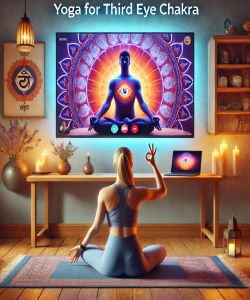
1. Overview of Yoga for Third Eye Chakra
Yoga for the Third Eye Chakra, or Ajna Chakra, represents a highly specialised and profound discipline aimed at the cultivation of supreme consciousness and intuitive perception. This is not a practice of mere physical exertion; it is a rigorous system of psycho-spiritual technology designed to awaken the latent capacities of the human mind. Situated conceptually at the point between the eyebrows, the Ajna Chakra is considered the command centre of the intellect, intuition, and inner wisdom. The yogic methodologies applied to its activation are therefore precise, targeted, and demanding. They transcend the more common objectives of physical flexibility or stress reduction, focusing instead on the systematic purification of the mind and the enhancement of its perceptive faculties. Through a disciplined synthesis of specific physical postures (asanas), controlled breathing techniques (pranayama), focused concentration (dharana), and deep meditation (dhyana), the practitioner is guided towards a state of heightened awareness. The ultimate objective is to dissolve the veil of ordinary perception, which is often clouded by sensory input and conditioned thought patterns, and to access a direct, unmediated understanding of reality. This path requires unwavering commitment and mental fortitude, as it challenges the very foundations of one’s perceived identity and worldview. It is a formidable journey inward, a deliberate process of moving from intellectual knowledge to experiential wisdom. The practice is therefore a direct confrontation with the self, a methodical stripping away of illusion to reveal the luminous core of pure awareness. It is the pinnacle of internal yoga, where the body serves as a stable vessel and the breath as a tool to command the mind, ultimately unlocking the gateway to higher states of consciousness and profound, unshakeable clarity. The practitioner who successfully navigates this path does not merely see the world differently; they perceive its underlying fabric with an authority born of direct, internal experience.
2. What are Yoga for Third Eye Chakra?
Yoga for the Third Eye Chakra constitutes a specific and integrated collection of advanced yogic techniques meticulously selected for their direct impact on the Ajna Chakra, the centre of intuition and inner sight. These practices are not arbitrary but form a cohesive system designed to stimulate, balance, and awaken this potent energy centre. The discipline is multi-faceted, employing a range of tools from the yogic arsenal to achieve its singular objective of heightened perception. It is fundamentally a practice of internalisation, where the focus is systematically withdrawn from the external world and directed inward to the point between the eyebrows.
The core components of this specialised yoga include:
- Asana (Postures): Specific physical postures are employed not for their acrobatic quality but for their physiological and energetic effects. Poses that increase circulation to the head and brain, such as Headstand (Sirsasana) and Child's Pose (Balasana), are fundamental. Furthermore, balancing postures that demand intense focus, such as Eagle Pose (Garudasana), directly train the mind’s capacity for one-pointed concentration, a prerequisite for Ajna activation.
- Pranayama (Breath Control): Breathing techniques are paramount. Alternate Nostril Breathing (Nadi Shodhana) is particularly crucial as it is understood to balance the ida and pingala nadis (energy channels), which converge at the Ajna Chakra. This balancing is considered essential for awakening the central channel (sushumna) and facilitating the ascent of conscious energy.
- Mudra (Energetic Seals): Hand gestures and specific bodily locks are used to direct the flow of prana (life force energy). Shambhavi Mudra, the practice of gazing at the eyebrow centre, is a direct and powerful technique for stimulating the Ajna. Hakini Mudra, where the fingertips of both hands touch, is believed to integrate the hemispheres of the brain, enhancing cognitive and intuitive function.
- Mantra (Sound Vibration): The chanting of specific seed sounds, most notably the universal mantra 'OM', is integral. The vibration is directed to the Ajna centre, believed to resonate with and purify the chakra.
- Dharana and Dhyana (Concentration and Meditation): These are the culminating practices. They involve sustained, unwavering focus on the Third Eye point, often accompanied by visualisation of a luminous light or symbol, leading to deep meditative states where intuitive insights can arise.
3. Who Needs Yoga for Third Eye Chakra?
-
Individuals experiencing persistent mental fog, cognitive indecision, and an inability to achieve clarity in their thought processes. This practice provides the tools to cut through mental clutter and establish a state of sharp, focused awareness.
-
Professionals and leaders in high-stakes environments who rely on sharp judgment, strategic foresight, and the ability to make critical decisions under pressure. The cultivation of intuition provides a decisive edge beyond mere rational analysis.
-
Creative professionals, artists, and innovators suffering from creative blocks or a lack of inspiration. Activation of the Ajna Chakra is directly linked to unlocking imaginative potential and accessing a deeper wellspring of original ideas.
-
Persons feeling a profound sense of disconnection from their inner self or life’s purpose. This discipline fosters a deep internal connection, guiding the practitioner towards an authentic understanding of their path and potential.
-
Practitioners of other spiritual or meditative disciplines who have reached a plateau and seek to deepen their introspective experiences and break through to higher states of consciousness.
-
Individuals overly reliant on external validation and data, who wish to develop greater self-trust and the capacity to rely on their own inner guidance system.
-
Those plagued by anxiety rooted in overthinking and future-based speculation. The practice anchors the mind in a state of present-moment awareness and perceptual clarity, reducing the tendency for mental projection.
-
Students of philosophy and esoteric knowledge who seek to move beyond theoretical understanding to direct, experiential wisdom. This yoga provides the practical methodology to transform intellectual concepts into lived reality.
-
Individuals seeking to enhance their memory, focus, and overall cognitive function. The techniques directly stimulate the neurological and energetic systems associated with mental acuity and concentration.
-
Anyone committed to a path of radical self-inquiry and personal evolution, who is prepared to confront and transcend limiting beliefs and conditioned patterns of perception. This is a discipline for those who demand self-mastery.
4. Origins and Evolution of Yoga for Third Eye Chakra
The conceptual framework for the Third Eye Chakra, or Ajna Chakra, is deeply rooted in the ancient esoteric traditions of India, particularly within Tantra. Unlike the classical yoga codified by Patanjali, which focuses primarily on the restraint of mental fluctuations, the Tantric systems developed a sophisticated cartography of the subtle body, comprising nadis (energy channels) and chakras (energy centres). It is from these Tantric texts, dating back well over a thousand years, that the detailed understanding of Ajna as the command centre of consciousness emerges. In these early scriptures, the Ajna Chakra was not merely a point for passive meditation but a critical gateway to be actively and systematically unlocked to achieve siddhis (spiritual powers) and, ultimately, liberation (moksha).
The practices associated with the Ajna Chakra were often secretive, passed down directly from guru to disciple, and considered highly potent and potentially hazardous if undertaken without proper guidance. Techniques such as Shambhavi Mudra (eyebrow centre gazing) and specific forms of pranayama were detailed in seminal Hatha Yoga texts like the Hatha Yoga Pradipika and the Gheranda Samhita, which served as a bridge, integrating Tantric subtle body practices into the broader fold of yoga. These texts codified the methods for purifying the nadis and awakening Kundalini energy, with the Ajna Chakra being a crucial station on its upward journey towards the crown chakra, Sahasrara.
In the modern era, the evolution of this practice has been twofold. On one hand, the global dissemination of yoga has led to a popularisation, and sometimes a simplification, of the chakra system. The Third Eye became a widely recognised symbol, often detached from its rigorous practical and philosophical context. On the other hand, authentic lineages and serious contemporary masters have preserved and adapted the profound techniques for a modern audience. Figures like Swami Sivananda and his disciples were instrumental in presenting these esoteric concepts in a clear, systematic manner. Today, dedicated forms of yoga, such as Kundalini Yoga as taught by Yogi Bhajan, place a strong, explicit emphasis on kriyas (sets of exercises) designed specifically to stimulate the Ajna Chakra and the pituitary gland, blending ancient techniques with a structure accessible to the modern practitioner. The practice has thus evolved from a hidden esoteric art to a defined discipline for those seeking to cultivate higher perception.
5. Types of Yoga for Third Eye Chakra
The activation and balancing of the Ajna Chakra are not the exclusive domain of a single yogic style; rather, several potent methodologies specialise in the cultivation of inner awareness and are therefore exceptionally suited for this purpose. Each approach offers a unique pathway to the same objective: heightened intuition and perceptual clarity.
-
Jnana Yoga (The Yoga of Knowledge): This is the philosophical path of self-inquiry, directly engaging the intellect to transcend it. Jnana Yoga is fundamentally an Ajna Chakra practice, as it employs rigorous discrimination (viveka) and contemplation to distinguish the real from the unreal. Its primary technique is Neti-Neti ('not this, not that'), a process of negating all that is not the true Self, which sharpens the intellect to a razor’s edge before it ultimately surrenders to direct, intuitive knowing.
-
Raja Yoga (The Royal Yoga): Codified by Patanjali, this is the path of mental mastery through the Ashtanga (eight-limbed) system. Its latter limbs—Dharana (concentration), Dhyana (meditation), and Samadhi (union)—are the core of Ajna Chakra work. Raja Yoga provides a systematic, step-by-step methodology for steadying the body, regulating the breath, and turning the mind inward to achieve one-pointed focus on an object of meditation, such as the point between the eyebrows.
-
Kundalini Yoga: This powerful and dynamic form of yoga directly aims to awaken the dormant Kundalini energy at the base of the spine and guide it upward through the chakras. It utilises specific kriyas—prescribed sets of postures, breathwork, mantra, and mudra—many of which are explicitly designed to stimulate the pituitary gland and activate the Ajna Chakra, leading to rapid shifts in consciousness.
-
Yin Yoga: While seemingly passive, Yin Yoga is a profound practice for the subtle body. By holding floor-based postures for extended periods, it places gentle, sustained stress on the connective tissues and stimulates the meridians, or nadis. Specific poses can be chosen to direct the flow of prana towards the head, and the long holds create a deeply meditative container for turning awareness inward to the Third Eye.
-
Trataka (Focused Gazing): Though a shatkarma (a purification technique), Trataka is one of the most direct practices for the Ajna Chakra. It involves unwavering, tearless gazing at a single point, typically a candle flame, followed by closing the eyes and holding the afterimage at the eyebrow centre. This practice fiercely develops concentration and directly stimulates the energetic centre of Ajna.
6. Benefits of Yoga for Third Eye Chakra
-
Enhanced Intuitive Capacity: A primary and direct benefit is the significant strengthening of intuition, providing access to an inner guidance system that transcends logical and analytical thought processes for superior decision-making.
-
Increased Mental Clarity and Focus: The practice systematically eliminates mental clutter and indecisiveness, cultivating a state of one-pointed concentration (ekagrata) and profound mental clarity that permeates all aspects of life.
-
Heightened Perception and Awareness: It facilitates a shift in perception, allowing the practitioner to see beyond superficial appearances and recognise the underlying patterns and interconnectedness of events and circumstances.
-
Improved Cognitive Function: Disciplines targeting the Ajna Chakra are directly linked to enhanced memory, intellectual power, and the ability to grasp complex concepts with greater ease and depth.
-
Stimulation of the Pineal and Pituitary Glands: The energetic practices are understood to directly stimulate the pineal and pituitary glands, master glands of the endocrine system, which regulate critical bodily functions and cycles.
-
Unlocking of Creativity and Imagination: By activating the centre of vision and imagination, this yoga dissolves creative blocks and opens a conduit to a vast reservoir of innovative ideas and imaginative potential.
-
Greater Self-Awareness and Insight: The discipline fosters a deep state of introspection, leading to profound insights into one's own nature, purpose, and psychological patterns, facilitating significant personal growth.
-
Reduction of Anxiety and Fear: By anchoring the mind and developing a trust in one's inner wisdom, the practice diminishes fear and anxiety that arise from a sense of uncertainty and lack of control.
-
Emotional and Psychological Equilibrium: Balancing the Ajna Chakra helps to harmonise the dualistic forces within the psyche, leading to greater emotional stability, resilience, and a detached perspective on life's challenges.
-
Development of a Vision for One's Life: It empowers individuals to formulate and hold a clear vision for their future, aligning their actions with their deepest purpose and manifesting their goals with greater precision and authority.
7. Core Principles and Practices of Yoga for Third Eye Chakra
-
Pratyahara (Withdrawal of the Senses): This is the foundational principle. The practitioner must consciously and deliberately withdraw awareness from external sensory stimuli—sights, sounds, and physical sensations—to create the internal quietude necessary for inner focus. All subsequent practices depend on this mastery.
-
Dharana (Concentration) on the Ajna Point: The central practice involves sustained, unwavering concentration on the Bhrumadhya, the point between the eyebrows. This focus must be maintained without strain, serving as an anchor for the mind and a direct point of energetic stimulation.
-
Asana for Cephalic Circulation and Focus: Select physical postures are mandatory. Inversions like Sirsasana (Headstand) and Sarvangasana (Shoulderstand) are employed to increase blood flow to the brain and pituitary-pineal gland complex. Balancing poses like Garudasana (Eagle Pose) are utilised to cultivate the intense mental focus required for deeper meditative states.
-
Nadi Shodhana Pranayama (Alternate Nostril Breathing): This specific breathing technique is non-negotiable. Its purpose is to purify and balance the ida (lunar, left) and pingala (solar, right) energy channels. The harmonious flow of these two channels is an absolute prerequisite for the awakening of consciousness at the Ajna Chakra, where they converge.
-
Application of Shambhavi Mudra (Eyebrow Centre Gazing): This is a direct and potent technique for Ajna activation. It involves directing the gaze of both eyes upwards and inwards towards the eyebrow centre. It is to be practised with precision and under guidance to avoid strain, powerfully stimulating the targeted energetic and neurological centres.
-
Chanting of the Bija Mantra 'OM': The primal sound 'OM' is considered the vibrational-energetic signature of the Ajna Chakra. The practice of chanting it, either aloud or mentally (manasika japa), with awareness focused at the brow point, serves to purify, energise, and attune the chakra to its native frequency.
-
Visualisation (Bhavana): Advanced practice involves sophisticated visualisation techniques. The practitioner may be instructed to visualise a brilliant point of light, a specific yantra (geometric diagram), or their chosen deity at the Ajna centre. This harnesses the power of the mind's eye to further concentrate and refine consciousness.
-
Cultivation of Witness Consciousness (Sakshi Bhava): The overarching principle is to develop a state of detached observation, where one witnesses thoughts, emotions, and sensations without identification. This dis-identification is the key to transcending the conditioned mind and accessing the pure, intuitive wisdom of the Ajna Chakra.
8. Online Yoga for Third Eye Chakra
-
Unhindered Access to Specialised Instruction: The online modality demolishes geographical barriers, granting practitioners access to highly specialised and authentic instructors from anywhere in the world. This is critical for a niche discipline like Ajna Chakra work, where qualified teachers are not universally available.
-
Creation of a Controlled, Personalised Sanctuary: Practising online allows the individual to construct a private, distraction-free environment. This is paramount for the deep introspection and sensory withdrawal (Pratyahara) required for this yoga, free from the potential disturbances or self-consciousness of a public studio.
-
Facilitation of Unwavering Discipline and Consistency: The ability to integrate the practice seamlessly into one's daily schedule from a home base fosters rigorous consistency. This regularity is non-negotiable for achieving the cumulative effect necessary to stimulate the Ajna Chakra effectively.
-
Intensified Requirement for Self-Discipline: The online format places the onus of commitment squarely on the practitioner. It demands a higher level of personal responsibility, focus, and internal motivation, which in itself is a practice that strengthens the will—a quality directly associated with a balanced Ajna.
-
Privacy for Profound Internal Processes: Ajna Chakra work can catalyse profound psychological and emotional experiences. The privacy of an online session allows the practitioner to navigate these internal shifts without inhibition or concern for external judgment, fostering a more authentic and transformative experience.
-
Direct and Focused Auditory Guidance: In an online setting, the instructor's voice can be received directly via headphones, creating an immersive and highly focused auditory experience. This minimises external sound distractions and allows for precise, uninterrupted guidance during delicate pranayama and meditation techniques.
-
Opportunity for Immediate Integration: Concluding a deep meditative session at home means there is no jarring commute or transition back to the external world. The practitioner can remain in a state of quiet reflection, allowing the benefits of the practice to be integrated more deeply and seamlessly into their being.
-
Review and Reinforcement through Recorded Sessions: Many online platforms provide access to session recordings. This enables the dedicated practitioner to revisit specific instructions, refine their technique, and reinforce their learning, accelerating their progress on this demanding path.
9. Yoga for Third Eye Chakra Techniques
A systematic approach is required to engage the Ajna Chakra effectively. The following sequence represents a structured and potent methodology. Each step must be executed with precision and full awareness.
-
Establish a Stable Foundation (Asana Sthira): Begin by assuming a comfortable and absolutely stable seated meditation posture, such as Sukhasana (Easy Pose) or Padmasana (Lotus Pose), using a cushion to ensure the hips are higher than the knees. The spine must be erect, the shoulders relaxed, and the hands resting in Jnana Mudra (thumb and index finger touching) on the knees. Maintain this physical stillness throughout.
-
Balance the Energetic Channels (Nadi Shodhana): Commence with a minimum of ten rounds of Alternate Nostril Breathing. Use the right thumb to close the right nostril and inhale through the left. Close the left nostril with the ring finger, release the thumb, and exhale through the right. Inhale through the right, close it, and exhale through theleft. This constitutes one round. This practice is mandatory to harmonise the body's pranic currents.
-
Direct the Gaze (Shambhavi Mudra): After completing pranayama, allow the breath to become natural and subtle. With the eyes remaining closed, gently and without strain, direct the gaze of both eyes internally upwards and inwards to a point at the centre of the eyebrows. Hold this inner gaze steady. If any tension arises, release the mudra momentarily and then re-engage.
-
Initiate Vibrational Resonance (Mantra Japa): Begin the mental or soft, audible chanting of the mantra 'OM'. With each repetition, feel the vibration resonating directly at the point of the inner gaze, the Ajna Chakra. Let the sound be the sole object of focus, merging the awareness, the gaze, and the vibration into a single, unified point of concentration.
-
Engage Focused Visualisation (Dharana): As the mind becomes absorbed, introduce a visualisation. Picture a small, brilliant point of white or blue light at the eyebrow centre. Maintain the image with unwavering focus. If the mind wanders, gently but firmly return it to the visualisation of the light. Let this light become increasingly vivid and steady.
-
Transition to Witnessing (Dhyana): After a sustained period of concentration, release the effort of visualisation and simply rest in the awareness of the space at the eyebrow centre. Become a detached witness to any thoughts, feelings, or insights that may arise, without attachment or analysis. Rest in this state of pure, open awareness.
-
Conclude with Grounding: To finish, slowly release the inner gaze. Rub the palms together vigorously to create heat and place them gently over the closed eyes. Slowly open the eyes into the darkness of the palms before releasing the hands. Sit in silence for a few moments to integrate the experience.
10. Yoga for Third Eye Chakra for Adults
For the modern adult, navigating a world saturated with information yet often starved of wisdom, the practice of yoga for the Third Eye Chakra is not an esoteric indulgence but a crucial tool for psychological and spiritual sovereignty. The pressures of career, family, and societal expectations demand a constant externalisation of focus, leading to a state of chronic mental fatigue, indecisiveness, and a profound disconnection from one’s own inner compass. This specialised yoga provides a direct and formidable antidote. It is a rigorous training programme for the mind, designed to cut through the noise of relentless data streams and cultivate an unshakeable core of inner certainty. For adults facing complex decisions, the practice moves beyond the limitations of pro-and-con lists, enabling access to intuitive intelligence—a faculty of holistic perception that grasps the entirety of a situation, not just its fragmented parts. It challenges the mature mind to transcend its own well-worn cognitive habits and belief systems, fostering a state of mental plasticity and openness to new perspectives. This is not about regressing to a simplistic state but evolving to a more sophisticated mode of operating, where intellect and intuition function in a powerful, integrated synergy. The discipline demands maturity and self-responsibility, qualities inherent to adulthood, making it an eminently suitable and deeply rewarding practice for those who are no longer content with superficial answers and are prepared to undertake the profound work of mastering their own consciousness. It is the definitive path for the adult who seeks not merely to cope, but to command their inner world.
11. Total Duration of Online Yoga for Third Eye Chakra
The total duration of a dedicated online session of Yoga for the Third Eye Chakra is precisely 1 hr. This is not an arbitrary timeframe but a deliberately structured container designed for maximum efficacy and intensity. The 1 hr period is a complete and self-contained journey, meticulously planned to guide the practitioner through the essential phases of preparation, deep engagement, and final integration. It begins with grounding and centering practices, which establish the necessary stability of body and mind. This is followed by specific preparatory pranayama techniques, such as Nadi Shodhana, which are essential for purifying the energy channels and are allocated a significant portion of the initial phase. The central part of the 1 hr session is dedicated to the core concentration and meditation techniques themselves—including mudras, mantra, and focused visualisation—which require sustained, uninterrupted effort to be effective. The concluding segment is reserved for a gradual return to normal awareness and a period of silent absorption, allowing the profound energetic and psychological shifts to settle and integrate within the practitioner’s being. Attempting to truncate this process would compromise its integrity and dilute its impact. The 1 hr duration demands the participant’s full and unwavering commitment, treating the practice with the seriousness it warrants and ensuring that a complete, transformative cycle is experienced in every single session. It is an hour of absolute focus, a potent dose of psycho-spiritual discipline.
12. Things to Consider with Yoga for Third Eye Chakra
Engaging in yoga for the Third Eye Chakra requires a level of consideration far exceeding that of general physical yoga practice. This is a potent discipline that directly interfaces with the psyche and the subtle energetic anatomy; it must be approached with informed respect and caution. Foremost, a practitioner must assess their own psychological stability. Individuals with a history of serious mental health conditions, such as psychosis, schizophrenia, or severe dissociation, should not undertake this practice without explicit approval and supervision from a qualified medical professional. The intense introspective nature and potential for altered states of consciousness can be destabilising for a vulnerable mind. Furthermore, one must have a solid foundation in basic yoga principles. Attempting to activate higher energy centres without first establishing physical stability (asana), energetic control (pranayama), and a degree of mental equanimity is both premature and hazardous. It is akin to building a roof without first laying the foundation. The guidance of a genuinely qualified and experienced instructor is non-negotiable. Self-teaching from books or unqualified sources courts the risk of energetic imbalances, psychological distress, or the inflation of ego. Finally, a practitioner must be prepared for what may arise. This work can unearth suppressed memories, intense emotions, and challenge deeply held beliefs. The willingness to face one's own inner landscape with courage and non-judgment is a fundamental prerequisite for safe and fruitful practice.
13. Effectiveness of Yoga for Third Eye Chakra
The effectiveness of yoga for the Third Eye Chakra is absolute, but it is entirely contingent upon the rigour, consistency, and intention of the practitioner. It is not a passive system that confers benefits upon the casual participant; it is an active, demanding discipline whose results are directly proportional to the effort invested. Its efficacy is not a matter of belief but of application. When the prescribed techniques of asana, pranayama, mudra, and meditation are practised with unwavering daily discipline, the effects are tangible and profound. The initial outcomes manifest as enhanced concentration and a noticeable reduction in mental chatter. As the practice deepens, a greater sense of clarity in thought and decision-making emerges. The practitioner begins to experience moments of intuitive insight—sudden, clear comprehensions that bypass the normal, laborious process of analytical reasoning. Over time, this intuitive faculty becomes a reliable and integrated aspect of one’s consciousness. The ultimate effectiveness lies in its capacity to fundamentally shift one's mode of perception from a state of confusion and sensory dependence to one of authoritative inner knowing and wisdom. However, sporadic or half-hearted practice will yield negligible results. The system is perfect; its effectiveness is therefore not a variable of the techniques themselves, but a direct reflection of the practitioner’s commitment. For those who approach it with the requisite seriousness and dedication, its power to transform consciousness is not a possibility, but a certainty.
14. Preferred Cautions During Yoga for Third Eye Chakra
This discipline must be approached with the utmost caution and an uncompromising respect for its potency. It is imperative that individuals with pre-existing or latent psychological conditions, particularly those involving psychosis, paranoia, or severe anxiety disorders, abstain from this practice entirely unless under the direct guidance and with the full consent of their treating psychiatrist. The intense inward focus and potential for altered states of perception can exacerbate such conditions to a dangerous degree. Physiologically, certain techniques demand vigilance. Inversions such as Headstand should be avoided by anyone with high blood pressure, glaucoma, detached retina, or cervical spine issues. Pranayama techniques involving breath retention (kumbhaka) must be learned progressively under expert supervision to prevent dizziness, headaches, or strain on the cardiovascular system. Should any practitioner experience feelings of significant disorientation, vertigo, persistent headache, or a spike in anxiety during or after the practice, they must cease immediately and seek guidance from their instructor. It is crucial to avoid an overzealous approach; forcing or straining in any of the techniques, particularly Shambhavi Mudra, can lead to physical discomfort and energetic imbalance. The objective is not to violently awaken the chakra but to gently and systematically cultivate the conditions for its natural efflorescence. The most critical caution is to never proceed without the mentorship of a deeply experienced and qualified teacher who can provide responsible guidance and mitigate the inherent risks. Self-experimentation in this domain is an act of profound irresponsibility.
15. Yoga for Third Eye Chakra Course Outline
-
Module 1: Foundational Theory and Preparation
- The Subtle Body: An Introduction to Chakras, Nadis, and Prana.
- The Anatomy and Symbolism of the Ajna Chakra.
- Establishing Asana Sthiram: Cultivating a Stable Meditative Posture.
- The Principle of Pratyahara: Techniques for Sensory Withdrawal.
-
Module 2: Purification through Asana and Pranayama
- Asana for Ajna: Practice and Theory of Inversions and Balancing Poses.
- Introduction to Nadi Shodhana (Alternate Nostril Breathing) without Retention.
- Bhramari Pranayama (Humming Bee Breath): Calming the Mind and Nervous System.
- Integrating Breath and Movement for Mental Focus.
-
Module 3: Concentration Techniques (Dharana)
- Trataka: The Practice of Focused Gazing (External and Internal).
- Bhrumadhya Drishti: Sustained Focus on the Eyebrow Centre.
- Introduction and Practice of Shambhavi Mudra under strict guidance.
- Mantra Japa: The Theory and Practice of Chanting 'OM'.
-
Module 4: Advanced Practices and Meditation (Dhyana)
- Introduction to Pranayama with Antar Kumbhaka (Internal Breath Retention).
- Ajna Chakra Visualisation: Techniques for focusing on light, colour, and yantra.
- The Practice of Silence (Mauna) and its Role in Deepening Awareness.
- Transitioning from Concentration (Dharana) to Meditative Absorption (Dhyana).
-
Module 5: The Cultivation of Intuition
- Understanding the Nature of Intuitive Insight vs. Intellectual Thought.
- Techniques for Listening to and Trusting Inner Guidance.
- Journaling and Self-Inquiry to Validate and Integrate Intuitive Hits.
- Discerning Egoic Desire from Authentic Inner Knowing.
-
Module 6: Integration and Sustained Practice
- Developing a Sustainable Personal Practice (Sadhana).
- The Importance of Grounding Practices to Balance Ajna Activation.
- Integrating Heightened Awareness into Daily Life and Decision-Making.
- Advanced Concepts: The Relationship between Ajna, Sahasrara, and Liberation.
16. Detailed Objectives with Timeline of Yoga for Third Eye Chakra
Initial Phase: Foundation and Purification (First Fortnight)
- Objective 1: To establish and maintain a completely stable and comfortable seated meditation posture for a minimum of 20 continuous minutes. This is the non-negotiable physical foundation.
- Objective 2: To achieve proficiency in Nadi Shodhana Pranayama (Alternate Nostril Breathing), performing a minimum of 12 rounds smoothly and without strain, to begin the process of balancing the primary energy channels.
- Objective 3: To demonstrate mastery of basic sensory withdrawal (Pratyahara) techniques, effectively minimising external distractions during practice sessions.
Intermediate Phase: Concentration and Activation (Second Fortnight)
- Objective 4: To sustain unwavering concentration (Dharana) on the eyebrow centre (Bhrumadhya) for a continuous period of at least 10 minutes without significant mental wandering.
- Objective 5: To correctly and safely practise Shambhavi Mudra (eyebrow centre gazing) with eyes closed, integrating it into the concentration practice as guided by the instructor.
- Objective 6: To develop a consistent practice of mantra repetition (japa), mentally chanting 'OM' with focused awareness at the Ajna point, thereby attuning the mind to its vibrational frequency.
Advanced Phase: Deepening and Integration (Third Fortnight)
- Objective 7: To begin transitioning from active concentration (Dharana) to a state of effortless meditative absorption (Dhyana), characterised by periods of deep silence and awareness.
- Objective 8: To cultivate the ability to recognise and distinguish authentic intuitive insights from ordinary thought patterns during and after meditation.
- Objective 9: To formulate and commit to a personal daily practice (sadhana) that integrates the core techniques learned, ensuring continued progress beyond the structured course timeline.
- Objective 10: To demonstrate the ability to apply the principles of clarity and heightened awareness to a practical, real-world decision-making process, effectively integrating the practice into daily life.
17. Requirements for Taking Online Yoga for Third Eye Chakra
-
Uninterruptible High-Speed Internet: A stable, reliable, and high-bandwidth internet connection is not a recommendation but a mandatory prerequisite to ensure seamless audio and video streaming without lag or disconnection, which would disrupt the sensitive nature of the practice.
-
Functional Audio-Visual Equipment: A high-definition webcam and a clear microphone on a capable device (computer or tablet). This is essential for the instructor to observe posture and technique for safety and to provide precise, real-time verbal guidance and correction.
-
A Dedicated and Sacrosanct Space: A private, silent, and immaculately clean room where the practitioner will not be disturbed by any person, pet, or electronic notification for the entire duration of the session. This space must be treated as a sanctuary.
-
Appropriate Yogic Equipment: A high-quality, non-slip yoga mat is fundamental. A firm meditation cushion (zafu) or block is required to facilitate a correct and sustainable seated posture with an erect spine.
-
Uncompromising Punctuality and Commitment: A commitment to being present and fully prepared at least five minutes prior to the scheduled start time of every session. Late entry is disruptive and unacceptable. Full, uninterrupted attendance is required.
-
A Baseline of Mental and Physical Stability: The practitioner must be in a state of sound mental health and possess a basic level of physical fitness, free from acute injuries or conditions that would contraindicate inversions or prolonged sitting.
-
Willingness to Receive and Implement Instruction: An attitude of humility and a readiness to follow instructions precisely, without deviation or personal interpretation. The practitioner must trust the instructor's expertise implicitly.
-
Commitment to Self-Discipline: The online format necessitates a high degree of self-regulation. The practitioner is solely responsible for managing their environment, focus, and commitment to the practice outside of the guided sessions.
18. Things to Keep in Mind Before Starting Online Yoga for Third Eye Chakra
Before embarking on an online course for the Third Eye Chakra, it is imperative to conduct a rigorous self-assessment and prepare the ground with uncompromising diligence. This is not a casual fitness programme; it is a deep dive into the architecture of your own consciousness, and the online format places a significant degree of responsibility squarely upon your shoulders. You must understand that you are not merely signing up for a class but committing to a discipline. Your physical space must be transformed into a sacred one; this means ensuring it is not only quiet and private but also energetically clean and dedicated solely to your practice during the session. All potential digital and domestic distractions—phones, notifications, family members, pets—must be rigorously excluded. Furthermore, you must be mentally and emotionally prepared to confront what arises from within. This practice can and will bring suppressed thought patterns, latent emotions, and profound insights to the surface. You must possess the maturity and stability to witness these phenomena without being overwhelmed. Scrutinise the credentials of the instructor with extreme care; in the online world, anyone can claim expertise. Seek teachers with a demonstrable lineage, extensive experience, and a clear emphasis on safety and gradual progression. Acknowledge that while the instructor provides the map, you alone must walk the path. Your progress will be a direct function of your self-discipline, your consistency, and your unwavering commitment to the integrity of the practice. This journey requires fortitude, not faint-hearted curiosity.
19. Qualifications Required to Perform Yoga for Third Eye Chakra
To instruct others in the potent practices of Yoga for the Third Eye Chakra is a profound responsibility that demands qualifications far exceeding standard yoga teacher certifications. An instructor in this specialised domain must be a seasoned guide, not merely a class facilitator. Their credentials must reflect a deep, lived understanding of the subtle body and the psychological impacts of advanced yogic techniques. The absolute minimum foundation is an advanced certification, such as an E-RYT 500 from a reputable organisation, but this is only the starting point. It must be supplemented by extensive, specialised training in the core components of the practice.
Crucial qualifications include:
- In-depth Study of Yogic Philosophy and Texts: Demonstrable expertise in the philosophical underpinnings of Tantra and Raja Yoga, particularly the sections of texts like the Hatha Yoga Pradipika or the Vigyan Bhairav Tantra that deal directly with dharana, dhyana, and the chakra system.
- Advanced Pranayama and Meditation Certification: Specific, certified training in advanced pranayama, including the use of bandhas (energetic locks) and kumbhaka (breath retention), as well as various schools of meditation.
- Direct Lineage or Mentorship: The instructor must have studied these techniques for a significant period under a recognised and authentic master or within a lineage that has a strong tradition of working with the subtle body. This ensures the transmission of knowledge is accurate and safe.
- A Substantial and Long-Term Personal Practice: The most critical qualification is a dedicated, multi-year personal sadhana in the very techniques they purport to teach. They must speak from a place of direct, experiential authority, not just theoretical knowledge.
- Psychological Acumen and Ethical Responsibility: A keen understanding of the potential psychological risks involved, the ability to screen students appropriately, and the wisdom to guide individuals through challenging inner experiences responsibly.
Without this comprehensive blend of theoretical knowledge, certified training, direct lineage, personal experience, and psychological maturity, an individual is unequivocally unqualified to lead others in this demanding practice.
20. Online Vs Offline/Onsite Yoga for Third Eye Chakra
Online
The online modality for practicing Yoga for the Third Eye Chakra offers a unique and powerful set of advantages rooted in control and accessibility. Its primary strength lies in its ability to transcend geographical constraints, granting practitioners access to elite, highly specialised instructors who might otherwise be unreachable. This is paramount for a niche discipline where qualified teachers are scarce. The online format mandates the creation of a personalised, controlled environment. The practitioner has absolute authority over their space, ensuring it is silent, private, and free from the social dynamics or subtle distractions of a public studio. This solitude is highly conducive to Pratyahara (sensory withdrawal), a cornerstone of Ajna Chakra work. The privacy afforded allows for uninhibited engagement with potentially profound emotional or psychological releases that can occur during deep practice. Furthermore, direct audio guidance via headphones creates an immersive, focused experience, allowing the instructor's voice to become the sole point of external reference. However, this format demands an exceptionally high level of self-discipline, personal accountability, and the technical requirement of a stable, high-quality internet connection. The practitioner is solely responsible for maintaining their own focus and energy.
Offline/Onsite
The traditional offline, or onsite, setting provides a different but equally valid set of benefits, centred on physical presence and group energy. The most significant advantage is the ability of the instructor to provide direct, hands-on physical adjustments and immediate, nuanced feedback based on direct observation. This can be critical for refining postures and ensuring safety, particularly in inversions. The collective energy of a group (satsang) practising together can create a powerful, supportive field that helps to deepen and sustain individual focus and meditation. The physical presence of a knowledgeable teacher provides a tangible sense of grounding and security, which can be reassuring when navigating the powerful internal states this practice can induce. The defined separation of leaving one’s home to attend a class creates a clear ritualistic boundary between daily life and practice. The primary limitations of the offline model are its geographical dependency, the potential for distractions from other students, a possible lack of privacy for deep emotional work, and the logistical challenges of travel and scheduling, which can become barriers to the consistent practice required for tangible results.
21. FAQs About Online Yoga for Third Eye Chakra
Question 1. Is this practice religious? Answer: No. This is a psycho-spiritual technology derived from yogic philosophy. It focuses on mind-body integration and the cultivation of awareness, and is independent of any religious dogma.
Question 2. Do I need prior yoga experience? Answer: Yes. A foundational understanding of basic asana, posture, and body awareness is a prerequisite. This is not a course for absolute beginners.
Question 3. Will I see visions or have psychic experiences? Answer: The aim is clarity and intuition, not sensationalism. While heightened perception can occur, the focus remains on grounded awareness, not chasing phenomena.
Question 4. Is this practice safe? Answer: When practised under the guidance of a qualified and experienced instructor and with adherence to all cautions, it is safe. Self-experimentation is strongly discouraged.
Question 5. What if I have a headache during the practice? Answer: This can indicate strain. You must immediately ease the intensity of your focus or breathing, and inform your instructor.
Question 6. Can this cure my anxiety or depression? Answer: This practice can be a powerful tool for managing mental states, but it is not a substitute for professional medical or psychological treatment. It is a complementary discipline.
Question 7. What technology do I absolutely need? Answer: A computer or tablet with a stable, high-speed internet connection, a functioning webcam, and a microphone.
Question 8. How soon will I see results? Answer: Results are proportional to the consistency and sincerity of your practice. Some benefits like improved focus may be felt quickly, while deeper intuitive shifts develop over time.
Question 9. Is it possible to do headstands in an online class? Answer: Only if you are already proficient and have been cleared by the instructor. Safety is paramount, and unsupervised inversions are not permitted for novices.
Question 10. What if I feel overwhelmed emotionally? Answer: The practice can surface deep emotions. The key is to remain a neutral witness. A qualified instructor will provide guidance on how to navigate this.
Question 11. Can I practise this every day? Answer: A consistent daily practice is the ideal. However, the intensity and duration should be built up gradually as advised by your instructor.
Question 12. Does this involve chanting? Answer: Yes. The use of mantra, particularly 'OM', is an integral part of the practice to attune the Ajna Chakra.
Question 13. Will my intuition become 100% accurate? Answer: The goal is to develop a clearer, more reliable intuitive faculty, not to achieve infallible clairvoyance. It is about enhancing your inner guidance.
Question 14. What if I fall asleep during meditation? Answer: This is common initially and indicates either fatigue or a subtle resistance. The discipline is to maintain alert relaxation.
Question 15. Can I do this practice if I am pregnant? Answer: No. This practice, with its specific pranayama and intense inward focus, is not recommended during pregnancy.
Question 16. What is the most important part of the practice? Answer: Consistency. A short, disciplined daily practice is infinitely more effective than a long, sporadic one.
Question 17. Why is the online format effective for this? Answer: It allows for a controlled, private environment, which is essential for the deep introspective work required.
22. Conclusion About Yoga for Third Eye Chakra
In conclusion, Yoga for the Third Eye Chakra stands as a formidable and elite discipline, far removed from the superficialities often associated with modern yoga. It is not a casual pursuit of relaxation but a rigorous and systematic path towards self-mastery and the cultivation of a higher order of consciousness. This practice demands unwavering commitment, mental fortitude, and profound respect for its power to reshape perception. Its methodologies—a precise synthesis of asana, pranayama, mudra, and meditation—are designed for a singular, potent purpose: to pierce the veil of ordinary, conditioned reality and access a state of direct, intuitive knowing. The journey is one of profound internalisation, requiring the practitioner to confront their own mental architecture and transcend its limitations. The benefits, therefore, are not trivial; they include unshakeable mental clarity, heightened insight, and the development of an inner compass that provides authoritative guidance in all of life’s affairs. To undertake this work is to declare an intention to move beyond a life governed by external circumstance and reactive thought, and to step into a reality commanded by inner wisdom and purpose. It is, in its truest sense, a path for the spiritual warrior, a structured methodology for forging a sovereign consciousness capable of perceiving truth with absolute clarity.